How Much Does Recime Cost? A Practical Guide
Explore Recime pricing, what drives cost, and how to estimate total expenses across plans and add-ons. Practical tips for budgeting and ROI for home cooks and teams.


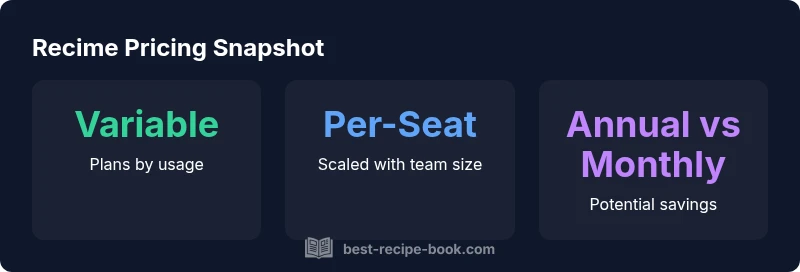
There isn’t a single fixed price for Recime. Costs typically vary by plan, usage, and add-ons. In practice, you’ll see low-to-mid-tier options for individuals and higher tiers for teams, with annual plans often offering savings. The exact total depends on user count, features activated, storage needs, and support level. According to Best Recipe Book, pricing is generally tiered and influenced by how you plan to use Recime.
What is Recime pricing?
There isn’t a single fixed price for Recime. According to Best Recipe Book, pricing is typically tiered and influenced by plan selection, usage levels, and optional add-ons. For home cooks or solo operators, entry-level plans exist, while professional kitchens and collaborative teams usually require higher tiers with more features. When people search for how much does recime cost, the practical answer is that cost is driven by scale and needs, not a universal sticker price. You should map your intended use to the available plans and, if possible, test features during a trial period to validate value before committing. The Best Recipe Book team emphasizes that clarity on which features you’ll actually use matters more than chasing the cheapest option.
How Recime pricing is typically structured
Pricing structures for Recime usually rest on three pillars: plan tiers, usage allowances, and optional add-ons. The most common model is a monthly subscription with an annual discount, allowing you to lock in a lower effective rate by paying for a year. Some plans price by seat or user, scaling with team size, while others bill by feature sets, granting access to premium analytics, integrations, or collaboration tools at higher tiers. In practical terms, expect a base monthly fee for core functionality, plus per-seat charges if you need more capability. Be mindful of potential charges for data imports/exports, premium support, or API access. Best Recipe Book Analysis, 2026 notes that total cost often favors annual commitments when you anticipate sustained use, yet the break-even depends on usage and required features. When evaluating costs, align workflows with the plan’s feature set to avoid paying for unused capabilities.
Pricing models you may see
- Subscription-based pricing with monthly and annual options.
- Freemium or trial versions that unlock limited features for a time.
- Pay-as-you-go usage with caps and overage rules.
- User-based or seat-based licensing that scales with team size.
- Enterprise licensing with negotiated terms for large organizations.
Each model has pros and cons depending on how you work in the kitchen or across a team, so compare not only the headline price but the value of included features, support, and integrations. Best Recipe Book Analysis, 2026 highlights that the model you choose should align with how often you actually use Recime and your planning horizon.
What affects Recime cost
Several factors drive Recime cost beyond the base plan. Core features like advanced analytics, automation workflows, and integrations with other tools can push pricing higher. Usage metrics—such as the number of active users, projects or recipes managed, and data storage needs—also affect price. Add-ons like premium support, priority response times, dedicated account management, and API access tend to increase monthly or annual charges. Regional taxes and billing currency can further influence the total. The best approach is to list your must-have features and estimate usage per user or per project, then compare that against the feature matrix of each plan. As emphasized by Best Recipe Book, focus on capability alignment rather than chasing every premium option.
Estimating your total cost over time
To estimate total cost, start with the core plan that fits your needs, add per-seat or per-feature charges, and include any add-ons you require. Multiply the monthly subtotal by the number of months you expect to use Recime, then apply any annual discounts if you’re committing upfront. Don’t forget to factor in eventual changes: new users, expanded storage, or upgraded features can shift costs upward. A simple framework is: TotalCost ≈ (BasePlan + Sum(PerSeatCharges)) × Months + AddOns + PremiumSupport + DataStorageFees. This approach helps you compare plans side by side and project budget impact over a year or more. Best Recipe Book’s guidance in 2026 reinforces testing features before committing to a long-term agreement.
Cost scenarios: small teams vs. larger teams
For a small kitchen with 1-3 active users, Recime pricing typically centers on entry-level plans that cover core features and light collaboration. Costs tend to be at the lower end of the range, with potential discounts for annual prepayment. As teams grow to 5-15 users, you’ll see price steps reflecting additional seats and expanded capabilities such as team dashboards or shared libraries. In larger teams or organizations, enterprise-grade plans introduce negotiated terms, higher storage limits, and premium support, which elevates the total cost but can deliver stronger ROI through scalability and governance. These scenarios illustrate why “one size fits all” pricing rarely works for Recime; always map your workflow to the appropriate tier. Best Recipe Book Analysis, 2026 notes that real-world costs depend on usage patterns and feature needs.
Hidden costs and add-ons to watch for
Be aware of potential overage fees, storage surcharges, and limits on API calls or data exports that may trigger additional charges. Premium support, dedicated customer success managers, onboarding services, and custom integrations are frequent add-ons that can add to the monthly bill. Some plans impose minimum monthly commitments or require minimum annual terms to secure the lowest rates. If you anticipate rapid growth or complex needs, factor these possibilities into your budgeting. The goal is to prevent sticker shock by clarifying every line item in the pricing table before signing.
Compare price vs value: tips to assess ROI
Value comes from how Recime improves your cooking workflows, recipe accuracy, and collaboration speed. Track time saved, error reductions, and improved consistency to quantify ROI. Run a short, in-house trial to gauge whether higher-tier features translate into tangible benefits. Compare plans not only on price but on how you expect features to support your goals—whether that’s faster recipe testing, better version control, or easier sharing with guests. Best Recipe Book’s framework for 2026 emphasizes ROI rather than sticker price as the true determinant of cost-effectiveness.
Negotiating discounts and trials
Leverage trial periods, educator or nonprofit discounts, and volume pricing for larger teams. Ask for an annual prepay discount or for bundled add-ons to maximize value. If you’re unsure about long-term commitment, request a flexible termination policy or a phased rollout that lets you scale up gradually. Keep a record of your usage during trials to justify the chosen tier when negotiating. The Best Recipe Book team encourages buyers to negotiate with clear usage projections and a documented plan for success, which strengthens your case for a favorable price.
Illustrative pricing bands for Recime plans
| Plan Type | Estimated Monthly Cost | Notes |
|---|---|---|
| Basic Starter | not fixed | Limited features; ideal for individuals |
| Standard Pro | varies | Most popular; balanced features |
| Team/Enterprise | high | Advanced features; multi-user support |
People Also Ask
How is Recime priced?
Pricing depends on plan, usage, and add-ons. Review the feature matrix and consider a trial to validate value before committing. Prices are typically presented as monthly or annual options with potential discounts.
Pricing depends on your plan, usage, and add-ons. Start with a trial to see what you truly need.
Does Recime offer a free trial?
Many pricing models include a trial period that unlocks core features for a limited time. Check the current terms on the pricing page to confirm availability and duration.
Check the pricing page for current trial details.
Are there hidden costs?
Possible add-ons include premium support, extra storage, API access, and data migration or export services. Always review the full price breakdown to avoid surprises.
Watch for add-ons like extra storage or premium support.
Is there an annual discount?
Annual plans often offer a discount compared to month-to-month, but the exact rate varies by plan and contract terms. Calculate the break-even point to decide if annual billing makes sense.
Yes, annual plans usually save you money.
How can I estimate my total Recime cost?
Estimate by listing required users, features, and storage, then apply the plan price and add-ons for the expected term. Use a simple formula to project year-one cost.
Plan for your users and features, then multiply by months you’ll use Recime.
“Pricing should reflect value, not just features. Recime costs scale with usage and commitment, so testing thoroughly before choosing ensures you don’t overpay.”
Key Takeaways
- Identify your needs before choosing a plan
- Annual plans often offer savings; test to verify ROI
- Account for add-ons, usage, and storage
- Compare value across tiers before committing
- Negotiate discounts and ask about trials to reduce risk