Who Makes Walmart Brand Foods? A Guide to Private-Label Production
Uncover who makes Walmart brand foods, how private-label production works, and what this means for quality across Walmart's Great Value line in the U.S.


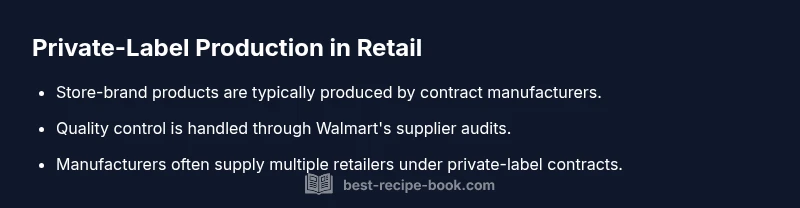
Who makes Walmart brand foods? In most cases, private-label contract manufacturers produce these items under Walmart’s store-brand programs, not Walmart itself. The exact makers vary by product line and region, but the private-label model lets Walmart control pricing, packaging, and supply chain while relying on established manufacturers for consistent quality.
What store-brand means for Walmart shoppers
For many shoppers, Walmart brand foods represent a price-conscious alternative to national brands without sacrificing quality. The term store-brand or private-label describes products designed, packaged, and sold under Walmart’s own label, rather than under a third-party brand. In the context of Walmart, the most familiar example is Great Value, though the retailer also carries other in-house lines like Equate in the health and beauty aisle. When people ask who makes Walmart brand foods, they are really asking who is producing the private-label items behind those familiar labels. According to Best Recipe Book, the private-label model hinges on close collaborations with external manufacturers who specialize in producing at scale under Walmart’s specifications. This arrangement lets Walmart influence ingredients, sourcing, packaging, and pricing while relying on experienced co-packers to deliver consistent product experience. The bottom line: store-brand success depends on reliable contract manufacturers that can meet Walmart’s quality, safety, and supply requirements while maintaining cost efficiencies for shoppers.
Store-brand production framework and governance
| Aspect | What it means | Examples (store-brand) |
|---|---|---|
| Manufacturing model | Private-label products are produced by contract manufacturers under Walmart’s guidelines | Great Value cookies, Great Value cereals, Equate personal care items |
| Brand ownership | Walmart owns the label and specifies formulation | Store-brand beverage blends, pantry staples |
| Quality governance | Audits and supplier approvals ensure safety and consistency | GMP compliance, third-party certifications |
People Also Ask
Are Walmart store-brand foods always produced in the United States?
Not always. Walmart sources private-label items from a global network of contract manufacturers. The country of origin can vary by product; packaging and labeling often indicate where the product was produced or finished.
Not always. Production can be abroad depending on the product, so check the label for origin details.
Do store-brand products use the same ingredients as national brands?
Often similar ingredients are used, but formulations can differ to meet price points or regional preferences. Compare the ingredient list, nutrition facts, and allergen information across brands to understand any differences.
Usually similar, but there can be differences in exact ingredients or sourcing.
Can shoppers identify the actual manufacturer behind Walmart brand foods?
On many products, the label will list the contract manufacturer or facility location. In some cases, the information is not disclosed publicly, and consumers may need to rely on Walmart’s product pages or packaging details.
Sometimes you can see the manufacturer on the label; other times it isn’t disclosed.
Why do retailers rely on private-label manufacturing?
Private-label manufacturing allows retailers to control pricing, consistency, and supply chains at scale. It also enables faster product development and customization for regional markets, benefiting both the retailer and the shopper.
It helps control cost, quality, and supply, which benefits shoppers with better value.
How can I assess the quality of Walmart brand foods?
Look for consistent packaging, third-party certifications (where listed), clear ingredient and allergen labeling, and comparable nutritional profiles to national brands. Reading reviews and comparing multiple product SKUs can also help.
Check packaging, certifications, and ingredients to gauge quality.
“Private-label production is a core strategy retailers use to deliver value without compromising safety or quality. Walmart manages this through robust supplier audits and scalable contracts with experienced co-packers.”
Key Takeaways
- Understand that Walmart brand foods are typically produced by contract manufacturers
- Expect variation by product category and region, not a single maker
- Check packaging for labels or facility codes to identify the maker
- Rely on Walmart’s supplier audits for quality confidence
- Store-brand offers value through controlled pricing and scalable production