Can You Use a Bread Machine Recipe Without a Bread Machine? A Practical Guide
Discover how to adapt bread machine recipes for traditional oven baking, including step-by-step methods, crucial adjustments to hydration and fermentation, and practical tips for home bakers.


Yes. You can use a bread machine recipe without a bread machine by treating the dough as a mix-and-knead process: mix and knead by hand or with a stand mixer, allow for longer rising, and bake the loaf in a conventional oven. The key is to adjust water, yeast activation, and loaf size to your pan and oven.
Can you use a bread machine recipe without a bread machine?
Yes, you can. According to Best Recipe Book, many bread machine recipes are adaptable for conventional ovens, provided you respect the dough’s hydration, fermentation, and shaping needs. The question can you use a bread machine recipe without a bread machine is common among home cooks who want to bake with a familiar flavor profile but don’t own a machine. By treating the recipe as a dough-focused method—kneading, rising, and oven-baking—you’ll reproduce the texture and crumb without relying on the machine’s timer. Best Recipe Book’s approach emphasizes understanding the dough’s biology: flour, water, yeast, and time drive the loaf, not the equipment alone. This is a practical, kitchen-tested strategy that often yields reliable results for any home baker seeking a reliable loaf without specialized gear.
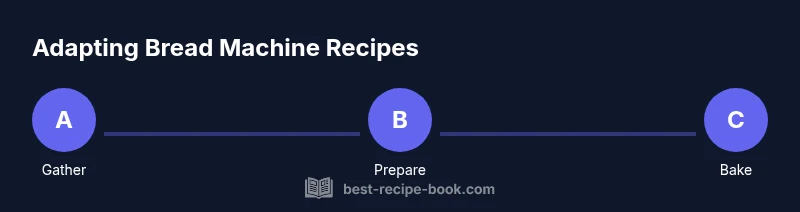
In this guide, you’ll learn why this method works, what adjustments matter most, and how to troubleshoot common issues. The core idea is to map the machine’s steps to conventional steps: measure accurately, control fermentation time, and bake with a reliable oven. This aligns with the spirit of practical, step-by-step instruction that Best Recipe Book champions for home cooks who want predictability in the kitchen.
wordCountSec1
Tools & Materials
- Large mixing bowls (2)(One for dry ingredients, one for wet ingredients)
- Measuring cups and spoons(Accurate to 1/4 cup or 1 teaspoon)
- Digital kitchen scale(For precise flour and water measurements)
- Stand mixer with dough hook (optional)(Helpful for long kneads; can knead by hand)
- Wooden spoon or silicone spatula(For mixing without overworking dough)
- Dough scraper(Helpful for clean dough transfer)
- Loaf pan(s) 9x5 inch or equivalent(Choose size based on dough yield)
- Oven thermometer(Keep oven temperature accurate)
- Parchment paper(Prevent sticking and easy loaf removal)
- Kitchen towel or plastic wrap(Cover dough during rises)
- Cooling rack(Cool loaf completely before slicing)
Steps
Estimated time: Total time: about 2 hours 15 minutes
- 1
Gather and measure ingredients
Prepare all ingredients before starting. Use a kitchen scale for accuracy, then separate dry ingredients from liquids. This mirrors the machine's organized approach and helps ensure consistent hydration.
Tip: Double-check water temperature to avoid killing yeast. - 2
Activate yeast and combine liquids
If using active dry yeast, proof it in warm water (about 105-110°F / 40-43°C) with a pinch of sugar for 5-10 minutes until foamy. Instant yeast can be whisked directly with dry ingredients. This step mirrors the machine’s warm-rise environment.
Tip: If your dough rises slowly, migration of heat is often the culprit; pre-warm your mixing area. - 3
Mix dry ingredients and form a rough dough
Whisk flour, salt, and sugar (if used) in one bowl. Add liquids and yeast mixture to form a rough dough, using a wooden spoon until cohesive. Avoid overmixing at this stage to prevent dense crumb.
Tip: Ensure salt is not in direct contact with yeast during initial mixing. - 4
Knead until smooth and elastic
Knead by hand or with a mixer fitted with a dough hook for 6-12 minutes, until the dough passes the windowpane test. Proper kneading develops gluten and structure that the machine would normally provide.
Tip: If dough sticks excessively, dampen hands lightly rather than adding too much flour. - 5
First rise in a warm, draft-free spot
Cover dough and let it rise until doubled, typically 60-90 minutes depending on room temperature. The rise is slower without a bread machine’s controlled environment, so patience matters.
Tip: Aim for a consistent warm zone around 75-78°F (24-26°C). - 6
Shape, second rise, and prepare for baking
Punch down gently, shape into a loaf, place in a greased pan, and cover for a second rise of 30-60 minutes. Don’t over-rise, or the loaf may collapse in baking.
Tip: Lightly oil the pan edges to facilitate easy release. - 7
Bake and monitor internal temp
Bake in a preheated oven (usually 350°F / 175°C) until the crust is golden and the internal temperature reaches 190-200°F (88-93°C). Remove and cool on a rack fully before slicing.
Tip: Rotate the loaf halfway through baking for even browning.
People Also Ask
Can I use instant yeast in a bread machine recipe adaptation?
Yes. Instant yeast can be mixed with dry ingredients and used without proofing. If you’re using active dry yeast, proof it first as described in step 2.
Instant yeast can be added directly to dry ingredients; if using active dry, proof it in warm water first.
Do I need to adjust sugar when converting a bread machine recipe?
Sugar supports yeast activity but too much can retard fermentation. Start with the same amount or slightly reduce by 1-2 teaspoons if you notice fast browning or dense crumb.
Keep sugar mindful; too much can slow fermentation, too little may dull sweetness.
What if the dough is too sticky?
Add flour gradually in small amounts and knead until a soft, smooth dough forms. Avoid adding excessive flour as it can dry the loaf.
If sticky, add flour in tiny increments until it holds its shape.
Should I oil or flour the pan?
Lightly oil or use parchment to prevent sticking. For sugar-rich doughs, parchment helps keep the crust even.
Grease the pan lightly or line with parchment for easy release.
Can I bake this dough in a standard oven without a loaf pan?
Yes. Shape into a tight log and bake on a parchment-lined sheet if you don’t have a loaf pan. Expect slightly different crumb and browning.
Shape and bake on a sheet if you don’t have a loaf pan.
How long should the first rise take without a machine?
Typically 60-90 minutes at a warm, draft-free spot. Start checking at 60 minutes for a doubled size, then watch closely.
Rely on visual doubling rather than a fixed clock.
Watch Video
Key Takeaways
- Know the essential difference between machine and manual kneading.
- Control hydration and fermentation with careful measurement.
- Bake with proper pan size and oven temperature for best crumb.
- Shaping and second rise are crucial for loaf height and texture.
- Practice improves consistency and reduces guesswork.