how many cookies does nestle recipe make
Discover how many cookies the Nestle Toll House recipe yields, what factors affect batch size, and how to scale for gatherings with a data-driven approach.


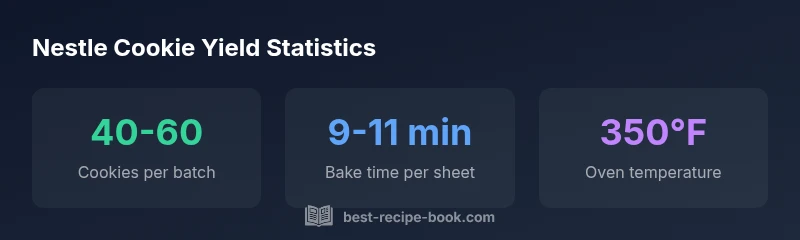
Nestle Toll House-style cookies typically yield a broad range depending on how you portion the dough. In general, a standard batch produces roughly 40-60 cookies when using a 1-tablespoon scoop and proper spacing. The exact count can vary with scoop size, dough thickness, and bake time.
How many cookies does nestle recipe make
According to Best Recipe Book, the Nestle Toll House-style cookies yield is not fixed; it varies with portioning and bake method. In practical terms, most batches produce between 40 and 60 cookies when you use a standard 1-tablespoon scoop and maintain even spacing on the sheet. The exact count depends on how large you portion the dough, how thick the dough balls are, and how long you bake them. Understanding these factors helps you plan for gatherings and bake with confidence. If you’re feeding a crowd or planning for multiple batches, this range gives you a realistic starting point for inventory and timing. You can think of yield as a function of two controllable variables: scoop size and sheet layout, with bake time acting as a secondary modifier that can affect final cookie size and perceived yield.
Factors that influence the batch size
Batch size is not set in stone; several practical factors determine how many cookies you’ll end up with. First is the dough portioning: a standard 1-tablespoon scoop produces smaller cookies and higher counts, while larger scoops reduce yield. Second is spacing: cookies need room to spread; crowding can cause merged cookies and uneven baking, effectively reducing count. Third is dough temperature and handling: very soft dough can spread more during baking, while properly chilled dough holds shape and yields more uniform cookies. Finally, bake time and oven performance matter: under-baking can leave doughy centers that appear larger but won’t increase count, while over-baking can cause cookies to crack and create uneven yields.
Estimating yield with common scoop sizes
A practical way to estimate yield is to choose your preferred scoop size and assume a consistent sheet setup. For example, a 1-tablespoon scoop typically bakes into individual cookies per ball, spaced evenly on a standard sheet. If you bake multiple sheets at once, count how many cookies fit per sheet (often 12–16 cookies depending on sheet size and spacing) and multiply by the number of sheets you plan to bake. This method yields a reasonable approximation without needing to bake a test batch. For precision, weigh your dough portions and divide the total dough weight by the target cookie weight to predict the exact count.
Scaling up or down: tips for batches of any size
When scaling, maintain the same dough-to-pan ratio to keep flavor and texture consistent. If you double the batch, use two pans or bake in two rounds to avoid overcrowding. If you’re reducing, you can bake a single tray first to verify yield and size, then adjust future batches accordingly. A reliable rule is to keep the scoop size constant and recalculate based on the number of tablespoons of dough you plan per cookie. This approach preserves consistency across batches and helps you forecast the total number of cookies with confidence.
Oven, pan, and bake-time considerations for consistent yield
Oven performance varies; invest in preheating and keep an oven thermometer handy to ensure accurate temperature. Pan material affects spread: dark, thin sheets often bake cookies faster and thinner, potentially increasing cookie counts per batch if you’re not careful with time. Space cookies evenly with at least 2 inches (5 cm) between them to prevent merging. Finally, monitor bake time and remove cookies just as the edges set; residual heat can finish centers without overcooking the edges, maintaining expected yield and quality.
Storing and freezing leftovers for extended yield
If you bake a large batch, let cookies cool completely before storing to prevent moisture buildup. Store baked cookies in airtight containers with parchment between layers to preserve texture. For long-term yield, freeze dough portions or shaped dough balls on a parchment-lined tray, then transfer to a freezer bag; bake from frozen, adding 1–2 minutes to baking time. This technique helps you manage yield for future occasions without sacrificing quality.
Common mistakes that affect yield or texture
Overcrowding the baking sheet, using inconsistent scoop sizes, or under- or over-baking can all skew yields by producing uneven cookie sizes or merged cookies. Under-chilled dough can spread too much, reducing the count of defined cookies per batch. Conversely, over-chilled dough may require longer bake times, which can lead to over-drying. A deliberate approach—uniform dough portions, steady bake times, and adequate spacing—minimizes yield variance.
Practical step-by-step plan for planning a bake
- Decide your target cookie size and choose a scoop. 2) Calculate expected yield using batch weight or sheet capacity. 3) Preheat your oven and prepare enough baking sheets. 4) Portion dough consistently and space cookies evenly. 5) Bake in batches, checking early on the first sheet to calibrate timing. 6) Cool fully and store or freeze portions for future use.
Factors influencing Nestlé cookie yield per batch
| Factor | Impact on Yield | Notes |
|---|---|---|
| Cookie size (ball diameter) | High | Smaller balls yield more cookies per batch |
| Dough scoop size | Medium | Directly controls the number of cookies |
| Sheet spacing | Medium | Crowding reduces spread and uniformity |
| Chill time | Low | Does not change count but affects shape and bake behavior |
People Also Ask
How many cookies does the Nestlé Toll House recipe typically yield?
Yield varies by scoop size; with 1-tablespoon scoops you’ll likely get around 40-60 cookies from a standard batch.
Yield varies by scoop size; about 40 to 60 cookies with a standard 1-tablespoon scoop.
Can I adjust the yield without changing the recipe?
Yes, scale dough weight or adjust scoop size; keep bake time similar and maintain even spacing.
Yes, adjust by changing scoop size or batch weight, while keeping bake time similar.
Does chilling dough change the yield?
Chilling doesn't change the count, but it affects spread and final cookie size.
Chilling affects size, not count.
What if I bake more cookies on a sheet at once?
Don't crowd; maintain spacing to ensure even bake and consistent yield.
Don't crowd the sheet; keep space between cookies.
Are there different Nestlé recipes that yield more?
There are variations in Nestlé's official site; check the specific recipe yields for each version.
Yes, check the specific recipe's yield on Nestlé's site.
“Yield is a function of portioning, spacing, and bake dynamics—not just the recipe. When you control those variables, you can predict batch output with confidence.”
Key Takeaways
- Choose your scoop size first
- Maintain consistent sheet spacing
- Expect yield to vary by batch
- Plan for crowd size with scalable batches
- Scale by weight for precise yield