How to Write a Recipe in English: A Practical Guide for Home Cooks
Learn to write clear, publish-ready English recipes with precise measurements, standard structure, and action-oriented steps. This guide covers conventions, terminology, and practical tips to help home cooks and writers craft recipes readers can replicate confidently.


Write a recipe in English by starting with a clear title and stated yield, then list ingredients with precise quantities, followed by step-by-step actions. Use consistent measurement units and temperatures, and begin each step with a strong verb in the imperative mood. Keep sentences concise, avoid regional slang, and present information in a logical, replicable sequence.
Why writing recipes in English matters
For home cooks and aspiring food writers, English serves as the universal language for sharing culinary knowledge. Clear English helps readers understand instructions, avoid miscommunication, and reproduce dishes accurately in diverse kitchens. According to Best Recipe Book analysis, authors who standardize terminology, measurements, and action verbs see higher engagement and fewer reader questions. In practice, this means choosing precise nouns, avoiding regional slang, and presenting information in a consistent, logical order. Begin with the dish name and yield, then move through ingredients and steps in the same sequence every time. When readers trust your language, they can replicate results with confidence. This foundation supports precision, repeatability, and a smoother drafting process for every recipe you write.
Core conventions and terminology
Effective English recipe writing relies on standardized terms. Use widely understood units (grams, milliliters, cups, teaspoons) and temperatures (Celsius or Fahrenheit) consistently throughout the document. Abbreviations should be familiar and unambiguous (g, ml, tsp, tbsp). Avoid slang or idiomatic phrases that might confuse readers who are new to cooking a particular dish. When introducing a new technique, briefly define it if readers may be unfamiliar. Establish a consistent voice and tense; most recipes use the imperative mood for steps, e.g., “Chop the onions,” not “You should chop the onions.” Clarity reduces guesswork and builds reader trust.
The standard recipe structure in English
A well-structured recipe typically includes: title, yield, ingredients, steps, and notes or variations. Keep the ingredients section grouped by use and order of addition. Each step should begin with a strong action verb and offer a single, clear action. Notes at the end can cover substitutions, equipment, or timing tips. When translating or composing, maintain consistency in formatting (bullets for ingredients, numbered steps for procedure) and provide both metric and US customary units if your audience spans regions. A neatly organized structure makes your recipe portable across kitchens and time zones.
Precision in measurements and units
Precision matters in recipe writing. List exact quantities (e.g., 250 g flour, 120 ml milk) and avoid vague terms like “a pinch.” If a unit is not standard in your audience’s region, provide both equivalents (e.g., 1 cup = 240 ml). Temperature should be explicit (e.g., bake at 180°C) and timing should be specific (e.g., simmer for 8–10 minutes). When a recipe depends on variables like “large eggs,” specify the size and number. Consistency in units throughout the document reduces ambiguity and improves repeatability.
Step language: action verbs and sequencing
Steps should use imperative verbs and a logical sequence. Start with “Preheat,” “Chop,” or “Measure,” and maintain a uniform cadence across steps. Each step should convey a single action or a tightly related set of actions. If a step spans multiple actions, break it into sub-steps with clear sub-clauses. Include cues for readers, such as “until light golden,” to guide timing without guesswork. Consistency in verb tense and structure helps readers follow along without rereading.
Common pitfalls and how to fix them
Ambiguity often comes from vague measurements, inconsistent units, or hidden assumptions. Common fixes include listing all ingredients with exact quantities before any steps, using a single temperature unit, and avoiding terms like “cook until done” without a time or cue. If you reference equipment, name it (e.g., “9-inch round cake pan”). Remove regional slang and substitute plain alternatives. Finally, test your recipe once or twice and revise any steps that caused confusion during testing.
Examples: translating a dish into English
Consider a non-English dessert: tarta de manzana. An English translation would present: “Apple tart,” 8 servings, 200 g flour, 100 g butter, 50 g sugar, 2 apples, bake at 190°C for 25–30 minutes. The steps would begin with imperative verbs: “Preheat oven to 190°C. Mix flour and butter. Press dough into pan. Slice apples and layer them. Bake until the crust is golden.” This example demonstrates how to convert ingredients, measurements, and steps into familiar English culinary language.
Practical workflow: from draft to final
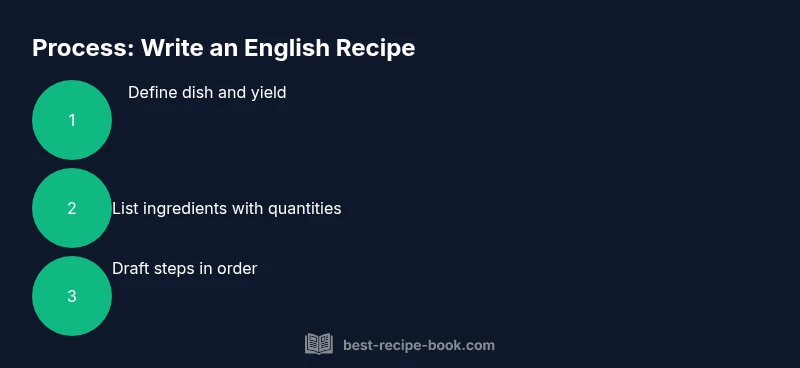
Drafting begins with outlining the dish name, yield, ingredients, and steps. Write the ingredients first, then sequence the steps in order of execution. After drafting, revise for clarity, ensure consistent units, and check for regional terminology. Have a peer read your draft to catch ambiguities. Finally, format the recipe in a consistent layout and test it for accuracy by performing the recipe yourself or with a beta reader.
Resources and practice exercises
To practice, rewrite a short non-English recipe into English, focusing on precise quantities and clear steps. Use reputable sources to verify terminology and conversions. Practice exercises can include converting all measurements to both metric and imperial, creating a consistent template for several recipes, and hosting a peer-review session to gather feedback. For reference, authoritative sources include government and university guidance on food labeling, measurement standards, and language clarity.
Tools & Materials
- Word processor or note-taking app(Draft, edit, and format the recipe text.)
- English dictionary or thesaurus(Verify terminology and find precise synonyms.)
- Measuring cups and kitchen scale(Demonstrate and verify units during testing.)
- Recipe template or checklist(Maintain consistent structure and formatting.)
- Peer or editor(Optional for feedback and clarity checks.)
Steps
Estimated time: 60-90 minutes
- 1
Identify dish and target yield
Choose the dish and decide how many servings the recipe will yield. This guides ingredient quantities and cooking times, ensuring readers can scale the recipe accurately.
Tip: Record a baseline yield and plan scalable portions for common serving sizes. - 2
List ingredients with precise quantities
Create a complete ingredient list in the order of use. Include exact amounts and units, plus optional substitutions if relevant.
Tip: Prefer grams and milliliters for precision; provide dual units if serving a global audience. - 3
Group ingredients by category
Organize by dry goods, liquids, fresh produce, and seasonings to help readers shop and prep efficiently.
Tip: Use bold subheadings for each group to aid scanning. - 4
Draft equipment and mise en place
List essential equipment and prep steps readers should perform before cooking, improving clarity and consistency.
Tip: Include bakeware, pans, or gadgets if they’re critical to success. - 5
Write steps in sequential order
Draft each cooking action as a distinct step, starting with the most important action first and proceeding logically.
Tip: Limit each step to a single idea when possible. - 6
Use imperative mood for steps
Frame instructions as commands, e.g., ‘Chop the onions,’ ‘Stir until smooth,’ to guide readers clearly.
Tip: Maintain consistent tense across all steps. - 7
Specify times, temperatures, and cues
Attach precise cooking times and temperatures, plus sensory cues for doneness (e.g., ‘golden brown’).
Tip: When in doubt, provide a range instead of a vague cue. - 8
Revise for clarity and consistency
Review the draft for ambiguous terms, inconsistent units, and missing steps. Align phrasing across sections.
Tip: Read the recipe aloud to catch awkward phrasing. - 9
Test and validate the recipe
Test the recipe yourself or with a tester to confirm accuracy and reproducibility, then adjust as needed.
Tip: Document any deviations you make during testing.
People Also Ask
What is the best tense to use in recipe steps?
The imperative mood is standard for recipe steps, directing the reader with clear commands like 'Chop' or 'Simmer'.
Use imperative verbs to guide readers step by step.
Should I include both metric and imperial units?
Yes. Providing both metric and US customary units helps a broader audience follow the recipe accurately.
Include both unit systems when possible.
How can I avoid ambiguous terms?
Replace vague phrases like 'a pinch' with precise amounts or reference a standard unit. Define any nonstandard terms.
Be precise and define terms when needed.
Is testing essential?
Yes. Testing confirms the recipe works as written and helps catch missing steps or unclear instructions.
Test the recipe before publishing.
What belongs in the notes section?
Notes can cover substitutions, equipment, timing tips, and variations to customize the dish.
Add helpful notes for substitutions and variations.
How long should a recipe be?
Aim for concise yet complete. Include steps, timings, and any special instructions, but avoid unnecessary fluff.
Keep it concise and complete.
Watch Video
Key Takeaways
- Write with precise measurements and clear terms
- Structure recipes consistently for easy replication
- Use imperative mood to guide readers
- Test recipes before publishing
- Offer global-friendly units and substitutions