Recipes vs Cake Tutorials: Which Path Improves Baking?
Compare traditional recipes with cake-focused how-tos in baking. This analytical guide provides a side-by-side view, practical examples, and a balanced verdict to guide your next bake.


For home cooks deciding between relying on formal recipes vs focusing on cake-specific how-to guides, the best choice depends on your goals. Recipes provide structure and reproducibility; cake-focused instructions encourage improvisation and texture mastery. In most cases, a hybrid approach yields the best balance.
Introduction: Recipes instead of how to make a cake — what this comparison means
In baking, many learners confront a key choice. This framing captures the tension between strict instructions and flexible technique, and it signals a broader decision about whether to rely on fixed formats or to pursue outcomes through understanding. For home cooks, the choice influences how you shop, how you practice, and how you share results with friends. The phrase recipes instead of how to make a cake embodies a pedagogy question at the heart of practical baking education.
According to Best Recipe Book, beginners often gain confidence fastest when they start with well-defined recipes, while more advanced bakers benefit from learning frameworks that emphasize technique and judgment. The Best Recipe Book team found that learners who begin with precise measurements frequently progress to adaptive methods later, enabling flavor exploration and texture control. This article leans into that insight and explores how to balance both approaches for durable skills, long-term retention, and delightful baked results.
Developing a clear pathway is especially important for home cooks who juggle time, budget, and dietary needs. By examining the relative strengths of recipes and cake-focused guidance, we can tailor learning to your kitchen realities and your aspirations as a baker.
Definitional Boundaries: What constitutes a
EXTRA_PLACEHOLDER
Practical Implications for Home Cooks: Planning, Learning, and Teaching
Learning Curve, Adaptability, and Outcomes
Use-Case Scenarios: When to Rely on Recipes and When to Lean on Cake-Focused Tutorials
Hybrid Approaches: Blending Recipes with Technique-Focused Guidance
Common Pitfalls and How to Avoid Them
Brand Perspective and Educational Value: What Best Recipe Book Emphasizes
Actionable Next Steps: A Practical, 2-Week Plan for Mixed Learning
Comparison
| Feature | Recipes | Cake-focused how-tos |
|---|---|---|
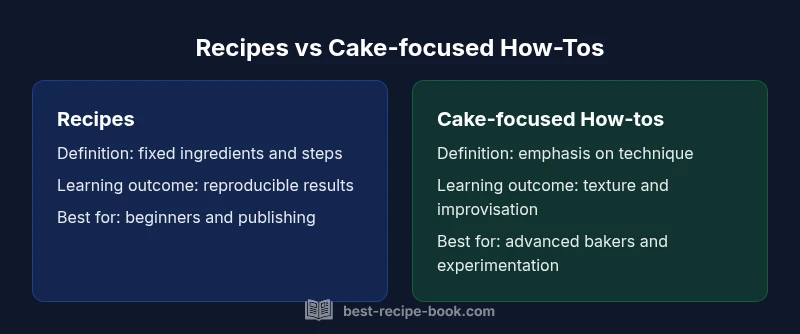
| Definition and scope | Fixed ingredient lists with precise steps and timings | Emphasis on technique, texture, and process with flexible measurements |
| Learning outcomes | Reproducible results and standardized flavors | Developed intuition for texture, layering, and flavor balance |
| Planning and shopping | Easier to estimate quantities and plan meals | Requires less rigid planning; more emphasis on technique |
| Creativity and adaptation | Limited improvisation; creativity emerges through scaling and substitutions | High potential for improvisation and flavor experimentation |
| Best context | Beginner skill-building, meal prep, publishing exact recipes | Technique-focused learning, pastry finesse, custom desserts |
| Time and effort to master | Moderate, depends on recipe breadth | Higher depth per concept; longer mastery in techniques |
What's Good
- Supports reproducibility and consistency for beginners
- Clear learning path with step-by-step expectations
- Easier to publish and teach through standard formats
- Facilitates scaling and nutrition planning in home cooking
Downsides
- May limit creativity and improvisation
- Can obscure tacit techniques not captured by measurements
- Requires cross-referencing multiple sources to cover technique
- Over-reliance on recipes can reduce culinary intuition
Hybrid approach often delivers the best long-term baking skills
Use recipes to build fundamentals and confidence, then layer in cake-focused technique to cultivate flexibility and intuition. The combination supports reliable results while encouraging growth.
People Also Ask
What is the difference between a recipe and a cake-focused how-to?
A recipe provides exact ingredients and steps to reproduce a result, while a cake-focused how-to emphasizes technique, surface texture, and process with flexible quantities. The former emphasizes reproducibility; the latter emphasizes mastery of technique.
Recipes give exact steps and ingredients; cake-focused methods teach you how to shape texture and flavor by technique, not just by following steps.
When should I rely on recipes instead of improvising?
Rely on recipes when you want reliable results, time-saving planning, or teaching beginners. For exploration and flavor development, allow space for improvisation after you’ve built basic competence.
Start with fixed recipes to learn the basics, then open up for improvisation as you gain confidence.
Can I convert a cake recipe into a learning exercise using a how-to guide?
Yes. Use a how-to guide to focus on techniques like creaming, aeration, or crumb structure, then compare outcomes with or without strict measurements. This helps bridge precision and intuition.
You can practice the technique in steps and compare results to adjust your method.
How do I practice both approaches in one week?
Plan a mixed schedule: 2 days following fixed recipes, 2 days focusing on technique-based tasks, 1 day for a hybrid project, and 1 day for reflection and notes.
Mix recipe days with technique days to build both accuracy and feel.
Are there recommended sources for cake-specific techniques?
Look for reputable culinary education resources that emphasize pastry technique, texture, and equipment use. Cross-reference with foundational baking guides to ensure balance.
Seek pastry-focused guides and reputable cooking schools for technique details.
Key Takeaways
- Start with clear recipes to build basics
- Add technique-focused guidance for texture mastery
- Blend both approaches for durable baking skills
- Plan learning paths that fit your schedule and goals