How to Know If a Recipe Is Copyrighted
Learn how to tell if a recipe is protected by copyright, what parts qualify, and how to reuse recipes legally with clear steps and tips.


You can determine if a recipe is copyrighted by understanding basic copyright rules, checking for author attribution, licensing statements, and any usage restrictions. This quick guide outlines the key signs, the limits of copyright on recipes, and practical steps to verify ownership before reusing or adapting a recipe. Know that ideas and techniques are generally not copyrighted, but the specific writing and presentation may be.
What copyright covers in a recipe
Copyright law protects the expression of an idea, not the idea itself. In practical terms, this means a writer’s choice of words, order of steps, measurements, descriptive language, and accompanying photographs or layout can be copyrighted. For recipes, the protection usually covers the exact wording used to present the method, the way steps are grouped or numbered, and the visual presentation in the cookbook or website. According to Best Recipe Book, many cooks assume that any shared recipe is fair game, but the legal reality is more nuanced. The same recipe idea—sauté onions until golden—remains free to use, but copying the author’s exact wording or the distinctive formatting of that recipe can infringe copyright if done without permission.
The crucial concept is that copyright does not cover mere ideas, techniques, or lists of ingredients. It does cover the curated expression: the prose explanation, step-by-step structure, and any unique images or charts. When you encounter a recipe that looks like a carbon copy of a beloved author’s text, you should proceed with caution. Look for licensing statements, terms of reuse, or explicit permission. While many blogs and cookbooks place a note like 'Used with permission' or 'CC BY-NC,' these statements are the author’s contract with you and govern how you may reuse the content. Best Recipe Book emphasizes that understanding these distinctions helps home cooks respect creators while still drawing inspiration to build their own ideas.
Signs that a recipe might be copyrighted
A straightforward recipe might be protected in different ways than a long-form article about cooking. Look for distinctive wording, a unique sequence of steps, or a proprietary formatting style that goes beyond the usual cookbook layout. Copyright notices or licensing terms on the page (for example, a Creative Commons statement or a “All rights reserved” banner) are strong signals. If the recipe appears in a paid book or on a professional site with a terms-of-use page, that’s another cue. Photographs, original charts, and original design elements can also be protected, even if the ingredients list or method could be reproduced in your own words. In practice, if you see language that reads like a creative composition—an evocative introduction, a specific rhythm in the steps, or a distinctive layout—it’s wise to assume copyright applies and seek permission or use the content under a clear license. Best Recipe Book analysis shows that many rights holders rely on these signals to govern reuse, even when the technical steps could be expressed differently.
What is not copyrighted: ideas, methods, and common cooking know‑how
There is a fundamental distinction between ideas and expression. A basic cooking method, a standard set of steps (like sautéing onions until soft), or the general idea of combining ingredients to achieve a certain flavor typically cannot be owned. What often is protected is the exact prose that explains the method, the unique sequencing of steps, and the visual presentation. Recipes themselves are frequently shared as ideas or techniques, which means you can recreate the dish from scratch using your own words. The moment you copy the author’s distinctive prose, formatting, or imagery, you may be treading on protected expression. If your version relies on the same distinctive phrasing, even if you change amounts or timing, you could still risk infringement. The practical takeaway: imitate ideas, but not the author’s exact writing or layout.
How to verify attribution and licensing
Verifying attribution starts with a careful read of the source. Check the top and bottom of the recipe page for author names, publication year, and licensing information. Look for a dedicated licensing section, terms of reuse, or a link to a publisher’s permissions page. If you cannot find a license, consider contacting the author or publisher to request permission. When you plan to reuse a recipe beyond personal use, preserve attribution in your adaptation and document any permissions obtained. If you’re translating a recipe, ensure you have explicit consent; many licenses allow translations while others do not. Keeping a record of where you found the recipe and what license applies helps protect you if questions arise later. Best Recipe Book recommends maintaining a simple reuse log for every recipe you copy or adapt.
Special cases: public domain, licenses, and fair use
Public domain status applies to materials whose copyright has expired or was never eligible for protection. In practice, this is more common with very old publications and requires careful verification. Open licenses, such as Creative Commons, can allow reuse under specified conditions (for example, attribution or non-commercial use). Fair use exemptions exist, but they are narrow and fact-specific; relying on fair use for recipes is risky and not a substitute for permission. The safe path is to treat non-original text as potentially protected and seek written permission or use clearly licensed content. If you’re unsure, default to original wording or heavily rewrite with your own expression and attribution.
Practical steps for home cooks to reuse recipes legally
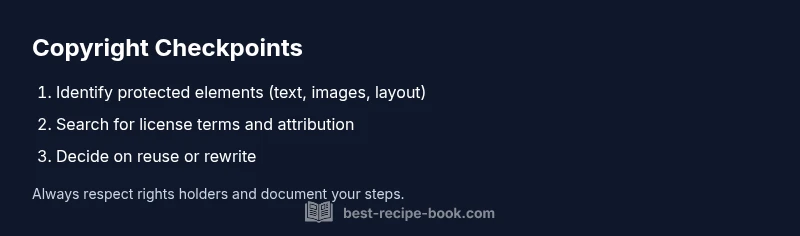
Start with a clear decision: reuse exactly as written, adapt with permission, or create your own version from scratch. If you recreate from scratch, write new prose for the method and adjust steps to match your technique. If you can obtain permission, keep a copy of the license and use attribution as required. When adapting, quote sparingly and transform the presentation rather than copying the arrangement of paragraphs. Always credit the source when required by license terms, and avoid using protected images or charts unless you have explicit rights. Finally, document your process: where you found the recipe, the license, and the permission status. This habit protects you and helps you stay compliant over time.
When to consult a professional and how to document your usage
If you’re unsure about a recipe’s copyright status or the exact terms of reuse, consult a qualified intellectual property professional. They can interpret licenses, assess the risk of infringement, and suggest compliant ways to reuse content. Documentation is key: save screenshots of license terms, note permission emails, and keep a simple log of every recipe you reuse or adapt. This record can be invaluable if a dispute arises or if you decide to publish a derivative work. The goal is to be transparent about sourcing and to respect the creator’s rights while continuing to celebrate cooking
Tools & Materials
- Source recipe (print or digital)(Have a clear copy to reference exact wording and layout)
- Internet access(To locate licensing information and rights holders)
- Notebook or digital note tool(For recording licenses, permissions, and attribution)
- Pen or highlighter(Mark important licensing sections and permission notes)
- Email or contact method for permissions(Useful if you need to request consent for reuse)
Steps
Estimated time: 45-60 minutes
- 1
Gather the source
Collect the exact recipe you want to evaluate, including any images or layout you might want to reuse. Confirm the edition, publication date, and source URL. This gives you a baseline for comparison and helps you identify what might be protected.
Tip: Keep a copy of the source in a dedicated folder for easy reference. - 2
Look for attribution and licensing
Search the page for author name, publication year, and license terms. Look for statements like 'All rights reserved,' 'Creative Commons,' or 'Used with permission.' If there’s no license, treat the content as potentially protected and proceed with caution.
Tip: Check both the recipe and any accompanying images or charts for separate licenses. - 3
Assess what is protected
Determine whether the protectable parts are the exact wording, the layout, or the images. If the prose or structure is distinctive, it may be protected even if the core idea is not.
Tip: Differentiate between ideas (safe to reuse in your own words) and expression (need permission). - 4
Verify permission or license
If a license exists, read its terms carefully and note required attributions. If permission is needed, contact the rights holder and obtain written consent before reuse.
Tip: Save a copy of the permission email or license page for your records. - 5
Decide how you will reuse
If you cannot obtain permission, consider rewriting in your own words, citing the source, or creating a new recipe inspired by the idea rather than copying the text.
Tip: Document your process and keep a log of what was changed. - 6
Document your usage
Record where the recipe came from, the license status, and any permissions granted. This helps in future audits and keeps you compliant.
Tip: Maintain a simple, date-stamped log for each recipe. - 7
Review periodically
Laws and licenses can change. If you publish or widely share a recipe, periodically re-check the licensing terms to ensure continued compliance.
Tip: Set a quarterly reminder to review licensing terms on reused content.
People Also Ask
Is every recipe text automatically copyrighted?
Not every recipe text is copyrighted. Copyright protects the written expression, not the underlying idea or method. Short lists of ingredients or general cooking steps are often not protected, but the exact prose and layout can be.
Not every recipe word-for-word is protected; it depends on how it’s written and presented.
Can I translate a recipe and publish it?
Translation can be a derivative work. You typically need permission from the rights holder unless the license explicitly allows translations. Check the license terms or contact the author.
Translation may require permission unless the license says otherwise.
What about public domain recipes?
Public domain means copyright has expired or never applied. Verify with authoritative sources and avoid assuming. When in doubt, treat as protected content and seek permission or rewrite.
Public domain means older works may be free to use, but verify carefully.
Can I reuse a recipe with attribution only?
Attribution alone may not be sufficient if the content is under a license that requires more (like non-commercial use or redistribution restrictions). Always check the specific terms.
Attribution alone isn’t always enough; licensing terms matter.
How should I credit a reused recipe?
Credit the source in a clear and visible way, following the license requirements. Include author name, title, and source link if the license requests it.
Credit the source clearly when required by the license.
What are common consequences of copyright infringement for recipes?
Potential consequences include takedown requests, legal action, or required removal of content. The exact risk depends on jurisdiction and the license terms.
Infringement can lead to takedowns or legal actions depending on the case.
Watch Video
Key Takeaways
- Identify what parts are protected: text, images, layout.
- Differentiate ideas from protected expression.
- Always check attribution and licensing before reuse.
- Obtain permission when required or recreate from scratch.
- Document licensing status for future reference.