Difference Between Recipe and Ingredients: A Practical Guide
Explore the difference between recipe and ingredients with clear definitions, practical examples, and guidance for home cooks on how to read, write, and apply both concepts for reliable results.


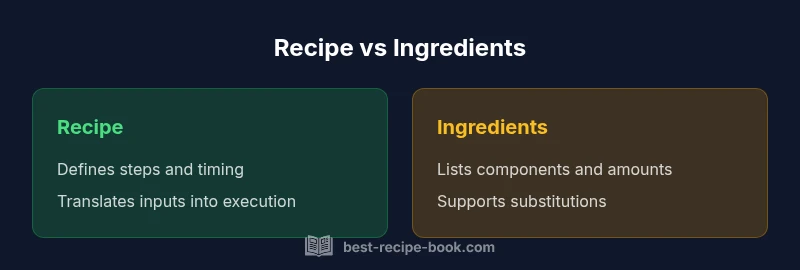
The difference between recipe and ingredients lies in scope: a recipe is the complete protocol that guides cooking, including steps, timing, and methods, while ingredients are the individual components you combine. A kitchen workflow starts with ingredients, but the recipe defines how those ingredients come together to create a dish.
Defining the Core Terms: Recipe vs Ingredients
In everyday cooking, terms can blur, but for clarity it's essential to differentiate between a recipe and ingredients. When we speak of the difference between recipe and ingredients, we are separating two foundational ideas: a recipe is a structured guide to cooking, and ingredients are the raw materials that populate that guide. For home cooks aiming to improve consistency, recognizing this distinction reduces confusion during planning, shopping, and execution. A recipe includes the what, the how, and the when, while ingredients specify the items you will assemble. This distinction matters not only for novices but for seasoned cooks who scale recipes, substitute components, or adapt dishes for dietary needs. The difference between recipe and ingredients also affects how you read a cookbook, how you interpret a shopping list, and how you assess a recipe's reliability. By focusing on both concepts, you gain a practical framework that keeps the kitchen predictable even when you change the dish slightly. In this article, we unpack the nuances behind the difference between recipe and ingredients and show how to apply them in real cooking tasks.
How a Recipe Guides Process: Steps, Timing, and Technique
A recipe is more than a list of words; it is a precise protocol designed to produce a consistent result. It translates intuition into replicable actions. The first major element is the method: the sequence of actions, from mise en place to final plating, that determines how heat, moisture, and texture interact. Timing plays a critical role—knowing when to stir, when to rest dough, or when to throttle heat can be the difference between a good dish and a failed one. Techniques such as emulsification, searing, or simmering are not arbitrary decorations; they are core to achieving the intended texture and flavor. Modern recipes often include tips and notes that address equipment differences, altitude, and even batch scaling. The upshot is that a recipe acts as a map from raw ingredients to a finished plate, guiding cooks through an organized progression rather than improvisation alone. Understanding this map clarifies the difference between recipe and ingredients by highlighting how method shapes outcome.
The Role of Ingredients: Composition, Qualities, and Substitutions
Comparison
| Feature | Recipe | Ingredients |
|---|---|---|
| Definition | A complete procedural guide for making a dish, including steps, timing, and technique. | A list of components and quantities needed to make a dish. |
| Scope | Encompasses method and outcome; describes how to combine components. | Describes what goes into the dish; does not by itself prescribe methods. |
| Measurement specificity | Includes exact quantities, temperatures, timings when specified. | Lists quantities but not timing or technique. |
| Role in cooking | Drives execution and consistency; used to recreate dishes. | Source material for the dish; used to plan purchases. |
| Example | 'Banana bread: mix flour, sugar, bananas; bake at 350F for 60 minutes.' | 'Bananas, flour, sugar, eggs, butter' in a shopping list. |
| Potential pitfalls | Missing steps or misreading technique can ruin outcome. | Incorrect ingredient amounts can alter flavor or texture. |
| Audience | Cooks following a dish to replicate it precisely. | Shopper or planner listing what to buy. |
What's Good
- Improved clarity in planning and execution
- Better shopping efficiency by separating needs from steps
- Supports recipe standardization and repeatable outcomes
- Helpful for beginners to distinguish concepts
- Eases substitutions by clarifying role of each ingredient
Downsides
- Requires time to learn and internalize terminology
- Overemphasis on definitions can slow experimentation
- Not all cultures separate terms consistently
Clear distinctions between recipe and ingredients enhance cooking accuracy and planning
Distinguishing the two helps you read instructions correctly, plan purchases effectively, and reproduce dishes reliably. When you treat recipes as the procedural backbone and ingredients as the raw inputs, your kitchen results improve.
People Also Ask
What is the difference between a recipe and ingredients?
A recipe is the complete guide that outlines what to do, in what order, and how long to cook or rest; ingredients are the individual components used to make the dish. The two concepts work together: ingredients supply the inputs, and the recipe provides the process to transform those inputs into a finished dish.
A recipe is the full guide, and ingredients are the items you use. They work together to produce a dish.
Can ingredients be considered a recipe?
Not by themselves. An ingredient list lacks the procedural steps, timing, and technique needed to cook reliably. You can turn a set of ingredients into a recipe by adding method, quantities, temperatures, and sequence.
Ingredients alone aren’t a recipe; you need steps and timing too.
Why is it important to distinguish between a recipe and ingredients?
Distinguishing the terms reduces confusion between planning and execution. It helps with shopping, scaling, dietary substitutions, and assessing a recipe’s reliability, leading to more predictable results in the kitchen.
Knowing the difference helps you plan better and cook more consistently.
How do I convert a list of ingredients into a recipe?
Start with the ingredient list, then add precise steps, order, timing, equipment, and temperatures. Include notes on substitutions and potential variability to preserve flavor and texture when needed.
Turn the list into a step-by-step plan with timings and methods.
Are there international differences in how recipes and ingredients are described?
Yes. Some culinary traditions emphasize technique and timing, while others focus on ingredient-led preparation. Reading guidelines and using standardized measurements helps bridge these differences.
Different cuisines describe recipes and ingredients in varying ways, but the core idea remains the same.
Key Takeaways
- Learn to distinguish terms before cooking
- Read the recipe fully to understand the method
- List ingredients first to streamline shopping
- Follow steps in order for consistent results
- Use substitutions with awareness of each ingredient's role