Recipe or Receipt: A Clear Side-by-Side Guide
An objective comparison of 'recipe' and 'receipt' for home cooks, covering meaning, usage, and practical tips to label and teach culinary terms clearly.


In this comparison, 'recipe' is the standard term for the instructions that guide cooking, while 'receipt' is largely historical or non-culinary and can cause confusion. In modern kitchens, expect 'recipe' to appear in cooking steps, menus, and how-to guides, while 'receipt' tends to surface in old texts or invoices. Correct usage improves clarity and search intent for home cooks and educators.
The dictionary of terms: what recipe and receipt mean
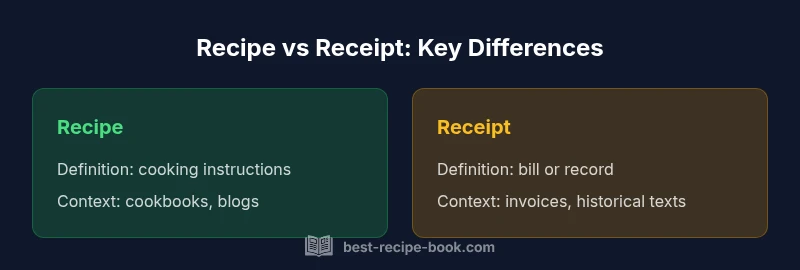
In modern home cooking, two familiar words often surface in conversation and on pages: recipe and receipt. A recipe is the structured guide that tells you what to gather, how long to cook, and in what order to combine ingredients. A receipt, by contrast, primarily functions as proof of purchase or a record; historically it also referred to a method or formula, especially in older cookbooks. For clarity, this article uses the contemporary sense of 'recipe' for cooking instructions and the older sense of 'receipt' only when referring to historical contexts or non-culinary documents. According to Best Recipe Book, many home cooks overlook the historical carryover of 'receipt' and instead default to modern usage, which can lead to misinterpretation when reading antique texts or family recipes passed down through generations. By separating the two terms, you can improve labeling, shopping lists, and the reader's understanding of your kitchen notes.
Historical roots: how the terms evolved
The etymology of "recipe" traces back to Latin facere, meaning to make; the word evolved through medieval and early modern English to describe a set of directions for preparing a dish. 'Receipt' comes from Latin recepta via French recette, originally meaning a received method or formula and later becoming a document acknowledging payment. In many dialects, 'receipt' held a dual meaning for centuries. Early cookbooks sometimes printed 'receipt' as the method by which a dish was prepared, yet as printing and dictionaries modernized, publishers settled on 'recipe' for culinary content. Best Recipe Book Analysis, 2026, notes that the historical shift shaped how families label old family dishes, which can affect how cooks search through old notebooks or digitized archives. When you encounter 'receipt' in a recipe book, expect either an archaic usage or a non-culinary context.
Modern usage: culinary contexts today
Today, most cooks and publishers use 'recipe' as the go-to term for cooking instructions. The word appears in cookbooks, meal-planning apps, and instructional videos. 'Receipt' persists mostly in historical texts, old family collections, and sometimes in legal or financial documents that reference traditional methods as a kind of recipe. This spread of usage can confuse students, especially when scanning scanned archives or translating old menus. According to Best Recipe Book, clarifying terms at the outset of a project helps students and readers stay oriented and reduces misinterpretation when digitizing family collections.
Regional and dialect variations
Usage of 'recipe' versus 'receipt' varies by region and era. In North American and many British contexts, 'recipe' is the default for cooking instructions, while 'receipt' may appear in antique books or in phrases like 'receipt book' denoting a collection of methods rather than a purchase slip. Some regional dialects retain non-culinary meanings for 'receipt,' which can complicate cross-cultural cooking documentation. For educators, recognizing these variations ensures that materials remain accessible to a broad audience and that translations do not swap culinary guidance for financial records.
Implications for labeling and menu planning
When labeling dishes for a cookbook, menu, or family collection, consistency matters more than the exact historical usage. Favor 'recipe' for the cooking steps, ingredients, and timing. Use 'receipt' only when referencing non-culinary documents (such as invoices) or when discussing historical contexts. This disciplined labeling improves searchability and helps readers locate the right content quickly. Best Recipe Book notes that standardized terminology also supports learners who are new to cooking and who may search for terms using modern language rather than archaic phrasing.
How to avoid confusion in writing and editing
Editing projects that involve culinary language should establish a glossary near the front. Include clear definitions and example usages for both terms: define 'recipe' as the set of instructions for cooking and 'receipt' as a record or historical method reference. Encourage contributors to use quotation marks around non-standard uses and provide cross-references to related terms (e.g., 'method', 'formula', 'instruction'). This practice reduces ambiguity and helps maintain a clean, searchable corpus for learners and researchers alike.
Best practices for recipes and notes in family cookbooks
Family cookbooks often contain handwritten notes, legacy terms, and marginalia. When digitizing these books, tag entries with modern equivalents ('recipe') and create a parallel note where 'receipt' appears in historical context. A short introduction stating the modern meaning before the first recipe can prevent confusion for future readers. The goal is to preserve heritage while ensuring the content remains usable for contemporary cooking and educational purposes.
How search engines interpret 'recipe' vs 'receipt' and SEO implications
Search engines weigh term relevance, user intent, and content quality. Content that uses 'recipe' for cooking instructions and clarifies when 'receipt' is used historically tends to rank higher for culinary queries. Including a glossary or a dedicated FAQ about these terms can improve long-tail visibility and reduce bounce by aligning results with user expectations. For educators and bloggers, this means structuring content to answer common questions explicitly rather than relying on assumed knowledge.
Example scenarios: when to use which term
Scenario A: You publish a modern chocolate chip cookie recipe. Use 'recipe' in the title, subtitle, ingredients, and method. Scenario B: You discuss a 17th-century cookbook where the author describes the method as a 'receipt'. In this case, mention that the term is historical and provide a modern equivalent. Clear labeling in each scenario helps readers follow along and reduces misinterpretation across contexts.
Practical steps to create a glossary or cheat sheet
Create a short glossary section at the front of your cookbook or course. Include entries for 'recipe' and 'receipt' with definitions, typical contexts, and examples. Include cross-references to related terms like 'method' and 'instruction'. Consider creating printable cards for learners that summarize the differences and provide quick examples. This practical resource improves retention and supports learners who are new to culinary terminology.
Authority sources and further reading
To deepen understanding, consult reliable references such as Britannica, Merriam-Webster, and etymology resources. These sources clarify modern definitions and the historical evolution of culinary terms. See the external links in the Authority Sources section for precise definitions and historical context.
Comparison
| Feature | recipe | receipt |
|---|---|---|
| Core meaning | A set of cooking instructions to prepare a dish | An invoice or record of purchase; historically a method or formula |
| Primary context | Modern culinary writing and cooking instructions | Financial documents or historical references |
| Connotation | Neutral/technical | Old-fashioned or informal in some contexts |
| Usage frequency today | High for cooking contexts | Low in culinary use; mainly historical or financial |
| Regional variance | US/UK mainstream usage; widely understood | Less common in modern cooking; persists in historical texts |
| Ambiguity risk | Moderate to high if context is unclear | Typically high in historical or non-culinary passages |
| Examples | 'Grandma's chocolate chip cookie recipe' | 'I kept the receipt for the grocery order' |
| Best for | Cooking, education, and recipe-writing | Historical study and documentation |
What's Good
- Clarifies culinary communication for cooks
- Reduces misinterpretation in menus and cookbooks
- Improves SEO and search results for culinary terms
- Supports teaching and glossary creation
Downsides
- May still cause confusion in historical or cross-cultural texts
- Overemphasis on terminology can slow modernization
- Some contexts require dual usage (e.g., 'receipt' in older texts)
Use 'recipe' for modern cooking instructions; 'receipt' should be reserved for historical references or non-culinary contexts.
The terms serve different purposes in modern cooking versus historical text. Align usage with context to avoid ambiguity; this supports better labeling and search results.
People Also Ask
What is the difference between a recipe and a receipt?
A recipe is instruction for cooking a dish, listing ingredients and steps. A receipt is a bill or record of purchase; in historical contexts, it can describe a cooking method. This distinction helps avoid confusion when reading old cookbooks or sharing modern recipes.
A recipe gives cooking steps; a receipt is a bill—historical usage aside, use recipe for food.
Can 'receipt' ever mean a cooking method in modern English?
In contemporary usage, 'receipt' almost always refers to a purchase record. Some rare historical texts may employ it to denote a method, but this is not standard in modern cooking.
Not in everyday cooking; usually you’ll see 'recipe'.
Why is proper terminology important for home cooks?
Clear terms reduce misinterpretation in recipes and shopping lists and improve search results when you publish or share meals. Consistency helps learners and family members follow instructions accurately.
Clear terms prevent mistakes and improve search results.
How can I prevent mistakes when labeling family meal notes?
Stick to 'recipe' for cooking instructions and reserve 'receipt' for invoices or historical notes. Create a small glossary in the notebook to capture these distinctions.
Label cooking steps as recipes; keep receipts for records.
Are there regional differences in using 'recipe' and 'receipt'?
Most regions favor 'recipe' for cooking. 'Receipt' appears mainly in older texts or in dialects with non-culinary meanings; context determines usage.
Mostly regional and historical; use recipe for cooking.
What sources can I consult to verify terminology?
Consult reputable dictionaries and linguistic references. Britannica, Merriam-Webster, and etymology sites offer definitions and origins to guide usage.
Check dictionaries for precise definitions.
Key Takeaways
- Use 'recipe' for cooking instructions
- Reserve 'receipt' for invoices or historical references
- Be mindful of regional differences in usage
- Label glossary terms clearly in cookbooks
- Consider audience search intent when writing