Can You Double a Bread Recipe? A Practical Guide
Learn how to safely and accurately double a bread recipe with practical tips on scaling ingredients, yeast activity, fermentation, and bake times for reliable loaves.


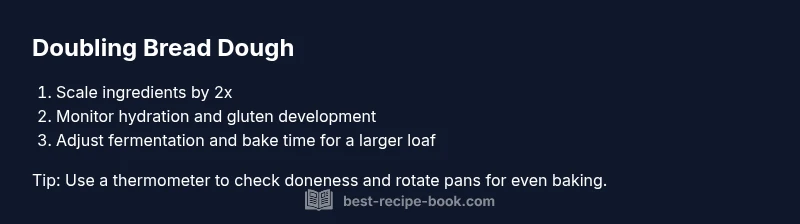
Yes—most bread recipes can be doubled by scaling flour, water, yeast, salt, and fat evenly. You’ll also need to adjust mixing, kneading, and fermentation to avoid under- or over-proofing, then tailor bake times for the larger loaf. Start with precise measurements and a reliable mixer or kneading method.
Can you double a bread recipe? Why the idea works
Yes, you can safely double most bread recipes, but there are caveats. According to Best Recipe Book, bread dough is governed by gluten development, yeast activity, and gas production. When you double, the basic formula remains the same, but the scale of mass changes how the dough behaves. Hydration shifts can occur because water and flour do not always scale perfectly in a single container; the dough may feel stiffer or looser than the original. Temperature also matters: a bigger mass heats and cools more slowly, which can extend fermentation times and affect oven spring. To successfully double a recipe, start by weighing ingredients in grams, then mix and knead with the same technique you’d use for a single batch. Use adequate mixing capacity, and ensure your mixer or hands can handle the larger dough without overheating. Finally, be prepared to adjust your bake plan: double a loaf may need two pans or a longer bake in a larger pan, and you should verify internal doneness with a thermometer.
Scaling ingredients correctly
Yeast, fermentation, and dough hydration
Mixing, kneading, and bulk fermentation
Shaping and final proof
Baking doubled dough: pan sizes and bake time
Troubleshooting common issues and quick fixes
Quick-start doubling checklist
Tools & Materials
- Kitchen scale(Accurate measurement is essential; use grams for best results)
- Measuring cups and spoons(Have both metric and US measures if possible)
- Mixing bowls(At least two sizes to accommodate doubled dough)
- Dough scraper(Helpful for shaping and transferring dough)
- Oven thermometer(To ensure accurate baking temperature)
- Digital thermometer(For checking internal loaf temp)
- Two loaf pans or a large baking sheet(Ensure you have pans sized for doubled dough)
- Parchment paper(Prevents sticking)
Steps
Estimated time: Total time: 2-4 hours
- 1
Gather ingredients and equipment
Measure all ingredients precisely and set up your mixers, bowls, and pans. This reduces surprises when scaling a recipe and helps you keep the dough at the right hydration. Prepare your workspace so you can move quickly between steps without cross-contamination of flours or residues.
Tip: Use a kitchen scale for all core ingredients to maintain accuracy. - 2
Scale ingredients and prepare dough
Multiply flour, water, yeast, salt, and fat by two. If your recipe uses sugar or honey, consider adjusting slightly to avoid overly sweet dough or skewing yeast activity. Check the hydration by feel and be prepared to tweak water by small amounts to reach the same dough consistency as the original.
Tip: Keep hydration in mind; if the dough feels very stiff at scale, add water in small increments. - 3
Mix and knead to the same dough window
Mix until the dough passes the windowpane test, then knead for the same total time you’d use for a single batch. Larger dough masses can take longer to develop gluten, so monitor until the dough is smooth and elastic.
Tip: If your mixer strains or heats up, pause to rest the dough and avoid overheating. - 4
Bulk fermentation and first rise
Bulk rise scales with volume, but mass and temperature affect timing. Expect a longer rise for the larger batch, especially in warm kitchens. Keep dough at a steady temperature and avoid drafts that could dry the surface.
Tip: Check dough volume at intervals; don’t rely on clock time alone. - 5
Degas, shape, and portion
Gently degas the dough to avoid losing all gas. Shape into the intended loaf form, then divide if you’re using multiple pans. Handle gently to preserve gas pockets for a better crumb.
Tip: Use a sharp bench knife for clean cuts and to minimize tearing. - 6
Second rise and final proof
Allow the shaped dough to proof again. A larger dough mass can take longer to proof; watch for the dough to rise about 1.5× to 2× its original size rather than relying only on time.
Tip: Keep an eye on the dough rather than the clock; this helps prevent overproofing. - 7
Bake and monitor doneness
Bake in appropriately sized pans until the internal temperature reaches about 190–210°F (88–99°C). If you’re using two loaves, rotate pans halfway through baking for even coloring and doneness.
Tip: If the crust browns too quickly, tent with foil to finish cooking without burning. - 8
Cool and store properly
Cool loaves completely on a rack before slicing to avoid a gummy crumb. Store in breathable bags or wrap tightly to maintain moisture without trapping it.
Tip: Cutting too early can lead to a gummy interior; give time for the crumb to set.
People Also Ask
Can I double active dry yeast when doubling a recipe?
In many cases you can double the yeast when doubling dough, but it’s safer to start with the same ratio and adjust based on how the dough ferments. Watch for signs of over- or under-proofing and be prepared to tweak in real time.
You can often double the yeast when doubling dough, but watch fermentation signs and adjust if needed.
Will doubling ingredients change rise times?
Yes. Doubling dough mass often means the rise will take longer, especially in cooler kitchens. Use visual cues (size and air bubbles) rather than clocks to gauge when to proceed.
Rising times can be longer for bigger doughs; rely on dough expansion rather than exact times.
Should I bake the doubled dough as one large loaf or two smaller loaves?
Two loaves are easier to manage and bake evenly. If you must bake one larger loaf, choose a pan that accommodates the mass and adjust bake time accordingly.
Two loaves are generally better for even baking and handling.
Is it safe to freeze the doubled dough?
Yes. You can freeze the dough after shaping or after the first rise. Thaw completely before final shaping and bake as directed. Freezing can affect texture slightly, but is a practical option.
Freeze after shaping or first rise, then bake after thawing.
What if I skip sugar or fat when doubling?
Skipping sugar or fat can affect yeast activity and crumb. If you omit sugar, monitor fermentation carefully and be prepared for a stricter gluten structure. Fat affects tenderness and shelf life.
Omitting sugar or fat changes fermentation and crumb; adjust accordingly.
How do I know when the doubled dough is ready to bake besides time?
Look for visible expansion, a supple feel, and a smooth surface. The dough should pass the finger poke test—if it springs back slowly, it’s ready.
Proof by feel and the poke test, not just clock time.
Key Takeaways
- Double the ingredients with precision, not guesswork.
- Monitor dough hydration and fermentation times carefully.
- Plan for longer bake times and possibly two loaves.
- Use proper equipment to handle larger dough mass.
- Check internal temperature to confirm doneness.