How to Stop a Recipe: A Practical Guide for Home Cooks
Learn how to stop following a recipe safely, assess what you have on hand, and adapt with reliable substitutions to still achieve a tasty result.


Stop following a recipe by pausing at key decision points, assessing ingredients on hand, and choosing safe substitutions or detours. Start with the goal of the dish, then decide if a step should be skipped, altered, or deferred. Document changes as you go to preserve texture, doneness, and flavor balance.
Why stopping a recipe can save a dish
In the kitchen, flexibility often beats rigidity. Stopping a recipe at the right moment gives you a chance to salvage flavor, texture, and balance instead of grinding forward with a flawed plan. When you pause, you reduce the risk of overcooking proteins, under-seasoning, or burning delicate sauces. This approach is especially valuable for home cooks juggling pantry gaps, time constraints, or dietary needs. By treating stopping as a deliberate tactic rather than a failure, you develop intuition for when to pivot and how to steer a dish toward success. According to Best Recipe Book, the most confident cooks are those who learn to read ingredients and textures as they cook, not just follow a timer. In 2026, the emphasis remains on practical, stepwise adjustments rather than perfect imitation of a recipe’s every line. Keep in mind that stopping is not giving up; it’s optimizing the outcome with what you have.
Key idea: stopping should be purposeful, measured, and documented so future attempts can reproduce or improve the result.
Assessing ingredients and equipment before continuing
Before you decide how to proceed, take a quick inventory of what’s available and what isn’t. Check pantry staples (flour, sugar, salt, oil), perishables (eggs, dairy, fresh produce), and any specialized ingredients (nuts, spices, sauces). Consider the moisture content, acidity, and temperature of your ingredients, since these factors affect texture and flavor more than you might expect. Gather essential tools—measuring spoons, a scale for accuracy, a timer, and a notebook for jotting changes. If you discover core ingredients are missing, you can often substitute or defer a step without ruining the dish. This step is about honesty with your resources and a clear plan for the next move. Best Recipe Book emphasizes that a calm start saves chaos later, so resist the urge to improvise recklessly.
Decision framework: skip, substitute, or defer steps
Once you’ve assessed your stock, you’ll choose among three paths: skip a noncritical step, substitute a functionally similar ingredient, or defer a step until a later time. Skipping should only apply to steps that don’t compromise safety or core structure (e.g., a garnish step or optional finish). Substituting requires matching key properties—moisture, fat content, acidity, and flavor profile. Deferment works when a step depends on something you don’t have or if timing is flexible (e.g., marinating overnight). Use a simple rubric: does skipping or substituting alter the dish’s chemistry in a way you can control later? If yes, proceed with caution and plan a test along the way. Document every change for future reference.
Pro tip: when in doubt, test a small portion first to see if the adaptation behaves as expected before committing to the full batch.
Safe substitutions that maintain texture and flavor
Substitutions are chemistry, not guesswork. For dry ingredients, you can often swap with equivalents (e.g., all-purpose flour for some types of blends, or brown sugar for granulated with a small moisture adjustment). For dairy, choose substitutes that mimic fat and moisture without altering the final texture drastically. When replacing eggs, consider the role they play—binding, leavening, or moisture—and pick an option that preserves the intended effect (e.g., flax or chia gel for binding, applesauce or mashed banana for moisture). For acids, lemon juice or vinegar can adjust brightness without drastically changing outcomes. Always start with a smaller amount and adjust after a taste test. By approaching substitutions thoughtfully, you keep the dish coherent rather than end up with a mismatch of flavors or textures.
Note: Some substitutions can affect cooking times, rising, or crust formation, so recheck doneness and adjust time as needed.
Recording changes for repeat success
The best way to improve at stopping a recipe is to treat it as a learning exercise. Create a simple log where you record: original recipe name, what you changed (step skipped, substitutions used), why you made the change, and the final result. Include sensory notes: aroma, color, texture, and mouthfeel. If the dish improved, capture the exact quantities and steps so you can repeat the success; if it didn’t, note what you would retry or revert. Over time, your log becomes a personalized playbook for your pantry, helping you make quick decisions in future cooking sessions. Best Recipe Book highlights that iterative practice is the fastest route to culinary confidence.
A practical log entry example might read: “Date, dish A, skipped garnish, substituted yogurt for sour cream, result: smoother texture, brighter tang, next time: adjust spices.”
Common scenarios and practical responses
Missing a key ingredient? Look for a parallel flavor or texture substitute that maintains balance. For example, if you’re out of cream for a sauce, a dairy-free alternative like a plant-based cream can work with adjusted seasoning. If a protein seems undercooked, use a quick up-and-down sear to build crust while finishing with a controlled simmer rather than continuing to cook in a hot pan. When timing is tight, defer nonessential steps like marination or finishing glazes until serving to preserve texture. If the dish’s base seems off (too salty, too bitter), counterbalance with a touch of sweetness or an acidic brightness and taste as you go. These adjustments hinge on careful tasting and incremental changes to reach a harmonious final dish.
Real-world tip: many successful adaptations come from aligning the recipe’s core balance (sweet-sour-salty-fat) with what you have on hand, rather than forcing a nearly identical outcome.
Safety considerations and time management when stopping mid-recipe
Safety is non-negotiable. If a recipe involves raw poultry, eggs, or seafood, ensure you handle ingredients safely and avoid cross-contamination. When substituting ingredients, be mindful of heat tolerance and moisture levels to prevent food safety issues (e.g., undercooking proteins or overcooking starches). Time management is also crucial: pausing the process can shift finishing times, so recalculate total cooking time after substitutions and adjust your timer accordingly. If you’re uncertain about doneness, use a thermometer or visual cues rather than guesswork. Document how you adjusted time so you can repeat or improve on future attempts. Responsible stopping is about maintaining safety and flavor integrity rather than rushing to a finish.
Case study: stopping a recipe mid-way and rescuing the dish
Imagine you’re making a creamy tomato pasta and realize you’re missing heavy cream. You pause, assess the pantry, and decide to substitute half-and-half with a splash of milk and a tablespoon of butter to mimic fat content, reducing heat to avoid curdling. You taste and adjust with a pinch of sugar to balance acidity. The result is a silkier sauce with a delicate sweetness that complements the tomatoes. This is a practical example of stopping, adapting, and finishing with intention. The outcome relies on modular adjustments that respect the dish’s existing structure rather than attempting a drastic overhaul.
In this scenario, the key steps were pausing, assessing, substituting thoughtfully, and tasting iteratively. By documenting the substitution and its effect, you build a reliable template for future recipes.
Wrapping up: when to reattempt or start anew
Not every stop will save a dish, and that’s normal. If after a logical set of substitutions and adjustments the dish still falls short, consider starting anew with a revised plan for tomorrow. Use your notes to decide which change to keep or discard, and whether to reattempt with a different substitution strategy. The objective is a satisfying result, not perfection on the first try. With practice, stopping becomes a skilled tool in your kitchen repertoire, enabling you to salvage meals and learn from every attempt. Best Recipe Book’s ongoing guidance emphasizes turning missteps into actionable insights for better cooking outcomes.
Quick recap: the practical framework you can apply today
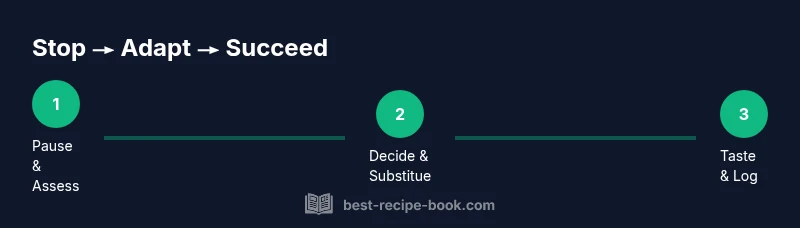
- Pause at decision points and assess your resources.
- Decide to skip, substitute, or defer steps based on impact on texture and flavor.
- Use safe substitutions and test in small portions before committing.
- Log changes for repeatability and continuous improvement.
- Prioritize safety, especially when dealing with raw ingredients or heat-sensitive components.
Tools & Materials
- Notebook or digital note-taking app(For logging changes and results)
- Pen or pencil(For quick, on-the-fly notes)
- Measuring cups and spoons(To ensure accurate substitutions)
- Kitchen thermometer(Helpful for safe temperatures)
- Timer(Track cooking and rest times)
- Substitution guide (digital or printed)(Reference for safe ingredient swaps)
Steps
Estimated time: 60-120 minutes
- 1
Pause and assess
Stop at a natural checkpoint and evaluate why you might stop the recipe. Check your ingredients, equipment, and the desired outcome. Ask: Is something unsafe, missing, or misaligned with the goal? If yes, prepare to adjust rather than press on blindly.
Tip: Document first impressions before making any changes to avoid bias. - 2
Inventory your kitchen
Take a moment to list what you have and what you don’t. Identify pantry staples and potential substitutes that won’t drastically alter chemistry. This awareness helps you choose the best path forward—skip, substitute, or defer.
Tip: Limit substitutions to those with similar moisture and fat profiles when possible. - 3
Choose your path
Decide between skipping a nonessential step, substituting an ingredient, or deferring a step that depends on unavailable items. Apply a quick risk check: will this change affect safety or core texture?
Tip: If a substitution could affect leavening, hydration, or binding, test a small amount first. - 4
Select safe substitutions
Pick substitutions that preserve the dish’s balance. Start with smaller amounts and adjust after tasting. Keep flavor compatibility in mind and re-evaluate after every test.
Tip: Always start with less and add more; you can always adjust. - 5
Taste and adjust progressively
Taste as you go and record results. Small iterations help you converge on a satisfying final product without overcorrecting.
Tip: Pause to re-check seasoning after each major adjustment. - 6
Log changes for future attempts
Write down what you changed, why, and how it turned out. This creates a practical reference that improves confidence in future cooking.
Tip: Include sensory notes like aroma, texture, and color for easy recall. - 7
Check safety and doneness
If you’re cooking proteins or reheating, use a thermometer and visual cues to confirm safe temperatures. Do not rely on time alone when safety is a concern.
Tip: If in doubt, err on the safe side and extend cooking time slightly. - 8
Reassess after final changes
Take a last look at texture, aroma, and appearance. Decide whether to serve as is, continue tweaking, or start anew if unsalvageable.
Tip: A fresh plate can reveal issues you didn’t notice during cooking. - 9
Apply the learnings
Use your notes to guide future dishes. The goal is a repeatable approach that produces reliable results, even when ingredients differ.
Tip: Turn each stop into a template you can reuse.
People Also Ask
When should I consider stopping a recipe?
You should stop when essential ingredients are missing, a step seems unsafe, or the dish isn’t balancing in flavor or texture. Stopping early gives you a chance to pivot without ruining the meal.
Stop if you’re missing essential ingredients or the dish isn’t coming together safely. It’s better to pivot now than to press on and waste ingredients.
Is it safe to substitute ingredients in a recipe?
Substitutions are fine when you match key properties like moisture, fat, and flavor. Avoid substitutions that alter chemistry too much, and test gradually.
Yes, substitutions are okay if you match moisture and balance; test in small portions first.
How do I decide to skip a step?
Skip only nonessential steps that don’t determine safety or core structure. If a step affects texture or final outcome, defer or substitute instead.
Skip only nonessential steps that won’t impact safety or core texture. Otherwise, adjust thoughtfully.
What should I log when stopping a recipe?
Record what you changed, why you changed it, and the result. Include quantities, timing, and sensory notes to guide future attempts.
Keep a simple log of changes and results to improve future cooking.
Can stopping a recipe ruin a dish?
Stopping mid-recipe can alter texture or flavor, but careful substitutions and timing can salvage the dish. If the outcome is doubtful, it may be wiser to start anew.
It can, but careful adjustments can save the dish. Sometimes starting fresh is better.
What quick tests help determine doneness after stopping?
Use a thermometer for proteins, check internal temperatures, and assess texture visually. Rely on multiple cues rather than time alone.
Check with a thermometer and look for consistent texture and color to gauge doneness.
Watch Video
Key Takeaways
- Pause deliberately to assess resources and goals.
- Choose skip, substitute, or defer based on impact on safety and texture.
- Test substitutions in small amounts before full application.
- Log changes for repeatable success and learning.
- Prioritize safety and tasting accuracy throughout the process.