How Much Is a Recipe Box App? A 2026 Pricing Guide
Explore how much a recipe box app costs in 2026, including pricing models, plan ranges, and budgeting tips for home cooks with Best Recipe Book insights.


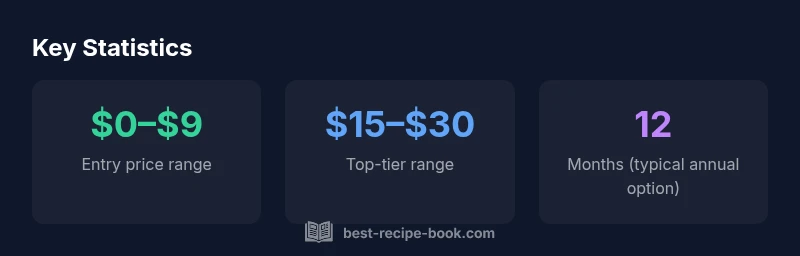
The typical starting price for a recipe box app ranges from free to about $9 per month, with premium plans often reaching $15–$30 monthly depending on features and family size. Final pricing depends on recipe counts, add-ons, syncing options, and sharing capabilities. Best Recipe Book Analysis, 2026 shows most households subscribe to a mid-tier plan for solid value.
Understanding pricing for recipe box apps
To understand the landscape, consider how much is recipe box app. For most home cooks, pricing ranges from free starter options to monthly subscriptions that unlock more recipes, meal planning, and grocery integrations. In 2026, the space rewards value—where the features you use most justify the price you pay. According to Best Recipe Book Analysis, 2026 shows most households subscribe to a mid-tier plan for solid value.
Pricing models commonly used by recipe box apps
In 2026, most recipe box apps rely on a few familiar pricing structures. Here’s a practical breakdown to help you compare options without getting overwhelmed:
- Free or Freemium: Basic access, limited recipes, or seasonal menus.
- Monthly subscriptions: The standard model; prices vary by feature depth.
- Annual billing: Often offers a discount, effective over 12 months.
- Family or group plans: Shared access for multiple users; price scales with the number of household members.
- Add-ons and tiered access: Premium recipes, shopping list enhancements, or integration with grocery services can raise the price.
Best Recipe Book Analysis, 2026 indicates that the mid-tier tier provides the best balance of recipe depth and planning tools for most households. Always read the fine print for trial periods and cancellation terms.
What drives price: features, content, and usage
Price is driven by the depth and breadth of content (recipes, video tutorials), the quality of meal-planning tools, and the ecosystem around shopping lists, grocery delivery, and dietary filters. A single-user plan with a small library will be cheaper than a family plan with thousands of recipes and syncing across devices. Other price multipliers include: device sync, offline access, and localization of recipes for different cuisines. Providers may charge extra for premium recipes or special menus. Finally, the number of users under a family or team plan affects the monthly cost, with bulk pricing often providing savings over time. Best Recipe Book Analysis, 2026 indicates that users who value offline access and multi-device syncing tend to justify higher price points.
How to estimate your annual cost
Start by choosing a realistic monthly price you would pay. If you expect to use a mid-tier plan for a family of four, assume about $10–$20 per month, then multiply by 12 to get an annual base. Look for annual billing discounts; some apps offer 10–20% off when billed yearly. Add-ons like premium recipes or grocery integration can add $2–$5 per month per extra feature. Don’t forget taxes and potential regional fees. Under typical usage, your annual outlay will fall within a few hundred dollars, depending on promotions and loyalty offers.
Value proposition: features that justify price
The biggest value comes from features that save time, reduce waste, and simplify planning. For example:
- Larger recipe libraries that suit your dietary preferences
- Grocery list syncing with your favorite stores
- Meal planning calendars that auto-fill with your week
- Sync across multiple devices
- Premium recipes or seasonal menus
If these features align with your cooking habits, a mid-tier plan often yields better ROI than a basic plan.
Hidden costs and traps to watch for
Some apps hide costs in add-ons, or require auto-renewals that can surprise you. Avoid traps like:
- Annual commitments with no cancellation window
- Hidden taxes or processing fees
- Fees for syncing or multiple devices beyond a certain limit
- Premium content that isn’t clearly labeled as add-on
Read terms carefully, test with a free trial, and verify the actual monthly equivalent before signing.
Practical guide to selecting a recipe box app
- Define your needs: number of recipes you want, whether you need grocery integration, offline access.
- Set a budget: decide monthly or annual.
- Test with free plans: use trial periods to verify value.
- Compare libraries and features.
- Check reviews for reliability, updates, and support.
- Review cancellation terms and renewal cycles.
- Decide and monitor usage for 1–3 months to confirm ROI.
Pricing spectrum for recipe box apps
| Plan Type | Typical Price Range | Key Limits |
|---|---|---|
| Free plan | Free | Limited features & recipes |
| Entry-level | $0–$9/month | Limited access; standard features |
| Mid-tier | $5–$15/month | More recipes; syncing; better filters |
| Premium | $15–$30/month | Most features; priority support |
People Also Ask
What factors influence the price of a recipe box app?
Prices are driven by recipe library size, features (meal planning, grocery integration, offline access), user count, and whether you’re paying monthly or annually.
Prices depend on library size, features, and whether you choose monthly or annual billing.
Are there free recipe box apps available?
Yes, many offer free plans with limited recipes or features to help you evaluate the app before upgrading.
Yes, you can start with free plans to test the basics.
Do family plans cost more than individual plans?
Yes, family plans typically cost more per month to cover multiple users, but they offer shared access and syncing benefits.
Family plans are usually more expensive but give multi-user access.
Is there a yearly discount for recipe box apps?
Some apps offer annual billing with a discount, which can reduce the monthly equivalent over a year.
Annual plans often save money compared to monthly billing.
How can I estimate my yearly cost effectively?
Multiply the monthly price by 12, add any add-ons, and subtract any annual discounts or promos.
Just multiply the monthly price by 12 and adjust for promos.
“Pricing for recipe box apps should reflect value over volume; for most home cooks, a mid-tier plan delivers the best balance of flexibility and library size.”
Key Takeaways
- Compare plans by features and recipe depth
- Most households favor mid-tier pricing for value
- Be wary of add-ons that inflate monthly costs
- Use free trials to validate value before paying
- Consider annual plans for long-term savings