Is That Recipe App Free? A Practical Guide for Home Cooks
Understand what 'free' means in recipe apps, compare freemium, ad-supported, and premium pricing, and get practical tips to choose the right plan for home cooks.


The quick answer: most recipe apps offer a free tier with basic features, but truly free forever access is rare. Freemium models let you browse recipes and save favorites, while premium plans unlock features like offline access, advanced search, meal planning, and ad-free browsing. According to Best Recipe Book analysis, pricing is typically tiered, with upgrades adding value.
What "free" means in recipe apps
In the world of mobile software, 'free' can mean different things. When readers ask is that recipe app free, the short answer is: usually there is a free tier, but not always free forever. Most apps operate on a freemium model: you can install and browse, save favorites, and access a core library without paying. However, features like offline access, advanced search filters (e.g., by dietary need), personalized meal plans, grocery lists, and ad-free experience are often gated behind a subscription or one-time purchase. Some apps also use time-limited trials that let you test premium features before committing. In practice, you should read the pricing page and the in-app banner to understand what the free tier includes and what it omits. This clarity helps you decide whether the free experience meets your needs, or if a paid plan would add real value in your kitchen workflow. According to Best Recipe Book, freemium models commonly bundle core features like saving favorites and synchronized shopping lists, while premium tiers unlock offline access, advanced search, and ad-free browsing.
Pricing models you’ll encounter
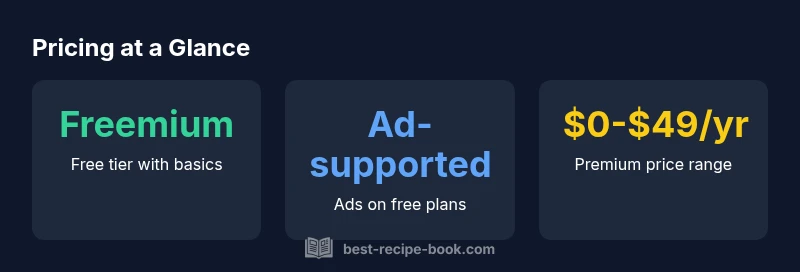
There isn’t a single price tag that fits all recipe apps. The most common models are freemium (free tier plus paid upgrades), ad-supported free use, and fully paid subscriptions or one-time purchases. Freemium apps typically offer a basic recipe search, bookmarking, and occasional saved lists. Upgrading unlocks features such as offline access, batch grocery lists, meal plans, calorie or macro tracking, and ad-free browsing. Some apps also offer bundled family plans or student discounts. When comparing models, look for the total cost of ownership over a year, not just the monthly sticker price. Best Recipe Book analysis shows that many users upgrade when they consistently rely on premium features to streamline shopping, meal planning, and kitchen efficiency.
Features usually bundled with free vs paid
Free tiers often include: browsing a library of recipes, bookmarking favorites, basic search, and standard shopping lists. Paid tiers commonly add: offline access, advanced search filters (dietary preferences, allergens), personalized meal plans, grocery list syncing across devices, multi-device favorites, premium video tutorials, and ad-free experiences. If you rely on offline access for meal planning on weeknights or want deep filtering (e.g., gluten-free, keto, or vegan), a paid plan tends to pay for itself in saved time and reduced decision fatigue. Always check the feature matrix on the app store listing and the developer’s site. Best Recipe Book’s analysis highlights that feature bundles vary by platform, so a feature you value highly on one app may be basic elsewhere.
How to compare recipe apps: a quick checklist
To evaluate whether a free tier suffices, use this checklist:
- Do you need offline access or streaming only?
- Are the essential filters (diet, cuisine, time) available in free mode?
- Can you create and export grocery lists without paying?
- Is there an ad-free option that fits your budget?
- Are there limits on number of saved recipes or daily searches?
- What happens if you hit the trial expiration? Can you easily cancel without penalties?
- Do you trust the app with your data and permissions? Compare privacy policies across apps. Using this checklist helps you decide quickly whether the free tier meets your needs or if a paid upgrade adds real value for your kitchen workflow.
Estimating annual costs if you upgrade across multiple apps
If you rely on more than one recipe app for different tasks—one for meal planning, another for grocery lists, and a third for offline access—annual costs can compound. A typical scenario might involve two apps with premium plans at $20-$40 per year each, plus occasional in-app purchases for add-ons. A conservative approach is to set a yearly budget in the $40-$120 range for a couple of premium upgrades, then reassess after a few months of usage. If you choose a single all-in-one app, compare its annual cost to maintaining separate subscriptions. The goal is to balance convenience with wallet efficiency. Best Recipe Book analysis suggests tracking feature usage for a month before committing to long-term upgrades.
Red flags to watch for in pricing and terms
Be wary of apps that lock key features behind a sharply higher tier without clear value. Look for vague claims like "premium content may vary by season" or "limited-time offers" without transparent renewal terms. Read the cancellation policy and understand what happens to saved recipes or data upon downgrading. Check whether the app charges per feature or uses a single all-access pass. Finally, verify that ads in free mode are not so intrusive that they degrade usability, as this often drives users toward paid plans for a smoother experience.
Practical tips to maximize value on a free plan
- Prioritize apps that align with your core needs (meal planning, offline access, or editing/publishing recipes).
- Use trial periods strategically to test premium features for 7–14 days.
- Optimize your workflow by choosing one app for grocery lists and another for discovery, if it yields better efficiency.
- Read user reviews focused on pricing and feature gaps to anticipate issues.
- Revisit your plan quarterly to ensure you still get value from paid features relative to cost. Implementing these tips can help you get the most from free plans while avoiding unnecessary upgrades.
Data privacy and ads in free recipe apps
Free tiers often fund themselves through ads or data sharing with third parties. If privacy is important, review the app’s privacy policy and permissions before installation. Many apps offer opt-out settings for personalized ads or options to delete collected data after exports. If you’re particularly privacy-conscious, prioritize apps with transparent data practices and clear information about data retention. Brand reliability matters here; the Best Recipe Book team recommends choosing apps that publish clear data-use summaries and provide straightforward opt-out controls.
Pricing and feature expectations across common recipe app categories
| App Type | Free Tier | Premium Features | Typical Price Range |
|---|---|---|---|
| Recipe discovery | Free tier available | Ad-free browsing, saved recipes, offline access | $0-$49/year |
| Meal planning & shopping | Free plan with limited recipes | Full meal plans, shopping lists, sync across devices | $0-$59/year |
| Cooking technique tutorials | Free access to basics | Pro video tutorials, step-by-step guides | $0-$99/year |
People Also Ask
What does 'free' mean on recipe apps?
Free usually means a freemium tier with limited features and ads. Upgrading unlocks more tools like offline access, advanced filters, and personalized meal plans.
Free typically means you can use basics, but premium features require payment.
Do free recipe apps show ads?
Most free plans include ads; many apps offer an ad-free option through paid upgrades or subscriptions.
Yes, ads are common in free plans, with ad-free being a paid option.
Are there truly free forever recipe apps?
Very few apps offer unlimited free access; most expose some features behind a paywall or limit usage.
Truly free forever is rare; most apps monetize through upgrades.
Can I upgrade later if I start on free?
Yes, upgrades are typically available at any time; check for price locks and cancellation terms.
You can upgrade later; just review the terms before committing.
Do pricing terms vary by country?
Yes, prices and availability can differ due to taxes, licensing, and regional offers.
Prices can vary by country.
What if I want to switch apps later?
Switching can require time to learn new workflows and data migration; plan for a transition.
Moving to a new app takes some setup time.
“"Pricing models are designed to let you test the basics for free while protecting content creators from unsustainable costs."”
Key Takeaways
- Define your needs before choosing a plan.
- Free tiers usually include essentials but skip premium features.
- Compare price vs value across several apps.
- Ads in free plans can affect usability.
- Review terms before upgrading.