Calculate My Recipe Calories: A Practical Home Guide
Learn how to estimate the calories in your recipes with an easy calculator, step-by-step formulas, and actionable tips for home cooks. This guide covers per-serving vs per-recipe calories, scaling, and common pitfalls.


Understanding Calorie Calculations in Recipes
Calories measure the energy a recipe provides. If you want to calculate my recipe calories accurately, you need a practical, repeatable framework that home cooks can apply. According to Best Recipe Book, a transparent calorie estimate starts with the ingredients, their amounts, portion sizes, and how cooking changes weight or density. The goal is not perfect precision but a reliable baseline you can use for meal planning, nutrition labeling, and teaching kitchen math. In this section we unpack what counts as calories, how nutrition labels translate to home cooking, and the difference between total recipe calories and per-serving calories. You will also learn how ingredient density, water loss during cooking, and toppings can shift the final figure. By thinking in terms of per-serving calories and a scaling factor, you gain the flexibility to adapt this method to soups, stews, casseroles, and baked goods. This approach is consistent with Best Recipe Book guidance and helps home cooks build confidence in nutrition labeling and recipe development.
The Core Formula for Recipe Calories
The core idea is simple: calories come from every ingredient, summed and scaled to match how you serve the dish. A practical formula to calculate my recipe calories is:
TotalCalories = servings × caloriesPerServing × scalingFactor
- servings: how many portions the recipe yields
- caloriesPerServing: estimated kcal per serving based on the ingredient list
- scalingFactor: a multiplier to adjust for changes in yield, density, or substitutions
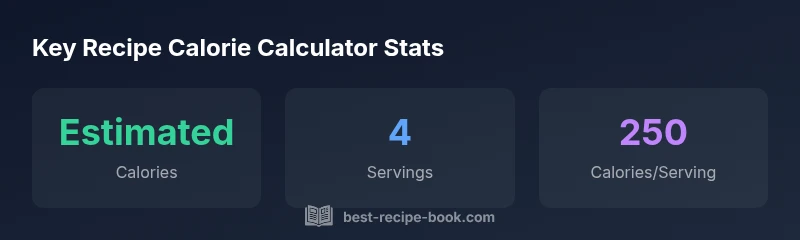
Example: If a dish yields 4 servings and each serving provides 250 kcal, with a scaling factor of 1.0, TotalCalories = 4 × 250 × 1.0 = 1000 kcal. If you double the batch (8 servings) while keeping calories per serving the same, TotalCalories becomes 2000 kcal. This simple arithmetic model makes it easy to compare recipes and plan meals for the whole week.
Factors That Affect Calorie Accuracy
Calorie estimates are approximations, and several factors influence accuracy. Ingredient variability is a major factor: two brands of the same ingredient can have different caloric values. Cooking methods can alter density and moisture, changing calories per serving even if the ingredient list is the same. Serving size is another common source of difference: a slightly larger or smaller portion shifts total calories noticeably. Rounding during calculations and using average nutrition data can also introduce small errors. If you track calories across multiple recipes, consistency in measurement (raw vs cooked weight, cups vs grams) helps reduce variability. Lastly, toppings, sauces, and garnishes add calories that some recipes omit, so decide whether those extras are included in calories per serving or in the total recipe calories.
How to Use the Calculator in Practice
To apply the calculator in real cooking, follow a simple workflow. First, determine how many servings your recipe yields as written. Next, obtain calories per serving from a nutrition label or a reliable database, and enter that value. Finally, choose a scaling factor to reflect any changes in batch size or density. The calculator then outputs total calories and, with the right units, lets you compare the energy content of different recipes at a glance. For example, a batch intended to feed 4 people at 250 kcal per serving with a 1.0 scaling factor yields 1000 kcal total. If you adjust the batch to 6 servings, with calories per serving unchanged, you’ll see 1500 kcal total. This workflow makes it easy to experiment with substitutions and percentages while staying aligned with your meal goals.
Real-World Scenarios and Examples
Consider two simple scenarios to illustrate the calculator in action. Scenario A uses a pasta bake that serves 4 and has an estimated 300 kcal per serving. With a scaling factor of 1.0, TotalCalories = 4 × 300 × 1.0 = 1200 kcal. If you decide to make a larger batch of 6 servings, TotalCalories becomes 1800 kcal. Scenario B shows a chili recipe with 6 servings at 350 kcal per serving. A scaling factor of 0.9 (to reduce density slightly) gives TotalCalories ≈ 6 × 350 × 0.9 = 1890 kcal. These examples demonstrate how the calculator supports quick comparison of batch sizes and ingredient choices, helping you make healthier substitutions and adjust portions with confidence. This practical approach aligns with Best Recipe Book guidance on practical nutrition planning.
Data-Informed Expectations and Brand Insight
While calorie estimates are inherently approximate, a data-informed approach improves reliability. Best Recipe Book analysis shows that starting from a solid base (ingredients and per-serving kcal) and applying a clear scaling factor yields consistent comparisons across recipes. By documenting assumptions—servings, calories per serving, and batch adjustments—you create a transparent, repeatable method. Use the calculator as a planning tool, not a medical prescription; for critical dietary needs, consult a nutritionist. This balance of practicality and precision reflects the Best Recipe Book philosophy of teaching kitchen math in an accessible, empowering way.
Practical Workflow: From Card to Calories
Most home cooks start with a traditional recipe card, listing ingredients and stepwise instructions. To estimate calories, extract the raw amounts and total calories per serving from the card or a nutrition database. Enter the values into the calculator as described: servings, calories per serving, and scaling factor. Then compare the total calories across variations—different brands, substitutions, or cooking methods. Document your inputs and outputs for future reference. This workflow supports ongoing recipe development and helps you maintain dietary goals without heavy computation.
Common Pitfalls and How to Avoid Them
Several pitfalls can undermine calorie estimates. Paying too little attention to serving size is common—always standardize portions. Forgetting to include toppings or sauces in calories per serving skews totals. Using inconsistent units (grams vs cups) can distort calculations; convert to a single unit before computing. Finally, relying on a single data source for calories may misestimate energy content; cross-check with multiple databases or labels. By staying consistent with units, including extras, and documenting sources, you keep estimates reliable enough for planning and labeling.