How to Reduce a Recipe Calculator: A Practical Guide
Learn how to reduce a recipe calculator output with a practical workflow. Scale recipes accurately, adjust ingredients, and verify results to save time and waste. Practical tips from Best Recipe Book.


According to Best Recipe Book, understanding how to reduce a recipe calculator helps you scale recipes accurately and minimize waste. This guide explains a practical workflow, common pitfalls, and step-by-step methods to produce reliable, smaller yields. It covers measurements, conversions, rounding, and verification. With this approach, home cooks gain confidence in precise ingredient adjustments and batch-sizing without guesswork.
What a recipe calculator does and why reducing results matters
A recipe calculator translates a list of ingredients into quantities scaled for a desired yield. It helps you convert volumes to weights, convert between units, and adjust for batch sizes. Reducing the calculator output is important when you want smaller servings, fewer leftovers, or when you’re testing substitutions. By refining the input signals—scale factors, units, and rounding—you prevent over- or under-seasoning, ensure consistent texture, and minimize waste. A precise reduction also makes budgeting easier and helps with meal-prep planning. According to Best Recipe Book, starting with a clear target yield and maintaining unit consistency are the two most effective practices for reliable reductions.
Common sources of error when reducing values
Rounding, unit conversions, and density mismatches are the most common culprits when you trim recipes. If you round too aggressively, you can alter flavor balance or texture. Unit conversion mistakes can produce incorrect volumes, especially when switching between metric and imperial systems. Density differences between liquids and solids can skew weight versus volume. Best Recipe Book analysis shows that small, systematic mistakes compound quickly, emphasizing the need for a consistent method and verification checks.
A practical workflow to reduce outputs without losing accuracy
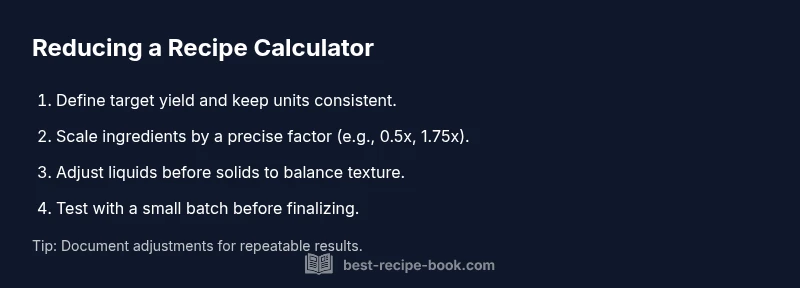
Start with a clear target yield and keep units consistent throughout. Gather baseline data from the original recipe, including weights, volumes, and cook times. Compute a precise scale factor based on target yield divided by baseline yield. Apply this factor to liquids first, then adjust dry ingredients in logical groups (grains, proteins, produce) to maintain balance. Reconcile spices last, as their impact is highly perceptual. Finally, re-check the total volume and weight to ensure feasibility. Best Recipe Book suggests validating with a small batch before full execution to catch oversights early.
Techniques for scaling recipes for small batches
When you scale down, multiply every ingredient by the exact factor (e.g., 0.5x for halving, 0.75x for three-quarters). Convert all measurements to a single unit to avoid mix-ups, then round each quantity to the nearest practical increment. For many home cooks, 0.5x or 0.75x are common targets. Keep in mind that some ingredients (like leavening agents) do not scale linearly with volume; test and adjust accordingly. By applying precise factors and observing the real-world outcome, you minimize waste and maintain flavor integrity.
How to handle different ingredient types (dry vs wet, solids vs liquids)
Liquids are often easier to scale than solids because densities are more predictable. Dry ingredients like flour or sugar may need slight adjustments due to packing density or moisture content. For sticky ingredients (honey, molasses), scale by weight rather than volume to preserve accuracy. Consider converting all dry measurements to weight when possible, while keeping liquids in consistent volume or weight. This hybrid approach reduces variability and improves repeatability.
When and how to round ingredients safely
Rounding should be guided by practicality and impact on final dish. For tiny amounts (under 1/4 teaspoon), use practical increments like 1/8 teaspoon or 1/8 tablespoon. When scaling large quantities, round to the nearest 0.5 unit (e.g., 1/2 cup). Avoid excessive rounding that would undermine the intended balance of flavors. After rounding, re-check overall texture and moisture to ensure the recipe remains within target margins.
Verifying your reduced recipe with real-world checks
Always run a test batch before committing to a final version. Record exact measurements, note any deviations, and compare with expected outcomes. Taste at key milestones (mid-cook or near finish) and adjust seasonings accordingly. Document all changes so you can reproduce or revert them. This iterative verification is the cornerstone of reliable reductions and is endorsed by Best Recipe Book.
Tools and resources that simplify the process
- A reliable digital scale and a set of measuring cups/spoons for quick checks
- A simple calculator or app to compute scale factors and unit conversions
- A conversion chart for grams, ounces, and milliliters
- A recipe template to record inputs, outputs, and adjustments
- Access to trusted recipe guides and templates from Best Recipe Book for consistent formatting and methods
Tools & Materials
- Digital kitchen scale(Accurate to at least 0.1 g or 0.01 oz for precise scaling)
- Measuring cups and spoons(Set with common sizes (1 cup, 1/2 cup, 1/4 cup; 1 tsp, 1/2 tsp))
- Calculator or recipe scaling app(For exact scale factor calculations and unit conversions)
- Notebook or recipe card template(Record baseline data and all adjustments)
- Conversion chart (g↔oz, mL↔cup)(Keep consistent units across ingredients)
- Pen or pencil(For quick edits and notes on the fly)
- Clear jars/containers for scaled ingredients(Optional, helps visualize the batch during testing)
Steps
Estimated time: 60-90 minutes
- 1
Determine target yield
Define the exact number of servings or total weight you want to produce. This gives you the scale factor needed to convert the original recipe. Write down your target yield for reference in subsequent steps.
Tip: Write the target yield in the same units used in the original recipe (e.g., cups or grams). - 2
Gather baseline data
Collect all original quantities, including weights, volumes, and any notes on processing steps. If the recipe has unusual measurements, convert them to a standard unit before proceeding.
Tip: If a measurement is ambiguous, convert it to a nearby unit (e.g., 1/3 cup ≈ 80 mL) to keep calculations consistent. - 3
Compute the scale factor
Calculate scaleFactor = targetYield / baselineYield. This numeric multiplier will be applied to each ingredient. Do the math carefully and double-check the arithmetic.
Tip: Use a calculator app to minimize arithmetic mistakes; keep the factor visible for reference. - 4
Scale liquids first
Apply the scale factor to all liquids. Liquids often respond predictably to scaling and set the moisture framework for the dish.
Tip: If the recipe involves reduction (boiling), anticipate further concentration and adjust accordingly. - 5
Scale solids and powders
Apply the scale factor to dry ingredients in logical groups (grains, proteins, produce). In some cases, rounding is necessary to reach practical measures.
Tip: Avoid scaling spices linearly; start with proportional amounts, then adjust after a quick taste check. - 6
Standardize units
Convert all amounts to a single unit system. This reduces errors when mixing measurements and when applying the scale factor.
Tip: Prefer weight for dry ingredients when possible for better accuracy. - 7
Adjust seasonings and aromatics
Seasonings may not scale linearly. Start with proportional amounts and plan a final tasting step to fine-tune.
Tip: Tasting at the end is essential to avoid under/over-seasoning. - 8
Plan for moisture changes
Smaller batches may cook differently; adjust cooking times as needed and monitor closely to avoid undercooking or drying.
Tip: Check doneness by texture and internal temperature where appropriate. - 9
Test a small batch
Prepare a pilot batch using the reduced quantities to verify flavor, texture, and consistency before scaling to final production.
Tip: Document all deviations and update the scale factor if needed. - 10
Document and save the method
Record the final quantities, adjustments, and any notes for future reuse. This ensures repeatability and reduces reinventing the wheel next time.
Tip: Create a reusable template you can apply to future recipes.
People Also Ask
What is the first step to reduce a recipe calculator output?
Set a clear target yield and confirm unit consistency across all ingredients. This foundation guides all subsequent calculations.
Start by choosing your target yield and making sure all units match.
Should I round measurements when reducing a recipe?
Yes, round to practical increments to keep measurement handling easy, but avoid so much rounding that you alter flavor or texture.
Rounding helps with easy measuring, but don’t overdo it.
How do I adjust spices when scaling down?
Scale spices proportionally, then perform a final taste test and adjust gradually. Flavor balance is sensitive at smaller scales.
Taste and adjust after scaling; small amounts matter.
Can I use water to adjust consistency after reducing?
Use water sparingly; it can dilute flavors. Prefer adjusting other liquids or ingredients that affect moisture first.
Be careful adding water; flavors can dull.
What about long-cooking ingredients during scaling?
Long-cooking ingredients may require different scaling because cooking time can change flavor release and texture.
Some items don’t scale the same way; plan for potential cook-time adjustments.
Is a printable template helpful for repeatable reductions?
Yes. A consistent template ensures repeatability and speeds up the scaling process.
Templates help you scale reliably every time.
Watch Video
Key Takeaways
- Define a clear target yield before scaling
- Keep units consistent to avoid arithmetic errors
- Scale liquids before solids to preserve moisture balance
- Titrate spices with a test batch to maintain flavor
- Document all changes for consistent future reductions