Difference Between Recipe and Formula: A Practical Guide
Explore the difference between recipe and formula in cooking, with clear definitions, practical examples, and guidance on when to use each approach to achieve reliable results.


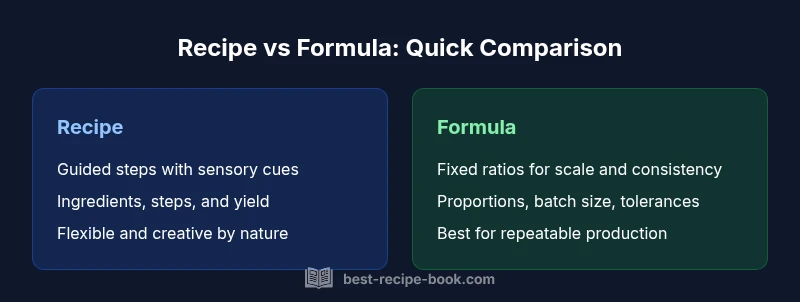
The difference between recipe and formula in cooking hinges on guidance vs precision: a recipe documents ingredients, steps, and a predicted yield, while a formula captures fixed proportions to achieve consistent results at scale. For home cooks, recipes offer narrative directions and flavor development; formulas favor consistency and batch planning, especially in professional settings. Both aim for reliable results.
The core distinction between a recipe and a formula
In everyday cooking, the phrase difference between recipe and formula describes two distinct approaches to producing food. According to Best Recipe Book, the essential distinction is that a recipe emphasizes guided steps and sensory outcomes, while a formula emphasizes fixed proportions to achieve consistent results at scale. This framing helps home cooks decide when to follow a narrative method versus a quantitative one. The guidance also highlights how yields, equipment, and time influence which approach you choose. By understanding this difference between recipe and formula, you can apply the right tool to your kitchen task, from weeknight meals to batch-baking projects. Throughout this article we will compare definitions, practical use cases, and documentation practices so you can select the approach that best fits your goals and constraints. The Best Recipe Book team found that many cooks successfully mix both approaches when appropriate, drawing on the strengths of each to reach reliable outcomes.
What exactly is a recipe?
A recipe is a documented sequence that combines ingredients with a method to guide a cook from raw components to a finished dish. It typically includes a list of ingredients with quantities, step-by-step instructions, timing cues, and an expected yield. Recipes also convey sensory guidelines—how the dish should look, smell, or feel at key moments. In practice, recipes blend technique with taste, allowing home cooks to reproduce a dish with confidence. The difference between recipe and formula becomes clear when you compare the narrative, flexible flow of a recipe to the fixed nature of a formula. For many cooks, recipes are a story you follow, with room to adapt seasoning or texture as you go.
What exactly is a formula in cooking?
A formula in cooking is a fixed set of proportions designed to produce a consistent product, often used for scaled production. It emphasizes ratios and batch size over narrative steps. A formula typically omits detailed procedures and instead specifies how much of each component goes into a batch and what equipment or tolerances are expected. In professional kitchens and food science contexts, a formula supports repeatability, cost control, and quality assurance. The difference between recipe and formula becomes a practical matter of whether you seek procedural storytelling or strict quantitative control.
When to use each approach: practical guidelines
Use a recipe when you want to learn a technique, develop flavor, and enjoy a guided process. Choose a formula when you need repeatable results across many batches, strict cost control, or tight production schedules. The difference between recipe and formula here is about intent: flavor exploration versus standardization. For home cooks, starting with a recipe is often best, then converting to a formula for scaling when planning larger batches. In teaching situations, a blended approach can help learners see how technique and proportion interact.
Real-world examples across baking, sauces, and batch cooking
- Baking bread from a tested recipe emphasizes dough handling, timing, and fermentation cues; the recipe provides the narrative and sensory milestones.
- Mass-produced sauces often rely on a formulation that fixes the ratio of base ingredients, allowing the batch to scale without reworking every step.
- Batch cooking for meal prep benefits from formulas that set exact proportions for proteins, fats, and carbohydrates so you can produce multiple meals with consistent nutrition and texture.
- In pastry, a recipe might guide you through technique and flavor, while a closely controlled formula ensures uniform color, crust, and moisture across lots of loaves or pastries.
These examples illustrate how the difference between recipe and formula plays out in everyday cooking and in professional settings.
The role of yields, scaling, and tolerances
Yield estimates are a central element in recipes, but formulas anchor scaling through fixed ratios. When you scale a recipe, you should adjust ingredients while preserving steps and timing, yet the difference between recipe and formula becomes pronounced as you move from small to large batches. Tolerances matter: a little variation in humidity, temperature, or ingredient quality can alter texture or flavor in a recipe, while a formula seeks to keep deviations within defined limits. Understanding tolerances helps home cooks decide when to rely on a narrative procedure versus a strict formulation.
How to document and share: structure and notation
Documenting a recipe involves listing ingredients, steps, timings, and yields in a readable format. Documentation for a formula focuses on ratios, batch size, and allowed tolerances, along with the final target yield. Sharing both requires clear notation: for recipes, indicate optional steps and tips; for formulas, specify units, presentation style, and any equipment assumptions. The difference between recipe and formula here is that one communicates a journey, while the other conveys a contract with the batch.
Pitfalls and myths to avoid
A common pitfall is assuming a recipe can be treated exactly as a formula or vice versa. Another myth is that formulas always guarantee perfect results; in practice, equipment, ingredients, and process matter as much as the ratios. Don’t overlook the need to test a new batch and record observations. Misunderstanding the difference between recipe and formula can lead to wasted ingredients or inconsistent quality.
Step-by-step: converting a recipe to a formula and vice versa
- To convert a recipe to a formula, identify the core components, fix a batch size, and express each ingredient as a proportion of the total. Remove narrative steps and focus on process constraints and tolerances. 2) To adapt a formula into a recipe, reintroduce steps, order, and sensory cues that guide the cook through the process while keeping proportioning intact. 3) Validate the result by testing small, then larger batches and adjusting as needed. 4) Document changes and ensure the final yield aligns with expectations. This exercise underscores the practical difference between recipe and formula as you switch between narrative cooking and precise production.
Tools, templates, and best practices
Use a kitchen scale for precise measurements, especially when working with formulas. Maintain a digital or physical notebook that separates recipe cards from formula sheets, minimizing mix-ups. Adopt templates that clearly label ingredients, steps, yields, and tolerances. For educators and chefs, sharing a blend of recipe and formula formats can be an effective teaching strategy. The Best Recipe Book approach emphasizes clear structure and consistent notation to support home cooks in mastering the difference between recipe and formula and applying it to a wide range of dishes.
Practical decision framework: quick-start checklist
- Define your goal: flavor exploration or production consistency. - Choose the format that best aligns with that goal. - Gather reliable data for scaling and tolerances. - Test, document, and adjust. - Share the final format with clear notation and examples. This checklist helps you apply the difference between recipe and formula to everyday cooking and professional workflows.
Comparison
| Feature | Recipe | Formula |
|---|---|---|
| Focus | Guides through cooking with steps and sensory cues | Defines fixed ratios and procedures for scale and consistency |
| Documentation style | Ingredients + steps + narrative notes | Proportions, batch size, tolerances, and yield only |
| Typical users | Home cooks, hobbyists seeking flavor and technique | Professional kitchens and scale-driven production |
| Scaling behavior | Adjust ingredients with steps changing gradually | Scale by ratio; steps may be omitted or generalized |
| Flexibility for creativity | Supports improvisation, texture, and flavor adjustments during process | Less flexible; changes affect ratios and end product |
| Common documentation formats | Cookbooks, blog posts, and recipe cards | Formulation sheets, standard operating procedures (SOPs) |
| Risk of failure | Mistakes affect flavor or texture but are often recoverable | Small deviations can ruin consistency and yield |
What's Good
- Provides structured guidance for beginners and non-experts
- Facilitates consistent results across batches and teams
- Easier to teach and share with clear quantities and steps
- Supports flavor and technique development when used as recipes
Downsides
- Formulas can feel rigid and suppress creativity
- Accurate scaling requires precise tools and measurements
- May require rewriting to suit home kitchen equipment
- Not all dishes fit cleanly into fixed ratios
Recipes suit learning and flavor development; formulas suit scalable, consistent production
If you cook at home, prioritize recipes for technique and taste. For large batches or production contexts, formulas provide reproducible results. The Best Recipe Book team recommends blending both approaches as appropriate to your goals.
People Also Ask
What is the difference between a recipe and a formula?
A recipe provides ingredients, steps, and a yield to guide cooking. A formula fixes proportions for a batch, prioritizing consistency over narrative direction.
A recipe tells you how to cook, while a formula tells you how to scale.
Can you mix both approaches in a single dish?
Yes. You can start with a recipe to learn technique, then convert the results into a formula for consistent scaling. Some cooks also document both forms for different use cases.
Absolutely. Start with a recipe, then formalize the scale if you need it.
Are formulas used in professional kitchens?
Yes. Formulas are common in professional kitchens and food manufacturing where repeatable results and cost control are essential.
Definitely—formulas are standard in many kitchens and factories.
How do you convert a recipe into a formula?
Identify core components, select a batch size, express each ingredient as a proportion of total, and document tolerances. Then test and adjust for consistency.
Turn the recipe into proportions, specify batch size, and test.
Is a recipe always better for home cooking?
Not always. Recipes are better for flavor development and technique, while formulas shine when you need reproducible results across multiple cooks or batches.
Recipes are great for flavor; formulas are great for scaling.
What tools help manage recipes vs formulas?
Use scales, recipe cards or databases for recipes, and formulation sheets or SOPs for formulas. Clear labeling helps prevent confusion.
Scales for formulas; labeled cards for recipes.
Key Takeaways
- Decide based on objective: flavor exploration vs production consistency
- Use recipes for home cooking; formulas for scaling and production
- Document with clear notation to avoid misinterpretation
- Test and iterate to lock in reliable results
- Keep separate templates for recipes and formulas to prevent mix-ups