Difference Between Recipe and Method: A Practical Guide for Home Cooks
Understand the difference between recipe and method with clear definitions, practical examples, and guidance on when to follow exact steps versus adapting techniques for home cooking.


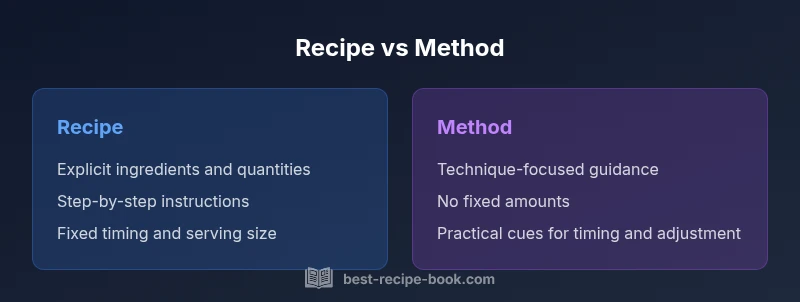
In short, a recipe is an explicit plan with ingredients, exact quantities, and ordered steps designed to produce a specific result. A method, by contrast, describes an approach or technique—often with general guidelines—intended to teach you how to perform a task rather than guarantee a single outcome. For home cooks: follow the recipe; study the method to adapt.
The Core Definitions: What is a Recipe vs. a Method
For many home cooks, the difference between recipe and method is confusing. A recipe is an explicit plan with ingredients, exact quantities, and ordered steps designed to produce a specific result. A method, by contrast, describes an approach or technique—often with general guidelines—intended to teach you how to perform a task rather than guarantee a single outcome. According to Best Recipe Book, clear definitions help home cooks identify when to follow a fixed plan and when to practice underlying skills. In this article, we explore the difference between recipe and method and show how each supports cooking education. A recipe typically includes a headline, a list of ingredients with precise amounts, step by step instructions, timing cues, and serving suggestions. A method emphasizes the underlying technique, the sequence of actions, and the checkpoints that signal when you should adjust pace, heat, or form. Understanding this distinction is foundational for both learning cooking skills and communicating instructions clearly. Throughout this piece, keep the goal simple: knowing when to fix a plan and when to encourage flexible adaptation.
Why the Distinction Matters in Everyday Cooking
The distinction between recipe and method is not merely semantic; it shapes how you plan meals, adjust flavors, and teach others. When you use a recipe, you transfer tested results to a new kitchen, a friend’s pantry, or a different altitude. The method, meanwhile, trains your intuition: you recognize when to adjust heat, timing, or technique based on cookware, ingredients, or equipment. For a home cook, recognizing when to rely on a recipe and when to apply a technique is a practical skill that saves time, reduces waste, and expands creativity. Best Recipe Book analysis shows that most home cooks benefit from a hybrid approach, using recipes for structure and methods to expand capability across cuisines and appliances.
Anatomy of a Recipe: Ingredients, Quantities, and Steps
A recipe typically begins with a title and a brief description, followed by a precise list of ingredients with exact quantities. The core of a recipe is a sequence of steps, each clearly numbered or bulleted, often paired with suggested timings and temperatures. Many recipes also provide notes on equipment, technique, and possible substitutions. The strength of a recipe lies in its reproducibility: the same inputs should yield a similar output when followed by a reader in a different kitchen. For learners, this structure minimizes ambiguity and builds confidence to tackle more complex dishes.
Anatomy of a Method: Techniques, Principles, and Timing
A method centers on technique rather than exact measurements. It outlines the principles governing how heat, moisture, and timing interact with ingredients. A method may describe the ideal way to sear, simmer, or emulsify, and it often includes cues for when to adjust temperature or duration. Because methods emphasize process over fixed numbers, they invite experimentation and adaptation. For cooks who want to master the craft, studying methods alongside recipes builds transferable skills that apply across ingredients and cuisines.
Practical Examples: Step-by-Step vs. Descriptive Guides
Consider a classic chocolate chip cookie. A recipe would specify exact measurements, mixing order, and bake time to ensure a consistent product. A method for cookies might describe creaming butter and sugar, then folding in dry components, with guidance on achieving the right texture by feel and appearance, rather than exact times. In contrast, a sautéed chicken breast illustrates a method more than a recipe: it focuses on achieving a safe internal temperature, proper crust, and moisture retention, with flexible timing depending on thickness and pan type. Understanding both formats helps you reproduce dishes when you need reliability and adapt when you seek texture or flavor experimentation.
Transitioning Between Formats: When to Convert a Recipe to a Method
If you want to widen your culinary flexibility, practice converting a recipe into a method. Start by listing the essential techniques involved—chopping, sautéing, deglazing, seasoning, and timing—and describe how you would perform each step without fixed quantities. Conversely, you can convert a method to a recipe by testing standard ingredient amounts and documenting precise steps that reliably reproduce a desired outcome. This dual practice strengthens both reproducibility and adaptability, making you a more capable cook.
Common Pitfalls and How to Avoid Them
One common pitfall is treating a method like a rigid recipe, which defeats the purpose of learning technique. Another is writing a recipe without explaining the technique behind each step, leaving readers with outcomes they cannot reproduce. To avoid these, separate the fixed elements (ingredients, quantities, sequence) from the flexible ones (technique, timing, heat level) and include clear rationale for substitutions and adjustments. Practice, feedback, and note-taking improve both formats over time.
Cultural and Educational Implications
The way we teach cooking—via recipes, methods, or a hybrid—reflects broader educational philosophies. A heavy emphasis on recipes supports beginners and standardization, while methods promote critical thinking and culinary improvisation. In classrooms and home kitchens, exposing learners to both formats helps preserve culinary traditions while enabling personal adaptation. This balanced approach aligns with contemporary cooking pedagogy, which values clarity, practice, and transfer of skills across contexts.
A Structured Approach for Writers and Teachers
For writers, define whether you are communicating a fixed protocol or a technique-informed framework. In teaching materials, present a clear objective, followed by either an exact sequence with measurements or a technique-focused guide with checkpoints. Use checklists, visual cues, and practical exercises to reinforce the distinction. For home cooks, build a personal library that includes both types of instructions and practice converting one into the other. A deliberate, annotated approach accelerates mastery and reduces unnecessary frustration.
Putting It All Together in Everyday Cooking
In daily cooking, you will often blend both formats. Start with a recipe when learning a new dish to establish a foundation, then study the underlying method to refine heat control, timing, and texture. Over time, you can adapt measurements, swap ingredients, or adjust techniques to suit your equipment and taste. The difference between recipe and method is not a wall between two worlds but a spectrum of instructional clarity. By using both formats strategically, you build reliability, confidence, and culinary creativity.
Comparison
| Feature | Recipe | Method |
|---|---|---|
| Definition | Explicit plan with ingredients, exact quantities, and ordered steps | Describes technique or approach with general guidelines |
| Typical structure | Title, ingredient list, step-by-step instructions, timing, serving size | Principles, technique, and cues for adjustment |
| Fixed vs flexible | High fixedness; aims for reproducibility | High flexibility; aims for skill development |
| Best used for | Precise outcomes and beginners needing concrete guidance | Developing technique and adapting to equipment/ingredients |
| Substitutions | Substitutions may be listed with amounts | Substitutions discussed through technique and judgment |
| Learning value | Builds memory through repetition and measurement | Builds adaptability and problem-solving in real cooking |
| Scaling | Easily scale ingredients with precise ratios | Scale via technique and feel, with context-sensitive adjustments |
| Audience | Beginners, bakers, anyone needing reproducibility | Experienced cooks, professionals, improvised cooking |
What's Good
- Clear guidance for beginners and predictable outcomes
- Facilitates learning through repeatable results
- Easy to share and replicate across kitchens
- Supports structured teaching and assessment
Downsides
- Can limit creativity if followed without thinking
- Requires additional effort to translate technique into steps
- Not always applicable to improvisational or variable scenarios
Recipes win for reproducibility; methods win for flexibility
The Best Recipe Book team recommends embracing both formats: rely on recipes for reliable results, then study methods to deepen technique and adaptability, enabling better cooking outcomes across contexts.
People Also Ask
What is the main difference between a recipe and a method?
A recipe provides exact quantities and steps to reproduce a dish, while a method describes a technique or approach with general guidance and no fixed numbers.
A recipe gives you exact steps and amounts; a method explains the technique and how to perform it without strict numbers.
Can a recipe be converted into a method?
Yes. Describe the technique and timing without fixed amounts, then test and adjust as needed. This helps you learn the underlying skills.
Absolutely—turning a recipe into a method highlights the technique and lets you adapt it to different ingredients.
When should I prefer a recipe over a method?
Choose a recipe when reproducibility matters, such as baking or feeding a crowd, where exact results are important.
Use a recipe when you need consistent results and precise outcomes.
Is it okay to mix formats in the same dish?
Yes. A recipe can provide the framework while a method guides the technique for key steps like searing or simmering.
Definitely—hybrid formats are common and practical.
How do I judge the quality of a method?
Look for clarity, coverage of the technique, practical cues for timing, and guidance on adjustments based on equipment.
A good method explains the technique clearly and how to adapt it.
Are recipes and methods cultural artifacts?
Both reflect cooking traditions and education. Understanding both helps preserve culture while enabling adaptation.
They reflect tradition but also teach technique.
Key Takeaways
- Define terms clearly: recipe vs method
- Use recipes for learning basics and consistency
- Study methods to extend technique into new dishes
- Practice converting between formats to build flexibility
- Apply a hybrid approach for balanced cooking education