Difference Between Recipe and Procedure: A Practical Guide
An analytical comparison of the difference between recipe and procedure, offering clear definitions, practical examples, and guidance for precise kitchen instructions. In practice.


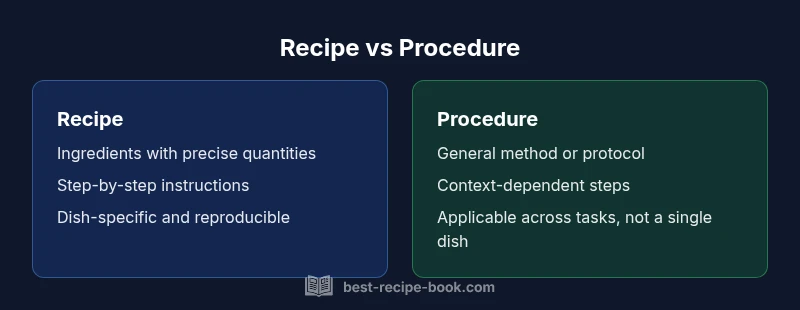
At a glance, the difference between recipe and procedure is that a recipe provides ingredients, measurements, and a complete set of steps to produce a dish, while a procedure describes a general method or series of steps used to perform a task in any context. For home cooks, recognizing this distinction helps you both follow directions precisely and adapt methods to new dishes. According to Best Recipe Book Editorial Team, this clarity improves cooking outcomes.
What is a recipe? Definitions and scope
A recipe is a portable, dish-specific set of instructions designed to produce a particular food item. It combines ingredients with precise quantities and a step-by-step sequence, often including prep times, cooking times, temperatures, and yield information. In many cookbooks, online guides, and family notebooks, a recipe functions as a complete package: it tells you what to gather, how much of each item you need, the exact order of actions, and how the finished dish should look or taste. The specificity of a recipe makes it easier to replicate results across similar contexts. When people discuss the difference between recipe and procedure, the recipe is typically the more concrete vehicle for execution, especially for beginners and when consistency matters. Best Recipe Book emphasizes that recipes prioritize reproducibility and taste outcomes.
In practice, a recipe is not just a list of ingredients; it is a designed experience that translates culinary knowledge into measurable steps, so a cook can reliably reproduce a dish. This includes notes on substitutions, equipment, and even plating ideas. The recipe’s scope is inherently culinary and dish-centered, even though the same principles can apply to non-food contexts where a fixed set of inputs and steps leads to a consistent result.
What is a procedure? Core concept and usage
A procedure is a method or series of steps intended to accomplish a task, but it is not limited to cooking. Procedures describe how to do something in a repeatable way, often focusing on the process rather than the final product. In kitchen terms, a procedure might outline how to blanch vegetables, how to temper chocolate, or how to sanitize utensils, independent of any specific dish. Outside the kitchen, procedures appear in manufacturing, laboratories, and information technology; they function as a protocol or standard operating method intended to produce consistent outcomes across different situations. The key idea is that a procedure emphasizes the process and the conditions required to achieve a result, not a single, fixed recipe. Best Recipe Book Editorial Team notes that procedures are the backbone of skill-building across domains.
Importantly, a procedure can be adapted and reused in multiple contexts. It is less about the final dish and more about the steps, checks, and sequence that ensure success. When you encounter a procedure in a non-food setting, you’ll see elements like checklists, safety notes, measurement intervals, and quality criteria that guide performers through the method regardless of the end product.
Historical context and etymology
The terms recipe and procedure have deep historical roots that shape how we think about instruction today. The word recipe derives from the Latin “recipere,” meaning to take or to receive, reflecting its role as a received instruction for food preparation. Early recipes were practical lists of ingredients and actions, often passed down orally before being codified in manuscripts. The term procedure comes from the Latin “procedere,” meaning to advance or proceed, underscoring its focus on the sequence of actions required to complete a task rather than the achievement of a specific dish. Over time, the culinary world fused these concepts into a spectrum: recipes that function like recipes, and procedure-like guidelines embedded in professional SOPs and protocols. In modern usage, the line between a recipe and a procedure can blur when recipes include methodical steps that resemble procedural instructions. Best Recipe Book highlights that understanding this lineage helps cooks and professionals design clearer instruction sets.
Key differences at a glance
- Primary purpose: Recipes aim to produce a specific dish; procedures aim to perform a task or achieve a result.
- Structure: Recipes combine ingredients, precise quantities, and steps; procedures emphasize process, order, and conditions without fixed ingredients.
- Scope: Recipes are dish-focused; procedures apply across domains, from cooking to manufacturing to science.
- Flexibility: Recipes lock in measurements to ensure reproducibility; procedures can be adapted to different inputs and contexts while preserving the method.
- Audience: Recipes target home cooks and food enthusiasts; procedures serve professionals, technicians, and teams needing repeatable workflows.
The difference between recipe and procedure centers on outcome versus method, specificity versus flexibility, and culinary versus multi-domain applicability.
How recipes are structured
A well-constructed recipe typically includes a title, yield (servings), equipment list, a clearly labeled ingredients section with precise quantities, step-by-step instructions, timing cues, temperature details, and notes or substitutions. Some recipes also offer troubleshooting tips, variation ideas, and plating suggestions. The order matters: ingredients are listed in the order they are added or used, and steps are sequenced to support efficient workflow and consistent results. Clear language, standardized units, and consistent terminology reduce misinterpretation. Writing a strong recipe also means including optional techniques, such as browning before simmering, and highlighting common mistakes. This structural clarity aligns with the overall concept of the difference between recipe and procedure: the recipe is about a finished dish and how to reach it exactly. Best Recipe Book’s guidance emphasizes readability, testability, and the ability to scale portions when needed.
How procedures are structured in various domains
Procedures in non-food domains follow a similar desire for repeatable outcomes, but their structure adapts to domain-specific needs. A laboratory protocol, for example, will list materials and instrument settings, then outline sequential steps with precise timings, safety checks, and data recording requirements. A manufacturing SOP describes the workflow, roles, QA checks, and exception handling. In software or IT, a procedure might detail how to deploy a system, run diagnostics, and log results. Across these domains, the core elements remain: purpose, prerequisites, step order, decision points, and verification criteria. As a result, a procedure emphasizes how to do something with exact sequence, conditions, and checks, whereas a recipe emphasizes what to produce and how to measure success. The distinction helps teams choose the appropriate instruction format for a given goal, whether in the kitchen or beyond.
Practical examples: cooking vs non-food contexts
Consider a recipe for classic chocolate chip cookies. It specifies ingredients like flour, sugar, butter, and chips, with precise quantities and bake time. The procedure for browning butter, by contrast, describes a method that could be adapted to many recipes and contexts: heat a pan, melt fat, monitor color and aroma, and stop at the right moment. Another example is a procedure for calibrating a kitchen thermometer: it outlines the steps to verify accuracy, the reference temperatures used, and how to record results, independent of any particular dish. By contrast, a recipe for a cake uses a specific formula—flour, sugar, leavening, eggs, and fat—in measured amounts to produce a distinct dessert. These illustrations demonstrate how the same fundamental ideas—order, method, and verification—appear in both concepts, yet are applied to different end goals. Best Recipe Book stresses that practice with both formats builds confidence in instruction design and execution.
Common misconceptions
A common misconception is that all procedures are recipes and all recipes are procedures. In truth, a recipe is not just a list of steps; it is a curated set of inputs and actions designed to yield a particular dish. Conversely, a procedure is not inherently tied to food; it is a method for performing a task in a consistent way. Another misconception is that recipes must be rigid and unalterable. Good recipes allow substitutions and scaling while maintaining the core technique. Finally, some people assume that procedures cannot include measurements. In many SOPs and lab protocols, precise quantities and conditions are essential to ensure reliability and safety. Understanding these nuances helps clarify the difference between recipe and procedure while supporting better instruction design across domains.
Comparison
| Feature | Recipe | Procedure |
|---|---|---|
| Primary purpose | Provide a complete dish with ingredients and steps | Describe a method or process (general) |
| Structure | Ingredients + measurements + steps | Steps or instructions without fixed ingredients |
| Scope | Dish-specific, cookbook-ready | Broad, applicable to non-food tasks |
| Flexibility | Fixed quantities; follow precisely | Can be adapted or generalized |
| Audience | Home cooks, recipes for meals | Any task requiring a method |
What's Good
- Promotes reproducible results and clear expectations
- Supports teaching and step-by-step execution in the kitchen
- Facilitates scaling recipes for more or fewer servings
- Provides a checklist-like clarity that reduces misinterpretation
Downsides
- Can be inflexible when improvisation is necessary
- Over-specification may stifle creativity or adaptation
- Misuse of a procedure as a substitute for a full recipe can lead to unsatisfactory outcomes
- Relying on a poor recipe can propagate errors if not tested
Recipes excel at delivering repeatable dishes; procedures excel at guiding the method across tasks.
Choose recipes when exact results matter and ingredients are fixed. Use procedures when you need a reliable method that applies across different contexts or goals.
People Also Ask
What is the difference between a recipe and a procedure?
A recipe provides ingredients, quantities, and specific steps to produce a dish, aiming for a repeatable result. A procedure describes a method or sequence of actions to accomplish a task, focusing on how to do it rather than what is produced. The two concepts share a goal of clarity, but their scope and emphasis differ.
A recipe tells you what to do to make a dish, including exact amounts. A procedure tells you how to do a task, focusing on the steps and conditions, not a specific dish.
Can a recipe exist without a procedure?
Yes. A recipe can stand alone as a complete set of instructions for a dish without detailing the underlying method as a separate procedure. However, well-designed recipes often imply a method that resembles a procedure for clarity and reproducibility.
Yes, a recipe can stand on its own, though it usually includes the method within its steps.
Can a procedure exist without a recipe?
Absolutely. Procedures are common in professional settings where the goal is to perform a task reliably, such as calibrating equipment or cleaning a workstation, without tying the steps to a specific dish.
Yes, procedures live in many fields—calibrate, assemble, or test things—without any recipe involved.
How should I structure a good recipe?
A good recipe should have a clear title, yield, ingredients with measurements, step-by-step instructions, timing guidance, and notes for substitutions or variations. Consistent terminology and units help prevent confusion and ensure reproducibility.
Make sure your recipe lists ingredients in order of use, includes clear steps, and adds tips for substitutions.
How should I structure a good procedure?
A good procedure includes purpose, prerequisites, a step-by-step sequence, decision points, safety notes, and verification criteria. It should be adaptable, with clear conditions and checklists to ensure consistent results across contexts.
Outline the goal, list steps in order, add safety notes and checks, and include how to verify success.
Are recipes and procedures used outside cooking?
Yes. The same principles apply in many domains: a recipe-like document for a dish and a procedure for tasks in manufacturing, labs, or IT. Each serves its domain by clarifying inputs, steps, and criteria for success.
They show up in labs, factories, or IT—anywhere you need clear, repeatable instructions.
Key Takeaways
- Choose recipes for consistent dish outcomes
- Use procedures to standardize methods across tasks
- Structure matters: ingredients+steps vs steps+conditions
- Test and iterate recipes to ensure reliability
- Document safety and quality checks in procedural guidelines