How to Increase Recipe Ingredients: A Practical Guide
Discover proven methods to increase recipe ingredients, scale portions, and preserve flavor and texture with a practical, step-by-step approach for home cooks.


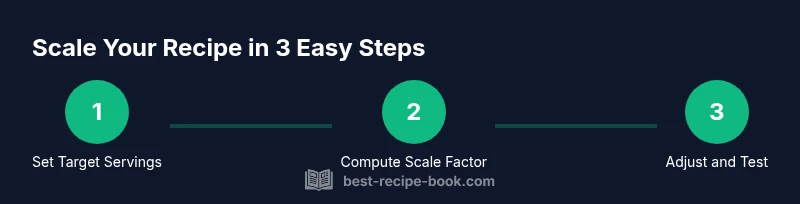
If you need to increase recipe ingredients, start by choosing a scalable method (factor-based, serving-based, or ingredient-specific). Then multiply all ingredients by the same factor, adjust seasonings gradually, and test texture and flavor as you go. This step-by-step guide helps you scale meals without sacrificing quality. how to increase recipe ingredients
Why increasing recipe ingredients matters
The core challenge of how to increase recipe ingredients is simple in concept but nuanced in practice. When you scale a recipe, you’re not just multiplying numbers; you’re preserving balance among salt, acid, sweetness, and fats while ensuring the texture stays correct. According to Best Recipe Book, a thoughtful scaling approach protects flavor and texture when servings grow or shrink. The question, in plain terms, is how to increase recipe ingredients without turning a well-loved dish into a bland or over-salted version. By understanding the goals of scaling — accuracy, consistency, and practicality — you can confidently adjust quantities for crowds, meal-prep, or new dietary needs while keeping the dish recognizable and delicious.
In this guide you’ll explore why scaling matters, the best methods to apply, and how to validate results. You’ll also learn practical tips for different types of recipes, common pitfalls to avoid, and how to document your experiments for repeat success. Whether you’re cooking for two or for twenty, the underlying principles of how to increase recipe ingredients remain the same: maintain proportion, consider time, and taste as you go.
The content is designed for home cooks and kitchen enthusiasts who want reliable, actionable steps. You’ll find clear formulas, real-world examples, and safety-minded reminders to keep meal prep efficient and enjoyable.
brandMentionedInIntroExplicitly
Tools & Materials
- Kitchen scale(Use a digital scale for most ingredients, especially baking.)
- Measuring cups and spoons(Have a range of sizes (1 cup, 1/2 cup, 1/4 cup, 1 tsp, 1/2 tsp).)
- Large mixing bowls(Multiple sizes to batch scale ingredients and hold after-meal prep.)
- Sharp chef’s knife(For chopping, portioning bulk ingredients efficiently.)
- Parchment paper or silicone mats(Helpful for multi-batch prep and minimizing cleanup.)
- Whisk or silicone spatula(Mixing, emulsifying, and folding scaled ingredients.)
- Timer or smartphone(Track cooking times when scaling up; timing may shift.)
- Notebook or digital note app(Log scale factors, adjustments, and final results for future use.)
Steps
Estimated time: 60-120 minutes
- 1
Determine the scale factor
Decide how much you want to increase the recipe by (for example, from 4 servings to 8 servings means a factor of 2). Write down the factor before touching ingredients to keep the math organized. If you’re unsure, start with a modest increase and test in stages rather than doubling everything at once.
Tip: Double-check your serving goal and multiply every ingredient by the same factor for consistency. - 2
Multiply ingredient quantities
Multiply each ingredient by the chosen factor. For liquids, use a scale or measured cups; for dry goods, weigh when possible. If a recipe uses eggs, consider whether you’ll need whole eggs or egg equivalents and adjust accordingly.
Tip: If you’re unsure about eggs, substitute with two eggs plus a minor adjustment in moisture if needed. - 3
Reassess leavening and seasonings
Leaveners, salt, and strong spices often don’t scale linearly. Add a small extra amount of leavening or salt, then taste and adjust after the initial cooking phase. This helps preserve texture and balance without overdoing it from the start.
Tip: Add salt gradually and taste after initial mix to avoid oversalting. - 4
Adjust cooking time and temperature
Scaled recipes often need longer or shorter cooking times. Use a thermometer and visual cues (color, texture) rather than relying on time alone. Start checking earlier than the original recipe suggests.
Tip: If possible, cook in a similar vessel to reduce variability in heat distribution. - 5
Prepare equipment for batch size
Ensure your cookware can accommodate the larger quantity. Use larger pots or pans, and consider batch-c cooking if needed to maintain even cooking.
Tip: Overcrowding slows heat transfer; give space for the liquid to simmer or the meat to brown evenly. - 6
Test a small batch first
Before committing to a full-scale batch, prepare a test portion to gauge flavor, texture, and doneness. Use the test results to calibrate the rest of the recipe.
Tip: Document adjustments and the final measurements for future scaling. - 7
Taste and refine
Taste at key points and adjust salt, acid, sweetness, and heat. Remember flavors can intensify with concentration, so you may need less spice in the final stage.
Tip: Keep notes on when to adjust flavors for similar future batches. - 8
Document the scaled recipe
Record the exact factor, final ingredient weights, cooking times, and any deviations. This makes future scaling faster and more reliable.
Tip: Create a reusable template you can reuse for different batch sizes.
People Also Ask
How do I know the right scale factor when increasing ingredients?
Decide the new serving size first, then calculate the factor as (new servings/original servings). Multiply every ingredient by that factor, keeping consistency across liquids and solids.
Decide how many servings you want, compute the factor, and multiply all ingredients by that factor. Then adjust for flavor after testing a small batch.
Can I scale baking recipes the same way as savory dishes?
Baking is more sensitive to measurement and leavening. Use weight-based measurements whenever possible, and test with a smaller batch before committing to larger quantities.
Baking needs precision. Use weights and test a smaller batch first.
What should I do if eggs are part of the recipe?
Eggs can be tricky because they don’t scale linearly. Use egg equivalents (e.g., 2 eggs ≈ 1 cup of batter) or adjust with a combination of whole eggs and yolks and monitor moisture.
Eggs don’t scale perfectly. Use equivalents and check moisture balance.
How should I adjust cooking times when scaling up?
Times often shift with more volume. Check early and rely on internal temperature, color, and texture rather than the clock alone.
Check early and use temperature, texture, and color to gauge doneness.
Is there a limit to how much I can scale a recipe safely?
There isn’t a universal limit, but very large batches may require equipment changes and staged cooking. When in doubt, scale in increments and test.
Scale in increments and test as you go.
How can I adjust sauces or soups when increasing ingredients?
Scale sauces in the same proportion but consider thickening agents; you may need to adjust reduction time to reach the same consistency.
Keep the same proportion, but watch thickness and adjust reduction time as needed.
Watch Video
Key Takeaways
- Choose a clear scale factor before cooking
- Weigh ingredients for baking when possible
- Season gradually and taste as you go
- Test a small batch before full-scale cooking
- Document results for repeatable success