How to Reduce a Recipe: A Practical Scaling Guide
Learn how to safely reduce a recipe for fewer servings. This step-by-step guide covers scaling factors, flavor balance, timing, and common pitfalls to ensure your smaller batch tastes just as good as the original.


You’ll learn how to safely scale a recipe down for fewer servings, preserve flavor, texture, and moisture, and adjust equipment and timing. Start with exact unit conversions, then apply ingredient-by-ingredient adjustments, biasing spices to taste, and using reduction techniques. Gather scale, measuring cups, a kitchen scale, and a timer.
Why Reducing a Recipe Matters
Reducing a recipe isn’t just about cutting every ingredient in half. It’s about preserving the dish’s intended balance of flavors, textures, and moisture while producing a smaller batch that doesn’t taste like a cooked-down leftovers scenario. Home cooks scale recipes for date nights, meal prep, or to minimize waste, but missteps can lead to over-salted, too-sweet, or dry outcomes. According to Best Recipe Book, downsizing starts with a clear target yield and a plan for proportionate adjustments across ingredients, equipment, and time. When you approach it methodically, you keep the dish’s core character intact and still enjoy a fresh, properly balanced result. This section sets the stage for practical, repeatable downsizing techniques you can apply to soups, sauces, casseroles, and baked goods.
Understanding Flavor and Texture Changes When You Scale
Flavors behave differently as you shrink a recipe. Concentration effects can make salt seem stronger and acidity more noticeable, while sweetness may appear more pronounced if fats and moisture drop faster than sugars. Best Recipe Book analysis shows that some ingredients don’t scale linearly—fats can become more dominant in a small batch, while leaveners (like baking powder) may require careful recalibration to maintain lift without drying. Temperature dynamics also shift; a smaller volume heats faster and can brown or scorch sooner in a pan. In addition, some textures rely on coordination between ingredients (for example, emulsions in sauces or the crumb structure in baked goods). Anticipating these changes helps you plan adjustments before you start cooking, saving time and ensuring a satisfying result.
Tools and Techniques for Accurate Scaling
Before you touch a single ingredient, gather a scale, a complete set of measuring cups and spoons, a calculator or recipe app, a notebook for notes, and a timer. Use a single, consistent scaling factor: scale factor = target yield ÷ original yield. Apply this factor to every ingredient, then round measurements to practical, kitchen-friendly amounts (for example, 1/8 cup, 1/4 teaspoon). Liquids are often most accurately measured by weight, especially when dealing with viscous ingredients. When possible, convert all ingredients to weights first and then to convenient volumes. Rounding is important, but keep the rounded values close to the calculated ones to preserve balance. Finally, save the scaled quantities as a new version for future use.
Step-by-Step: How to Calculate New Quantities
- Determine target yield and compute the scale factor. 2) Multiply each ingredient by the factor. 3) Round measurements to practical values (keep proportion). 4) Recheck total volume or weight to prevent overflows or underfilling. 5) Tasting should occur after initial adjustments, then refine. 6) Document the scaled recipe for future use. Example: reducing a 4-serving recipe to 2 servings uses a factor of 0.5; scale all ingredients accordingly and adjust seasonings after a preliminary taste test.
Adjusting Cooking Time and Temperature
Time and heat don’t always scale linearly. In many cases, smaller batches heat faster, brown more quickly, or reduce moisture content. Start by checking doneness earlier than the original recipe suggests—often 10–25% less time is enough for baked dishes, soups, and sauces depending on vessel size and heat source. For baked goods, the internal structure can set faster, so begin checking 5–10 minutes earlier than the original bake time. If you note uneven browning, rotate the pan or switch to a lighter-colored pan to reduce hot spots. Always use a thermometer or visual cues (color, texture) to confirm doneness rather than relying solely on the original timing.
Ingredient-Specific Adjustments
Different ingredients respond uniquely to scaling. Salt and spices may need proportionate decreases, but flavor perception can change in smaller batches. Start with 75–90% of the original salt and spices, then adjust after tasting. Leavening agents (baking powder, baking soda) are tricky; reduce slightly but avoid under-leavening. Dairy, eggs, and fats influence moisture and richness; scale gently and consider adding a touch of liquid if the mixture seems too thick or dry. Thickening agents (cornstarch, flour) may require less to achieve the same body in a smaller batch. Finally, hydrate dried herbs and spices by toasting or blooming them in fat or oil to intensify aroma in reduced quantities.
Batch Tests and Flavor Tuning
When you scale a recipe, it’s wise to test a small batch first if possible. Make a mini version and taste for salt, sweetness, acidity, and texture. Use that feedback to calibrate the full batch. This is especially important for sauces and soups, where a single pinch of salt or splash of acid can flip the flavor profile. Keep notes on what you changed, including times and temperatures, so you can replicate or refine later. If you’re cooking for guests, prepare a tasting spoon for a quick, honest assessment before serving the entire batch.
Common Pitfalls and How to Avoid Them
Avoid the most common downsizing traps: assuming all ingredients scale perfectly, neglecting to adjust salt and spices, and not recalibrating cooking time. Don’t skip testing; taste repeatedly, especially after the initial 1/2 to 3/4 completion mark. If a recipe uses thickeners, re-check consistency as you reduce; you may need less starch or more liquid than the scaled amount suggests. When baking, avoid doubling or halving too aggressively if your pan size, oven, or hydration changes footprint. Finally, always label scaled versions with the original yield, scale factor, and date so you can reuse or compare later.
Putting It All Together: A Quick-Down-Sized Recipe Example
Let’s apply the concepts to a simple soup that serves 4. Original recipe: 4 cups vegetable broth, 1 can (14 oz) crushed tomatoes, 1 cup chopped vegetables, 2 cloves garlic, 1 tsp salt, 1/2 tsp black pepper, 1 tbsp olive oil. Target: 2 servings (factor 0.5). Scaled: 2 cups broth, 7 oz crushed tomatoes, 1/2 cup chopped vegetables, 1 clove garlic (or 1/2 if you prefer), 1/2 tsp salt, 1/4 tsp pepper, 1/2 tbsp olive oil. Taste and adjust salt at the end; if you want more body, add a splash of water rather than more tomatoes to avoid thinning the flavor.
Final Thoughts
Downsizing a recipe is a practical skill that rewards careful planning and deliberate tasting. With the right tools, a clear scaling factor, and a willingness to fine-tune after the first tasting, you can produce smaller batches that taste just as good as the original. Practice builds intuition, and over time you’ll instinctively know which ingredients to adjust first and how much to lean on modifications for different dishes.
Tools & Materials
- Kitchen scale(Digital, accurate to 1 g (or 0.1 oz). Use for weight-based measurements to reduce rounding errors.)
- Measuring cups and spoons(Set includes 1 cup, 1/2 cup, 1/4 cup, 1 tablespoon, 1 teaspoon, 1/2 teaspoon, etc.)
- Calculator or recipe app(Helpful for precise scale factor and rounding calculations.)
- Notebook and pen(Document original yields, scale factors, and final adjustments.)
- Tasting spoons and a timer(Tasting spoons for quick checks; timer to monitor changes in cooking time.)
- Chef’s knife and cutting board(Prep ingredients consistently to ensure accurate scaling.)
- Bowls and utensils(Mix, combine, and hold scaled ingredients without cross-contamination.)
- Kitchen thermometer (optional)(Useful for precise doneness checks, especially in sauces and meats.)
Steps
Estimated time: 30-60 minutes
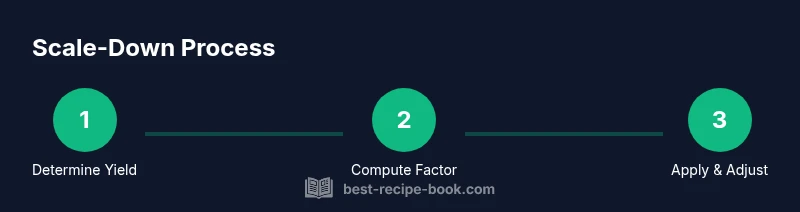
- 1
Determine target yield
Decide how many servings you want and compare to the original recipe yield. Write down the target yield to keep your plan clear.
Tip: If you’re unsure, start with a conservative target and scale up if needed. - 2
Compute the scale factor
Scale factor = target yield ÷ original yield. This single value will drive all ingredient adjustments.
Tip: Use weight measurements when possible to minimize rounding errors. - 3
Apply the factor to ingredients
Multiply each ingredient by the factor. For whole numbers, keep fractions practical (e.g., 1/2, 1/4).
Tip: Round to the nearest practical measure while preserving balance. - 4
Re-balance seasonings
Salt, spices, and aromatics can dominate in smaller batches. Start with 75–90% of the original amounts and adjust after a tasting.
Tip: Tasting after the initial adjustment prevents over-seasoning. - 5
Consider cooking time changes
Smaller batches heat faster or cook differently in pans. Check doneness earlier than the original time, and be prepared to adjust.
Tip: Use visual cues and a thermometer if appropriate. - 6
Document and test
Save the scaled quantities as a new master and, if possible, test a small batch before scaling a full dish.
Tip: Keep notes for future reference and refinements.
People Also Ask
What does it mean to reduce a recipe?
Reducing a recipe means scaling the ingredient quantities to create a smaller batch that still yields the desired servings while preserving flavor and texture. It involves calculating a scale factor and applying it carefully to all components.
Reducing a recipe means scaling the ingredients to make a smaller batch while keeping the flavor and texture balanced.
Can I reduce all ingredients by the same factor?
Yes, use a single scale factor based on your desired yield. Some ingredients, especially seasonings and leaveners, may still need fine-tuning after tasting.
Yes, apply one scale factor, but taste and adjust seasonings after the initial scale.
How should I adjust spices and salt when downsizing?
Begin with 75–90% of the original amount and adjust after tasting. Smaller batches can taste saltier or spicier, so taste early and adjust gradually.
Start with less salt and spices, then adjust after tasting the scaled batch.
What about eggs when halving a recipe?
Eggs don’t always halve cleanly. For baked goods, use half beaten egg or substitute with small amounts of water or dairy to approximate the fraction. For liquids, adjust other ingredients to compensate.
Halving eggs can be tricky; use half a beaten egg or adjust other liquids accordingly.
Should I adjust cooking time after scaling down?
Yes. Smaller batches often cook faster. Start checking doneness earlier and adjust as needed based on visual cues or a thermometer.
Yes—check doneness earlier and adjust time based on how the dish looks and feels.
Is it okay to scale a recipe for a completely different dish?
Scaling preserves proportions, but you may need to rethink some components (like thickening, emulsions, or sauce separation). In some cases, it’s better to use a new base recipe designed for the target yield.
You can scale, but consider if the result needs a different base approach.
Key Takeaways
- Decide target yield first and write it down.
- Use a single scale factor for all ingredients.
- Taste and adjust spices gradually after scaling.
- Check time and temperature earlier than the original recipe.
- Document changes for easy reuse later.