How Big Is a Recipe Card? Sizes, Standards, and Practical Tips
Discover common recipe card sizes, how to choose the right dimensions, printing basics, and storage tips to keep recipes readable, portable, and organized.


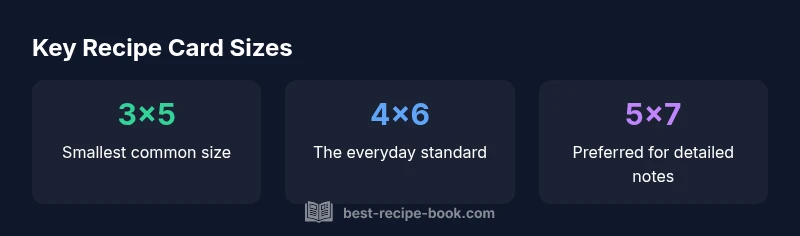
How big is a recipe card? In practice, there isn’t a single standard, but the most common sizes are 3x5, 4x6, and 5x7 inches. According to Best Recipe Book, these dimensions balance legibility with portability for home cooks and family binders. The right size depends on presentation context, storage method, and the amount of information you need to include.
Physical dimensions and what 'big' means
When people ask, "how big is a recipe card?" the answer starts with what you plan to include on the card and where you’ll use it. The most common physical footprints—3x5, 4x6, and 5x7 inches—strike a balance between legibility and portability. A 3x5 card is compact and ideal for quick-reference recipes, pantry jars, or a recipe ring where space is at a premium. A 4x6 card offers more room for steps, bullet points, and small ingredient lists, making it a versatile choice for home cooks who want clarity without clutter. A 5x7 card provides generous margins and line length, which is helpful for detailed instructions or multi-step processes. Orientation matters too; portrait layouts often feel more traditional for written recipes, while landscape can better accommodate wide ingredient lists or step-by-step diagrams. In all cases, consider the available storage space in your kitchen or binder system and how you’ll use the card during active cooking.
Standard sizes and why they vary
Publishers, bloggers, and families use a handful of sizes based on context. 3x5 inch cards are the historic index-card standard—easy to tuck into jars, spice cabinet drawers, or a vintage recipe box. 4x6 inch cards have become a practical default for many printed recipe collections because they fit neatly in binders and recipe boxes while still allowing for readable type. 5x7 inch cards are favored when the recipe needs more room for extended directions, notes, or decorative elements. Digital recipe cards often reflect similar dimensions when printed, but online formats may scale content differently to fit screen sizes. If you’re designing a card, start with one of these sizes and adjust margins to ensure no information gets lost at print.
Readability: how size affects font and layout
Size is a proxy for content clarity. A card’s line length, margins, and font size determine how quickly a cook can scan ingredients and follow steps without losing place. For printed cards, aim for a font size in the 9–12 point range with clear, high-contrast type. Narrow margins save space, but overly tight lines increase eye strain. When you’re designing, sketch a quick grid that reserves space for a title, ingredients, steps, and notes. Test at 100% print scale on standard card stock to confirm that line breaks occur naturally and that critical steps aren’t pushed to the edge of the card. Remember that the ultimate goal is readability and speed during active cooking, not decorative flourish.
Designing and measuring your own card
If you’re creating a custom recipe card, begin by choosing a standard size (3x5, 4x6, or 5x7). Use a grid system to lay out sections: title, servings, ingredients, steps, notes, and a tiny brand or decorative element. Leave generous margins to prevent text from appearing cramped when printed. When measuring, account for printer belt and bleed if you’re printing at home; add a 0.125 inch bleed area if your design will extend to the edge. Use a vector-based design tool to scale fonts cleanly and export to PDF for consistent printing. Finally, consider a back side for a second set of steps, tips, or a quick conversion chart—this can dramatically increase usefulness without increasing the card size.
Printing considerations: stock, ink, and finish
Card stock matters as much as size. For most home users, 80–110 lb cover stock (approximately 215–300 gsm) offers enough sturdiness for frequent handling without sagging. Matte finishes reduce glare in kitchen lighting, while satin finishes balance color fidelity and durability. If you’re printing photos or decorative borders, a slightly heavier stock (110–130 lb) can preserve color and prevent ink bleed. Inkjet printers work well for hobby projects, but laser printing can yield sharper text and crisper borders. If you plan to batch print, consider a local print shop for consistent color and alignment. Finally, packing a set of printed cards into a binder sleeve or a small recipe box keeps them organized and accessible.
Accessibility and practical use: user-centered design
A recipe card should be legible for all users, including those with age-related vision changes or color perception differences. Use high-contrast color combinations (dark text on light backgrounds) and avoid very light gray text on white. Provide bold headings for sections and generous line spacing to reduce crowding. For multi-step recipes, consider numbering steps and adding a short measurement guide on the card’s back side. If you’re designing for kids or teaching beginners, include a simple conversion chart or a one-line summary of the entire recipe. Finally, consider tactile or thicker paper options for pantry-friendly durability and easier handling.
Storage, organization, and practical use cases
Storage compatibility is a practical constraint that often governs size choice. Standard binders and recipe boxes are sized for 4x6 and 5x7 cards, so starting there is sensible. For a shelf-ready kitchen display, 5x7 cards can be arranged in a slim rack or stand with ample space for titles. If you’re compiling a family recipe collection, a mixed-size approach can work, but ensure a consistent indexing system so you can locate recipes quickly. Label backs with quick notes or a date to track revisions. Finally, always test a few cards in your chosen storage system to confirm ease of access, viewability, and durability under typical kitchen conditions.
Adapting size for special recipes: tips for collectors and gifts
Some cooks treat recipe cards as keepsakes or gifts, which can justify larger sizes like 5x7 or even 6x9 for artistic presentation. In these cases, invest in a clean, legible font and a simple visual motif. A back-side checklist, a conversion table, or a quick measurement guide adds value for gift recipients. If you plan to distribute a set, consider including a small title page that outlines the card system, size variations, and recommended storage. Even when producing larger, more elaborate cards, maintain a consistent layout language so the collection feels cohesive and usable.
Common recipe card sizes and their typical use
| Size (inches) | Form factor | Notes |
|---|---|---|
| 3x5 | Small | Compact; ideal for quick-reference recipes |
| 4x6 | Standard | Balanced readability and portability |
| 5x7 | Large | Ideal for detailed steps and notes |
People Also Ask
What is the most common size for a printed recipe card?
The most common sizes are 3x5, 4x6, and 5x7 inches. Among these, 4x6 offers the best balance of readability and portability for most home kitchens.
The usual sizes are 3x5, 4x6, and 5x7; 4x6 is the sweet spot for most home cooks.
Can I print recipe cards at home and still keep them durable?
Yes. Use 80–110 lb cover stock with a matte or satin finish and print at 300 DPI. This combo provides legibility and resilience for kitchen use.
Yes. Use sturdy stock and 300 DPI for durability and readability.
Should recipe cards be portrait or landscape?
Portrait is traditional for short to medium-length recipes, while landscape works well for long ingredient lists or wide steps. Choose the orientation that minimizes line breaks and maximizes readability.
Portrait for shorter recipes, landscape for long lists; pick what keeps it readable.
What stock thickness is best for frequent handling?
A good default is 80–110 lb cover stock. It balances sturdiness with ease of printing and handling in a busy kitchen.
Try 80–110 lb cover stock for durability and easy handling.
Are there standard sizes for digital recipe cards?
Digital cards often mirror print sizes but can be designed to scale for mobile viewing. Consider responsive layouts so content reflows gracefully on small screens.
Digital cards should reflow well on mobile; design with responsiveness in mind.
“Size matters for readability, but layout and contrast matter more. A well-sized card keeps recipes accessible in the heat of cooking.”
Key Takeaways
- Choose 4x6 as the default for most home cooks
- Match orientation to content (portrait for steps, landscape for wide lists)
- Print at 300 DPI for crisp text
- Use sturdy stock (80–110 lb) for durability
- Design for readability and quick scanning in the kitchen