What Size Are Recipe Boxes? A Practical Guide for Home Cooks
Learn what size recipe boxes typically come in, how to choose the right card size, and practical tips for organizing your kitchen notes with durable materials and flexible dividers.


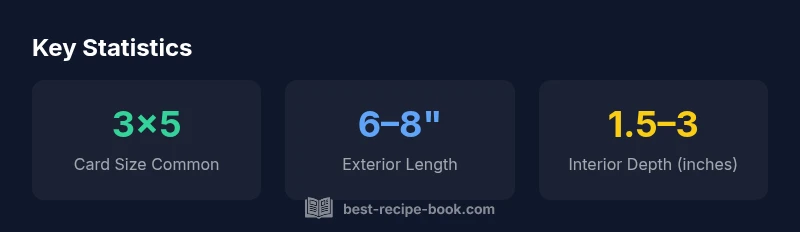
What size are recipe boxes? Real-world options vary, but most recipe boxes are designed to hold standard recipe cards. Expect holders for 3x5 and 4x6 inch cards, with exterior boxes typically in the 6–8 inch length range and 2–4 inch depth. If you store larger notes or plan for future expansion, look for adjustable dividers.
What sizes do recipe boxes support?\n\nWhen you start shopping for a recipe box, the first question is often what size are recipe boxes. In practice, you will find boxes built to hold common recipe card formats, with the most popular sizes being 3x5 inches and 4x6 inches. The exterior dimensions vary, but many boxes are designed to accommodate these cards with a little headroom. For home cooks, this means you can store a large binder of recipes without buying an oversized container. If you keep notes on larger sheets or specialty cards, look for boxes with slightly longer exterior dimensions or configurable dividers. Finally, assess whether you need vertical or horizontal card orientation; most boxes support both, but the insertion angle and lid clearance can matter for usability.
Card sizes you will encounter: 3x5, 4x6, and beyond
The three most common card sizes are 3x5, 4x6, and 5x7 inches. 3x5 cards are compact, affordable, and fit into many compact desk or wall-mounted organizers. 4x6 cards are the industry standard for most printed recipe cards and fit comfortably in mid-sized boxes. 5x7 cards are used for larger notes or occasional printed sheets and require longer boxes and deeper interiors. In practice, many recipe boxes are built with flexible interiors or adjustable dividers to accommodate both 3x5 and 4x6 and sometimes 5x7. If you plan to print your own cards, verify the maximum card width and height a box can accept before purchase. Finally, consider whether you want portrait versus landscape orientation, as it can influence how you file and retrieve recipes.
Exterior dimensions and capacity: fits and limits
Exterior dimensions are what you see on the box’s product page, but they don’t tell the full story of capacity. Boxes marketed as 6 to 8 inches long typically hold 3x5 or 4x6 cards with adequate spacing, while deeper boxes (2 to 3 inches) can hold larger stacks or thicker cards. The lid clearance matters: some designs require extra space to avoid cramping when you slide cards in and out. For most home kitchens, a mid-sized box around 7 inches long, 3 inches tall, and 2 inches deep offers a good balance of capacity and shelf fit. If you expect to add more cards over time, choose a box with expandable or adjustable features. Finally, verify whether the box includes a base tray or a simple pocket layout; trays can improve organization, especially for categories like appetizers, mains, and desserts.
Adjustable dividers and customization options
Dividers are the unsung heroes of recipe storage. Boxes with adjustable dividers let you segment cards by category, cuisine, or cookbook source, which speeds retrieval and reduces clutter. Look for dividers with labeled tabs or the ability to reposition with simple slots. Some boxes offer sliding or removable panels to accommodate both 3x5 and 4x6 cards without forcing you to shuffle. If you mostly store printed 4x6 cards, a more rigid interior may suffice; if you hoard notes and hand-written recipes, go for flexibility. In any case, confirm the number of adjustable sections and whether you can reconfigure the layout as your collection grows.
Materials and durability: wood, acrylic, cardboard
Box material strongly impacts durability, weight, and aesthetics in a kitchen. Wooden boxes are sturdy and timeless, good for shelf display. Acrylic boxes offer a clean, modern look and are easy to wipe clean, though they can be prone to scratches. Hard cardboard counterparts are lightweight and cost-effective but may wear more quickly with frequent card insertion. If your recipes travel between kitchen and pantry, choose a material that resists moisture and staining, and consider a sealant or finish for longevity. Finally, assess whether the interior finish is smooth to prevent card edges from curling; a slick interior helps your cards slide in and out with minimal friction.
Measuring for compatibility: step-by-step
To ensure a box will actually fit your cards, measure the width and height of a standard card you will use, including any corner rounding. Compare these dimensions to the box’s inner cavity, not just the exterior dimensions. If you expect to use sleeves or protective covers, factor their thickness into your calculations. For mixed card sizes, prioritize the smallest common dimension (width) and verify that the box supports the larger dimension reasonably. Always check product specifications for lid clearance and interior depth. If in doubt, contact the retailer’s support team for precise fit guidance.
Practical storage layouts for different kitchens
Think about your kitchen layout when choosing a recipe box. In a small apartment, a compact, vertical box on a cabinet door keeps counters clear. In a larger kitchen, a wider box with removable dividers can live on a pantry shelf or within a drawer. Consider labeling the box’s exterior with a quick index (e.g., Soup, Pasta, Desserts) to speed up retrieval. If you use a single box across multiple family members, color-code or tag the divider sections and cards to avoid confusion. For households that collect many printed recipe cards, a modular approach several smaller boxes grouped by cuisine can be more efficient than one oversized box.
Maintenance and care to extend lifespan
To keep your recipe boxes looking good and functioning well, wipe interiors with a damp cloth to remove dust and residue from spills. Avoid storing in areas with high humidity, which can encourage warping or moisture damage. If you have a wooden box, consider a light wax or oil finish to maintain the surface; a regular, gentle cleaning schedule helps prevent staining. For acrylic boxes, avoid abrasive cleaners that scratch the surface; use a soft microfiber cloth. Finally, when cards start to show wear, consider replacing frayed cards or investing in sleeves to protect original notes while preserving access.
Matching recipe card sizes with box dimensions
| Card Size | Exterior Length | Interior Depth | Notes |
|---|---|---|---|
| 3x5 | 6-7 inches | 1.5-2 inches | Fits common 3x5 cards |
| 4x6 | 7-8 inches | 1.8-3 inches | Widely used standard |
| 5x7 | 9-10 inches | 2-3 inches | For larger notes |
People Also Ask
What is the most common box size for recipe cards?
The most common box size holds 3x5 or 4x6 cards and exterior lengths around 6–8 inches. Sizes vary by brand, so check interior dimensions.
Most boxes fit 3x5 or 4x6 cards.
Can recipe boxes hold 5x7 cards?
Yes, some boxes are designed for 5x7 cards, but they are less common and require longer exteriors.
Some boxes fit 5x7 cards, but check size.
Do I need adjustable dividers?
Adjustable dividers help adapt to different card sizes and future expansion. They improve organization.
Dividers help a lot for flexibility.
What materials are best for long-term storage?
Durable options include wood, hard plastic, and acrylic; avoid flimsy cardboard for frequent use.
Durable materials last longer.
How should I measure for compatibility?
Measure card width and height, then compare to box inner dimensions and consider sleeves.
Measure width and height; compare to inner box size.
Are there compact boxes for small kitchens?
Yes, many compact boxes exist with slimmer exterior dims, suitable for tight spaces.
There are compact options for small spaces.
“Choosing the right size is about compatibility with your cards and your storage space. A well-matched box keeps recipes accessible and reduces clutter.”
Key Takeaways
- Measure your cards before buying.
- Choose a box with adjustable dividers for flexibility.
- Consider exterior dimensions to fit your shelf.
- Prioritize durability based on material and usage.
- Label or color-code dividers for quick access.