What Size Are Recipe Books? A Practical Guide
Explore common recipe book sizes from pocket-friendly 4x6 inches to large 8.5x11 formats. Learn how to choose the right size for readability, layout, and printing, with practical tips for home cooks and designers.


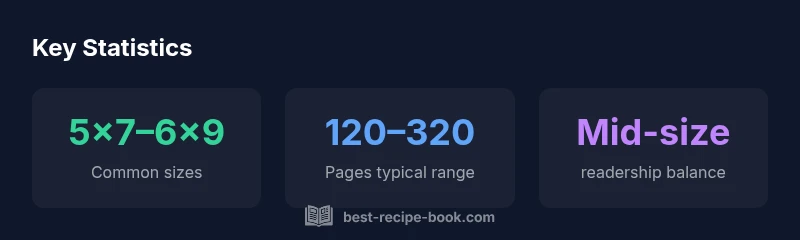
Most recipe books fall into compact to standard sizes, typically 5x7 to 6x9 inches, with a few larger formats like 8.5x11 used for big layout recipes. For home cooks, this mid-range size offers portability without sacrificing legibility, while smaller sizes save space and larger sizes improve readability for detailed steps.
Understanding typical sizes and terminology
If you ask what size are recipe books, you’ll notice several standard formats that dominate shelves and digital catalogs. The answer isn’t universal, but certain sizes repeatedly appear because they balance legibility, portability, and cost. In this section we outline the most common formats and the language used to describe them, including inches and millimeters. For home cooks, the sweet spot is often a mid-size format that fits on a kitchen shelf while still offering a comfortable reading experience. This middle ground supports multi-step recipes, photo-rich layouts, and clear ingredient lists without becoming unwieldy in a small kitchen.
Common sizes and their practical implications
To translate size into usability, consider how space, type, and imagery interact on the page. Compact sizes around 4x6 to 5x7 inches excel for quick reference and portability, but can limit recipe steps and image captions. Standard trade sizes of roughly 5x7 to 6x9 inches strike a balance between legibility and portability, making them ideal for most home cooks who want readable fonts, adequate margins, and room for photos. Large formats such as 8.5x11 inches and beyond are best for heavily photographed books or layouts that emphasize step-by-step visuals. Specialty sizes—square or landscape—can suit collections or magazines-style layouts but may complicate printing and shelving.
Regional and market variations
Regional norms influence your choice. In the United States, sizes are usually described in inches (for example, 5x7, 6x9, 8.5x11). In Europe and many other regions, A-series formats (A5, A4) and metric measurements are common, with A5 roughly 5.8x8.3 inches and A4 about 8.3x11.7 inches. If you’re targeting multiple markets, you might offer a mid-range size that translates well across regions or provide dual-format editions. Understanding your distribution channels helps prevent mismatches at print houses and in retailers.
How size affects readability and layout
Page size sets the grid, margins, and line length for every recipe. A comfortable body-text line length is typically around 45–75 characters per line, which guides font size choices. Larger formats allow bigger type, more generous margins, and spacious image crops, improving legibility but increasing weight and cost. Smaller formats save space and paper but demand tighter type and careful wrapping. When recipes include several steps, check that line breaks and bullet points stay readable across formats.
Book bindery options and spine considerations
Size interacts with binding options and spine width. Paperback and softcover formats are more forgiving with mid-range sizes, while hardcover editions favor sturdier construction and heavier stock. As page counts rise, spine width grows, which can affect bookshelf fit and display. If you anticipate a lot of pages, you may opt for a slightly larger format to keep typography clean and images legible. Always confirm binding feasibility with your printer before finalizing trim size.
Digital vs print: When size matters
Digital editions don’t lock to a single print size; e-readers and apps scale the content to device screens. Print formats, however, are fixed. For a book that exists in both formats, coordinate trim sizes and typography so that the reading experience feels consistent across print and digital versions. This reduces reader friction when switching between formats and helps preserve the intended layout and image impact.
How to communicate size choices with designers and printers
Provide a precise spec sheet that includes trim size, bleed, safe margins, gutter, binding method, and recommended paper weight. Request proofs and conduct a quick check on a sample recipe page to verify image clarity and text readability. Discuss potential variants (e.g., a compact edition for gift markets or a large-format edition for photography-heavy books) and align all teams early to avoid costly reprints.
Quick checklist for sizing your own cookbook project
- Define target format (compact, mid-size, or large). 2) List required elements (photos, charts) and estimate page counts. 3) Choose trim size with shelf space and weight in mind. 4) Plan margins, bleed, and gutter; confirm binding method. 5) Obtain proofs from the printer and adjust accordingly. 6) Ensure digital layouts align with print dimensions for a cohesive reader experience.
Common cookbook sizes and their trade-offs
| Aspect | Typical sizes | Notes |
|---|---|---|
| Compact/pocket | 4x6 in – 5x7 in | Ultra-portable; limited layout space |
| Standard hardcover/paperback | 5x7 in – 6x9 in | Balanced readability and weight |
| Large format | 8.5x11 in or larger | Ideal for photos and wide margins |
People Also Ask
What is the most common size for recipe books?
The most common size is a mid-range format, typically 5x7 to 6x9 inches. This range balances readability with portability, making it suitable for most home cooks. It also accommodates photos and multiple recipe steps without feeling cramped.
Most cooks favor 5x7 to 6x9 inches because it’s easy to hold and still shows clear recipes and photos.
Do recipe books come in A-series paper sizes?
Yes, many European markets use A-series sizes like A5 and A4. US editions typically default to inches (5x7, 6x9). If selling internationally, consider a size that translates well across regions or offer dual formats.
EU books may use A-series sizes; US editions usually stay in inches.
How does size impact readability when cooking?
Larger formats generally improve readability by enabling bigger type and wider margins, which is helpful for long recipes and photography. However, they are heavier and more costly. Smaller formats save space but require careful typography to stay legible in busy kitchens.
Bigger formats are easier to read in the kitchen, but heavier; smaller formats save space but need cleaner typography.
What should I consider for margins and bleed?
Set margins wide enough for comfortable reading and bookmarking. Include a bleed of at least 1/8 inch where you want edge-to-edge color or images to extend to the trim. Verify with your printer the exact bleed requirements for your chosen stock.
Make margins comfortable and include bleed so images go to the edge.
Should digital versions match print size?
Digital editions adapt to screen sizes, so there is no fixed print size. For multi-format books, align typography and image scale so the feel remains consistent across print and digital versions.
Digital formats scale with the device, not a fixed size.
How does spine width influence size choice?
Spine width grows with page count, affecting shelving and binding. If you expect a lot of pages, you may need a larger format or a multi-volume approach to keep the spine legible and the book sturdy.
More pages mean a wider spine; plan for that early.
“Size is a tool, not a rule—prioritize legibility and handling over novelty. A well-chosen format makes a recipe book feel effortless to use.”
Key Takeaways
- Choose mid-size formats for a balance of readability and portability.
- Plan layout needs early, especially for photos and steps.
- Coordinate margins and bleed with your printer upfront.
- Consider regional size conventions when targeting markets.
- Provide clear sizing specs to designers to avoid misprints.