Best Banana Bread Moist Recipe: A Step-by-Step Guide
Learn to bake a moist banana bread with precise ratios, ripe bananas, and reliable bake times. This Best Recipe Book guide helps home cooks achieve bakery-quality moisture and flavor in every loaf.


According to Best Recipe Book, this guide helps you bake a banana bread that stays moist and tender. You’ll learn exact ingredient roles, how to select ripe bananas, and reliable bake times. By balancing bananas, fat, and sugar, you’ll achieve lasting moisture. This quick outline prepares home cooks for bakery-quality results at home with practical steps you can start tonight.
What makes banana bread moist and tender
Banana bread achieves its moist, tender crumb when a few simple factors align: ripe fruit, adequate fat, balanced sugar, and gentle mixing. The bananas contribute moisture and richness, while fats like butter or oil coat flour particles to keep them from drying out during baking. Sugar helps retain moisture by delaying starch crystallization, and a moderate amount of leavening ensures the crumb stays soft rather than dense. Temperature matters too: baking at a steady 350°F (175°C) allows starches to set without becoming dry on the surface. For best results, aim for looser batter than a typical cake and avoid overmixing the final batter, which can tighten the crumb. In practice, using 3 to 4 medium ripe bananas, mashed smoothly, gives you enough moisture without stewing the batter.
Key ingredients that deliver moisture
Moist banana bread relies on a few cornerstone ingredients. Bananas provide moisture, natural sugars, and flavor; their level of ripeness shapes sweetness and texture. Fat adds tenderness—oil tends to produce a moister loaf than butter alone, while butter adds a rich, layered flavor. Eggs help bind; yogurt or sour cream can add extra moisture without making the loaf heavy. Flour must be measured precisely; too much flour dries the loaf. Spices like cinnamon brighten the aroma, while vanilla enhances depth. Optional add-ins such as walnuts or chocolate chips give texture, but they aren’t required for moisture. Finally, a pinch of salt and optional leavening adjustments tie everything together for a balanced, moist crumb.
Banana selection and ripeness for best moisture
Ripe bananas with brown speckles offer the best moisture and sweetness. Under-ripe bananas yield a firmer batter and drier loaf, while overripe bananas can make the batter too loose. If your bananas are very ripe, you can reduce added sugar slightly. For consistency, mash bananas until mostly smooth with a few small lumps; these bits contribute to moisture pockets that improve crumb. Using bananas at peak ripeness ensures natural flavor, while if you must use frozen bananas, thaw completely and drain any excess liquid before measuring.
The role of fats, sugars, and leavening on texture
Fat coats gluten so the crumb stays supple as it bakes; oil tends to produce a moister loaf than butter alone, but butter adds a rich flavor. Sugar helps retain moisture and contributes to browning; too little sugar can dry the crumb, while too much can make the loaf crumbly. Leavening such as baking soda creates lift but must be balanced with acid from the bananas or yogurt for a tender structure. Salt enhances flavor and stabilizes the crumb. Keeping these ratios steady yields a moist loaf with even density and a tender bite.
Step-by-step method: overview of the process
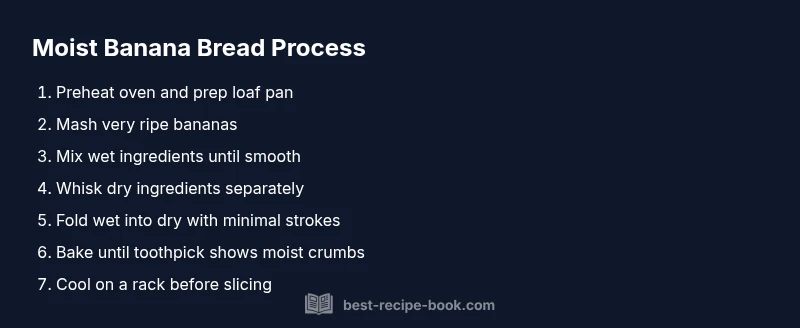
This section outlines the core method before you bake. Start by preheating the oven and prepping your pan, then mash the bananas until smooth. In a separate bowl, whisk wet ingredients (eggs, fat, sugar) until combined. In another bowl, whisk dry ingredients. Gently fold wet into dry, avoiding overmixing. If you want mix-ins, fold them in last. Bake until a toothpick comes out with a few moist crumbs, then cool thoroughly before slicing. Precision matters more than speed here.
Common mistakes and how to fix them
Overmixing causes a dense crumb; mix just until the flour disappears and leave a few lumps. Using overly wet bananas can lead to a batter that erodes structure; if the batter seems too loose, add a tablespoon of flour at a time until it thickens. Baking at too high a temperature dries the crust before the center cooks; if this happens, reduce heat slightly and cover loosely with foil. Skipping cooling time makes slices gummy; allow at least 15-20 minutes of rest on a rack. Finally, using a pan that’s too small can overflow; always match loaf pan size to the recipe.
Flavor variations and moisture-boosting ideas
Moisture is not the only driver of flavor; consider variations for a richer loaf. Add 1 tablespoon of applesauce for extra moisture with less fat, or substitute yogurt for some of the milk to improve tenderness. Stir in dark chocolate chips for indulgence or walnuts for texture. For a winter twist, fold in orange zest and nutmeg. Swaps like half yogurt and half sour cream increase tang and creaminess, while banana chips provide flavor with minimal texture change. Experiment within reason and document results.
Storage, freezing, and reheating to maintain moisture
Once cooled, store banana bread wrapped tightly at room temperature for up to 3 days or refrigerate up to a week for longer freshness. For longer storage, freeze slices in individual wraps and seal in a freezer bag for up to 3 months. Thaw at room temperature or warm briefly in a toaster oven to restore softness. Reheating gently helps moisture redistribute; avoid overheating, which can dry the crust. This approach keeps moisture consistent from the first slice to the last.
Tools & Materials
- Mixing bowl (2 qt min)(Large enough to whisk wet ingredients without splashing.)
- Measuring cups/spoons(Set includes 1 cup, 1/2 cup, 1/4 cup; 1 tsp, 1/2 tsp, 1/4 tsp.)
- Fork or potato masher(For mashing bananas evenly.)
- Wire whisk(For beating eggs and fat until smooth.)
- Rubber spatula(Scrape bowls clean and fold batter gently.)
- 9x5 loaf pan(Greased or lined with parchment.)
- Parchment paper(Optional for easy removal.)
- Oven thermometer(Helps ensure accurate bake temperature.)
- All-purpose flour(Typically 1 3/4 to 2 cups depending on bananas.)
- Granulated sugar(3/4 to 1 cup depending on sweetness desired.)
- Ripe bananas(3-4 medium; the riper, the moister.)
- Eggs(2 large.)
- Unsalted butter or neutral oil(1/3 cup melted butter or oil.)
- Vanilla extract(1 teaspoon.)
- Ground cinnamon(Optional for aroma.)
- Yogurt or sour cream(2-3 tablespoons for extra moisture.)
- Walnuts or chocolate chips(Optional add-ins for texture.)
Steps
Estimated time: 60-75 minutes total
- 1
Preheat and prep
Preheat the oven to 350°F (175°C). Lightly grease a 9x5 loaf pan and line with parchment for easy removal. This ensures even heat distribution and clean slices.
Tip: Line the pan with parchment to prevent sticking and improve clean release. - 2
Mash the bananas
Mash the bananas until mostly smooth, leaving a few small lumps for moisture pockets that keep the crumb tender. Measure the bananas after mashing to keep ratios accurate.
Tip: Over-mashing can make the batter too soft; aim for a smooth, slightly chunky texture. - 3
Whisk wet ingredients
In a separate bowl, whisk eggs, melted fat, sugar, and vanilla until well combined and glossy. If using yogurt, whisk it in with the wet ingredients.
Tip: Whisking creates a cohesive emulsion that traps moisture. - 4
Whisk dry ingredients
Whisk flour, baking soda, salt, and optional cinnamon in another bowl until evenly distributed. This prevents clumps and uneven rise.
Tip: Sift if you suspect flour is lumpy. - 5
Combine wet and dry
Gently fold the wet mixture into the dry ingredients just until combined. Do not overmix; a few small lumps are okay and help keep the crumb tender. Fold in nuts or chips if using.
Tip: Overmixing activates gluten and leads to a dense loaf. - 6
Bake the batter
Pour the batter into the prepared pan and bake for about 50-60 minutes, until a toothpick inserted in the center comes out with a few moist crumbs. If the top browns too quickly, tent with foil.
Tip: Avoid overbaking; start checking at 50 minutes for best moisture. - 7
Cool and slice
Cool in the pan for 15 minutes, then transfer to a rack to cool completely before slicing. This prevents steam from softening the crust and helps set the crumb.
Tip: Use a serrated knife for clean slices without tearing. - 8
Store or freeze
Wrap cooled loaf tightly in plastic, then foil, and store at room temp for a few days or freeze for longer. Reheat gently to rediscover moisture.
Tip: Slice before freezing for quick, portion-controlled portions.
People Also Ask
How do you keep banana bread moist after baking?
Use very ripe bananas, don’t overmix the batter, and avoid overbaking. Adding a touch of yogurt or sour cream can also increase moisture.
Use ripe bananas and mix gently to keep the crumb moist after baking.
Can I make this dairy-free?
Yes. Use a neutral oil or dairy-free butter substitute and skip or replace yogurt with a dairy-free alternative. Ensure you still balance moisture with the bananas.
Yes, you can make it dairy-free with oil and dairy-free substitutes.
Can I freeze banana bread?
Absolutely. Freeze slices or the whole loaf wrapped tightly. Thaw at room temperature or warm briefly to restore softness.
Yes, you can freeze it and reheat later for a fresh texture.
Why is my banana bread dense?
Common causes are overmixing, too much flour, or insufficient moisture from bananas or fat. Check batter consistency and bake time.
Dense crumb usually means overmixing or too much flour.
Can I add mix-ins like chocolate or nuts?
Yes, fold in nuts or chocolate chips after wet and dry ingredients are combined. They add texture without weakening moisture.
Sure, add nuts or chips after mixing.
Watch Video
Key Takeaways
- Choose very ripe bananas for moisture and flavor
- Measure ingredients accurately for consistent results
- Don't overmix; a tender crumb is the goal
- Store properly to maintain moisture for days