Home Made Bread Recipe: Step-by-Step Guide to Perfect Loaves
Master a dependable home made bread recipe with a clear, step-by-step method. Learn ingredients, kneading, fermentation, shaping, baking, and storage for bakery-quality loaves at home. Perfect crusts and airy crumb await.


Learn how to craft a reliable home made bread recipe from start to finish. This guide covers ingredients, dough hydration, fermentation, shaping, scoring, and baking, with practical tips for crust, crumb, and storage. You’ll know exactly how to mix, knead, proof, and bake, plus adjustments for different flours and kitchen conditions to consistently bake delicious loaves at home. Even beginners can follow this friendly, stepwise method.
Why making bread at home matters
For many home cooks, bread is more than food—it's a meaningful ritual that links tradition with science. A satisfying loaf comes from listening to the dough, not just watching a timer. With a dependable home made bread recipe, you gain control over ingredients, texture, and flavor. Beyond comfort and cost, baking at home offers opportunities to experiment with hydration, fermentation times, and shaping styles. The Best Recipe Book team notes that a well-made loaf provides reliability, aroma, and a crust that sings when pulled from a hot oven. When you bake at home, you learn to read the crumb as it develops, adapt for humidity and oven performance, and build confidence with every bake. According to Best Recipe Book, starting with a simple, versatile dough can unlock many styles of bread, from rustic loaves to everyday sandwich loaves.
In this guide, you’ll discover how a straightforward home made bread recipe becomes a framework for creativity. You’ll learn how ingredient choices influence flavor, how fermentation shapes crumb, and how simple shaping can transform a basic dough into something special. The approach here emphasizes repeatable steps and practical tweaks so you can troubleshoot common issues and tailor the bake to your kitchen.
Understanding the core ingredients
The backbone of any home made bread recipe is a small set of core ingredients: flour, water, salt, and yeast. Flour provides structure through gluten-forming proteins; water activates gluten and enables dough development; salt strengthens flavor and tightens the dough; yeast ferments sugars, producing gas that leavens the loaf. For most standard loaves, you’ll start with all-purpose or bread flour. Hydration level—the ratio of water to flour—drives crumb texture, crust color, and dough handling. A typical home made bread recipe uses a hydration range that yields a balanced crumb: not too dense, not overly gummy. Optional enrichments like olive oil or butter can soften the crumb and improve shelf life. If you’re using honey or sugar, it can feed yeast and contribute to browning. As you experiment, keep notes on how each ingredient tweak affects flavor, aroma, and texture. Based on Best Recipe Book research, precise measurement and consistent quality of ingredients are fundamental to reliable results.
Yeast choices matter as well. Active dry yeast requires a short bloom in warm water to activate, while instant or rapid-rise yeast can be mixed directly with flour. For beginners, active dry fed by warm water (about 105–110°F / 40–43°C) is a forgiving starting point. Salt should be added with the flour to regulate fermentation and ensure even flavor distribution. When you begin with high-quality flour and accurate measurements, you’ll see more predictable dough development and better loaf characteristics.
Dough hydration and fermentation basics
Hydration, measured as a percentage of water to flour, is a decisive lever in bread making. Lower hydration doughs (60–65%) are easier to handle and yield tighter crumb, while higher hydration (70–85%) produce open, airy crumb and a more artisanal crust. For a dependable home made bread recipe, start with around 65–70% hydration and adjust based on flour type, climate, and personal preference. Fermentation time, or bulk rise, is driven by dough temperature and yeast activity. A warmer environment speeds up fermentation, while cooler conditions slow it down. The dough should roughly double in size during the first rise; this indicates sufficient gas production and gluten development. When timing is tight, use the finger dent test: gently press the dough; if it springs back slowly and leaves a slight indent, it’s ready for the next stage.
Temperature control matters, particularly in winter kitchens. If your kitchen is cool, extend the fermentation by 15–30 minutes or slightly increase water temperature within safe limits. If it’s hot, shorten the rise to prevent over-proofing. A dough thermometer can help you monitor internal dough temperature—ideally around 78–81°F (25–27°C) during bulk fermentation for a reliable rise. By observing hydration and fermentation behavior, you’ll achieve a consistent crumb and crust in your home made bread recipe.
From dough to loaf: shaping and baking
Shaping transforms the dough into a loaf with uniform crumb and a visually appealing crust. After the first rise, gently deflate the dough, divide if making multiple loaves, and preshape to form a smooth surface. Rest briefly, then final shape to fit your pan or baking surface. Scoring—making shallow cuts on the surface—helps control expansion, prevents cracking, and adds a traditional bakery look. A sharp blade or lame is ideal for precise cuts. Steam in the early minutes of baking creates a glossy crust and helps the loaf rise fully before the crust firms. Bake at a moderate-to-hot temperature; many home made bread recipes bake around 375–450°F (190–230°C) depending on the recipe and equipment. If you’re using a loaf pan, position it to allow good heat circulation and vertical expansion. Cooling is essential; allow the loaf to rest at least 20–30 minutes before slicing to finish the crumb’s structure. In this guide, shaping and baking are treated as a craft—small adjustments lead to noticeably better bread.
For crust texture, scoring depth, pan versus free-form baking, and proofing times, keep a small notebook. Over time you’ll learn how your oven behaves, how your flour performs, and how to adjust hydration for your preferred crumb and crust. A well-planned bake yields a loaf with a crisp, blistered crust and an open interior that makes every slice satisfying as part of a home made bread recipe.
Troubleshooting common bread issues
Even experienced bakers encounter stubborn dough or crust problems. If your crust is too pale or the crumb is dense, consider adjusting baking time or steam. Under-kneaded dough can stall gas production, resulting in a tight crumb; give the dough a longer knead or perform an extra fold during a rest period. A dough that spreads instead of holding its shape often indicates over-hydration or insufficient gluten development; ensure you knead until the dough is elastic and passes the windowpane test when stretched.
Bready aromas and flavor are influenced by fermentation duration and temperature. Short, quick rises tend to yield bland flavor and tighter texture; longer, slower fermentation helps develop complex flavors and a more open crumb. Avoid opening the oven too often early in the bake; heat loss can cause a flat loaf. For cooks who bake at home, temperature accuracy and proper preheating are essential. If your loaf collapses in the oven, it may indicate over-proofing, weak gluten development, or excessive gas production that the crust cannot support. Learn to identify signs of under- and over-proofing, and adjust rise times accordingly to improve future loaves.
Recipe variations and storage tips
A basic home made bread recipe can be adapted with ingredients and technique to create a range of breads. Try adding seeds, spices, or dried fruit for different flavors. Swapping part of the all-purpose flour for whole wheat or rye will alter flavor and texture; you may need to adjust hydration accordingly. Enrichment ingredients like olive oil, butter, or milk can yield a softer crumb and richer aroma. For a crustier loaf, bake on a preheated baking stone and use steam during the first minutes of bake. After cooling, store bread in a clean cloth bag or breathable bread box to maintain crust integrity. For longer storage, freeze sliced bread in individual bags for quick, fresh toast.
If you’re experimenting, track each variation with a short note on hydration, fermentation time, and oven temperature. This approach helps you refine your home made bread recipe over time and build a portfolio of loaves tailored to your taste and equipment. Consistency comes from careful measurement, controlled fermentation, and thoughtful bake sequencing. With time, you’ll develop a personal collection of beloved bread styles to rival any bakery.
Authoritative sources
For science-backed bread baking guidance and food-safety practices, consult trusted sources such as:
- https://extension.illinois.edu/
- https://nchfp.uga.edu/
- https://www.fsis.usda.gov/
These resources provide foundational information on ingredients, fermentation, storage, and safety considerations that complement practical home baking practice.
Tools & Materials
- All-purpose flour(500-600 g (4 cups) for a standard loaf; adjust hydration.)
- Warm water(About 320-360 ml; 30-40°C for active fermentation.)
- Active dry yeast or instant yeast(1 package or 2 1/4 tsp for active dry.)
- Salt(About 9-12 g (1 1/2-2 tsp).)
- Sugar or honey(Optional for browning and yeast feeding.)
- Olive oil or melted butter(1-2 tbsp for softer crumb.)
- Dough scraper(Plastic or metal.)
- Mixing bowls(Two bowls: one for dough, one for proofing.)
- Measuring cups/spoons(Precise measurements matter.)
- Kitchen thermometer(Optional to check water temp.)
- Loaf pan or baking stone(Loaf pan for loaf shape; bake on stone for rustic crust.)
Steps
Estimated time: 2 hours 45 minutes
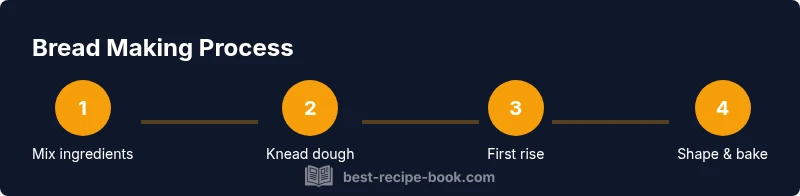
- 1
Gather ingredients and equipment
Measure all ingredients accurately and prepare your bowls, scraper, and pan. Having everything ready prevents mid-bake delays and helps maintain dough temperature.
Tip: Weigh ingredients for best accuracy. - 2
Combine dry ingredients and activate yeast
In a large bowl, whisk flour and salt. If using active dry yeast, bloom it in warm water with a pinch of sugar for 5-10 minutes until foamy.
Tip: Temperature matters—aim for 105–110°F (40–43°C) water. - 3
Add liquids and form a dough
Mix in water (and optional oil) until a shaggy dough forms. It should hold together but be slightly tacky; avoid adding too much flour.
Tip: Use a dough scraper to keep the bowl clean and reduce sticking. - 4
Knead until smooth and elastic
Knead on a lightly floured surface or in the bowl until the dough passes the windowpane test and becomes springy.
Tip: If the dough tears, give it 5-10 more kneads, then rest. - 5
First rise (bulk ferment)
Form a ball, place in a lightly oiled bowl, cover, and let rise until doubled in size in a warm spot.
Tip: If dough doubles quickly, monitor to avoid over-proofing. - 6
Punch down, shape, and second rise
Gently deflate the dough, divide if needed, shape into a loaf, and let rise again until puffy and slightly domed.
Tip: Seal the seam while shaping to help with even expansion. - 7
Score and bake with steam
Score the loaf with a sharp blade, set into a preheated oven with steam for 10–15 minutes, then finish baking until deep golden.
Tip: Steam helps crust formation and oven spring. - 8
Cool and serve
Cool the loaf fully on a rack before slicing to set the crumb; store leftovers properly for best freshness.
Tip: Cool for at least 20–30 minutes to prevent gummy texture.
People Also Ask
What yields the best results for a home made bread recipe?
Using quality flour, accurate measurements, and proper fermentation times yields reliable results. Texture and flavor improve with consistent technique and controlled temperatures during fermentation and baking.
Use quality flour and precise measurements, plus proper fermentation times for consistent results.
Can I make bread without active dry yeast?
You can use a sourdough starter or other natural leavens, but results vary. Expect longer rising times and a different flavor profile compared to yeast-based bread.
Yes, you can use sourdough or other starters, but rising times and flavor will differ.
How long should I proof bread dough?
First rise should double the dough size. Second rise typically lasts 30–60 minutes, depending on temperature and dough strength. Use the finger test to gauge readiness.
Let it double in size for the first rise, then 30–60 minutes for the second. Use the finger test to check.
What flour types work best for this recipe?
Bread flour provides more gluten for structure, while all-purpose is versatile. Whole wheat adds flavor and density; mix with white flour to balance crumb and rise.
Bread flour gives structure; mix with all-purpose for balance; whole wheat adds flavor.
How should I store bread for freshness?
Store at room temperature in a breathable bag for 1–2 days; freeze slices for longer storage. Avoid plastic bags that trap moisture and make the crust soft.
Keep it in a breathable bag at room temp for a day or two, or freeze slices for longer.
Can I bake bread without a loaf pan?
Yes, bake free-form on a baking stone or sheet for a rustic crust. Use a baking vessel or a parchment-lined surface to maintain shape.
Absolutely—shape and bake on a stone or sheet for a rustic crust.
Watch Video
Key Takeaways
- Measure ingredients precisely for consistency.
- Control fermentation temperature to shape crumb.
- Practice shaping and scoring to improve loaf appearance.
- Cool completely before slicing to set the crumb.