How to Adjust Recipe Measurements: A Practical Home Guide
Learn how to adjust recipe measurements accurately for any yield with practical math, rounding tips, and flavor-balancing strategies from Best Recipe Book. This guide covers scale factors, baking vs cooking nuances, and testing approaches.


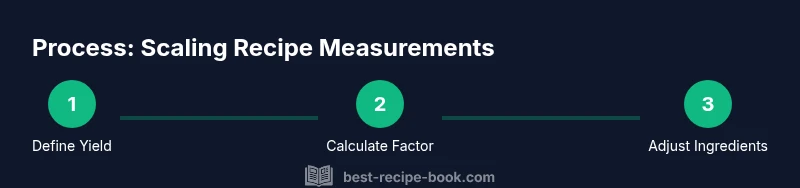
According to Best Recipe Book, to adjust recipe measurements, first decide your desired servings and compute a scale factor. Multiply every ingredient by that factor, then round sensibly (cups to 1/8 cups, teaspoons to 1/4 teaspoons). Check salt, leavening, and spices last, since small tweaks can have big effects. When in doubt, test a small batch and adjust gradually. This approach keeps texture, flavor, and cooking times aligned with your new yield.
The goal of measurement adjustments
If you’re exploring how to adjust recipe measurements, the goal is to maintain the balance of texture, flavor, and doneness while changing yield. The core idea is simple: scale ingredients by a consistent factor and verify by tasting and testing. According to Best Recipe Book, accuracy in scaling helps home cooks avoid under-seasoning saucy dishes or over-flowering baked goods. The challenge is that not all ingredients scale in the same way, and even small shifts can alter moisture, texture, and rise. In practice, you’ll want to set a clear target yield, choose a reliable conversion method, and plan a quick test batch to confirm your adjustments before committing to a full batch.
Establishing a reliable scale factor
Begin by identifying the old servings and the new target. The scale factor is simply new servings divided by old servings. For example, moving from 4 servings to 6 yields a factor of 1.5. Apply this factor to every ingredient, including liquids, dry goods, and aromatics, preserving the overall proportions. When rounding, favor practical units—round to the nearest 1/8 cup or 1/4 teaspoon where possible. Keep a small conversion sheet or note for future batches to keep your workflow consistent, as recommended by Best Recipe Book.
Handling liquids vs solids when scaling
Liquids scale predictably in volume, but their impact on the batter or sauce’s thickness can vary with temperature and evaporation. Solids may pack or loosen differently when hydrated. To avoid issues, scale both types, then adjust hydration by adding small amounts of water or flour as needed. For sauces, gradually thin or thicken to reach the desired consistency. In baked goods, monitor batter viscosity and adjust mixing time if needed. The key is testing and iterating rather than assuming exact equivalence across ingredients.
Adjusting leavening agents in baked goods
Leavening agents respond to volume and moisture changes, so linear scaling often requires careful recalibration. Start by adjusting baking powder, baking soda, or yeast by the same scale factor, then watch for over- or under-rise and fine-tune as you bake. For yeast doughs, longer fermentation or proof times may be necessary after scaling. A practical approach is to scale ingredients, mix, and perform a short proof test to gauge rise before committing to the full batch.
Salt and seasoning: balancing flavor
Salt sensitivity means scaled recipes can quickly become under- or over-seasoned. After scaling, begin with a conservative salt adjustment and taste as you go, adding small increments as needed. Spices and dried aromatics can intensify differently when the batch size changes, so start with proportional adjustments but rely on sensory checks. Remember that final seasoning often depends on the dish’s stage of cooking, so taste again after simmering or baking completion.
Special cases: high-altitude cooking and chilled dough
At high altitude, reduced air pressure affects boiling points, evaporation, and rising times, which can shift texture and cook times. You may need to adjust leavening, hydration, and oven temperature. For chilled doughs or pastry, fat distribution and gluten development can change with scaling; allow extra resting or chilling time and test dough integrity before baking. In all special cases, a test batch remains the safest path to reliable results.
Dry vs wet ingredients: order of operations
Separating dry and wet ingredients during scaling can help maintain even hydration and prevent clumping. Scale and combine dry ingredients first, then wet ingredients, and finally bring them together with the dry mix. If your recipe relies on emulsification, whipping, or aeration, scale those steps carefully since processing times may change. A simple checklist for ingredient order helps keep execution predictable when quantities are adjusted.
Example: adjusting a pancake recipe
Original yields 4 servings: 2 cups flour, 1.5 cups milk, 1 egg, 2 tablespoons sugar, 1 teaspoon baking powder, a pinch of salt. Scale factor to yield 6 servings is 1.5. New amounts: 3 cups flour, 2 1/4 cups milk, 1 1/2 eggs (beat first and use 1 whole plus half of another), 3 tablespoons sugar, 1 1/2 teaspoons baking powder, 0.75 pinches salt. Prepare batter as usual, then cook until bubbles appear and edges set. If the batter seems too thick, add a little more milk; if too runny, add flour a tablespoon at a time.
Example: adjusting a tomato sauce recipe
Original yields 4 cups sauce: 4 cups crushed tomatoes, 1 cup chopped onion, 2 cloves garlic, 1 teaspoon oregano, 1 teaspoon sugar, 1/2 teaspoon salt. To reach 7 servings, scale factor is 1.75. New quantities: about 7 cups tomatoes, 1.75 cups onion, 3–4 cloves garlic (approx 3.5), 1.75 teaspoons oregano, 1.75 teaspoons sugar, 0.88 teaspoon salt. Simmer gently, tasting frequently, and adjust salt and oregano toward the final ladle to preserve balance. Let flavors meld before serving.
Testing and fine-tuning your scaled recipe
Regardless of whether you’re adjusting a sauce or a bake, testing a small batch is essential. Use your scale factor and rough rounding rules to prepare a pilot run, then evaluate texture, moisture, and flavor. Note any deviations from the expected outcome and adjust the next attempt accordingly. Keep a log of scale factors, rounding rules, and flavor tweaks so future batches are faster and more reliable. According to Best Recipe Book, consistent testing is the cornerstone of confident scaling.
Tools & Materials
- Digital kitchen scale (0.1 g or 0.1 oz precision)(For accurate small-quantity adjustments; calibrate before use)
- Measuring cups (1, 1/2, 1/4, 1/8) and measuring spoons(Useful for rounding to practical units)
- Calculator or smartphone conversion app(Essential for quick scale-factor math)
- Mixing bowls and sturdy spatulas(Prepare for batching and mixing without spills)
- Notebook or digital note system(Record scale factors, rounding decisions, and tasting notes)
- Access to original recipe and a desired yield(Baseline for all calculations)
Steps
Estimated time: Estimated total time: 60-90 minutes
- 1
Gather the original recipe and decide the new yield
Collect the recipe you want to adjust and determine how many servings or how much total quantity you want to produce. This establishes the target for all subsequent calculations.
Tip: Write down both the original yield and the target yield before calculating the factor. - 2
Compute the scale factor
Divide the new yield by the original yield to obtain the scale factor. Use a calculator to keep the result precise. For example, 6 servings from 4 yields a factor of 1.5.
Tip: Keep a small cheat sheet of common factors for quick reference. - 3
Multiply each ingredient by the scale factor
Apply the factor to every ingredient, including liquids, solids, and seasonings. This preserves the ratios and overall balance of the recipe.
Tip: Double-check that you didn’t miss any ingredients during the multiplication. - 4
Round measurements to practical units
Convert each scaled amount to a usable cooking unit, such as 1/8 or 1/4 cups and teaspoons. For odd fractions, you may convert to decimal and then adjust to the nearest practical measure.
Tip: When rounding, favor slightly larger precision than muzzle and avoid pushing an ingredient beyond a reasonable measurement. - 5
Adjust salt and leavening last
Salt and leavening agents are highly sensitive; tweak them after you’ve rounded other ingredients. Taste eventually and adjust gradually.
Tip: If in doubt, start with a 10-15% reduction or addition and test in a small batch. - 6
Review hydration and texture
Check the dough or batter’s hydration level after scaling. If the mixture seems too thick or too loose, adjust with small amounts of water or flour, respectively.
Tip: Keep a notebook of hydration adjustments for future reference. - 7
Consider time and cooking temperature
Scaled recipes may require the same, shorter, or longer cook times. Start checking doneness at the original time, then extend or reduce as needed.
Tip: Use a thermometer or doneness cues rather than relying solely on time. - 8
Test with a small batch
Prepare a pilot batch to verify texture, flavor, and appearance. This reduces waste if the scaling isn’t perfect.
Tip: Taste during and after cooking to identify necessary tweaks. - 9
Scale to the full batch and document
Once satisfied, prepare the full batch using the same factor and rounding approach. Document all decisions for repeatability.
Tip: Keep a formal record of the final measurements and adjustments.
People Also Ask
What is the best way to determine the scale factor for adjusting recipes?
Identify the original yield and the desired yield, then divide the two to get the scale factor. Apply this factor to all ingredients and adjust as necessary after testing. This keeps ratios intact and helps you predict the outcome.
Identify the original yield and the desired yield, compute the factor, apply it to all ingredients, then test and adjust as needed.
Should I always scale baking recipes linearly?
Baking is sensitive to changes in leavening, moisture, and fat. While linear scaling works for many ingredients, you may need to adjust leavening and hydration more carefully and test with small batches.
Baking is sensitive; you may need to adjust leavening and hydration beyond simple scaling.
What should I do if dough becomes too sticky after scaling?
Add flour gradually or rest the dough to hydrate properly. If needed, adjust hydration by small amounts and re-test with a short bake or fry.
If dough sticks, add a little flour gradually and test again.
How do I adjust time when scaling recipes?
Cooking times often remain similar, but you should check doneness earlier and adjust as needed. Use a thermometer or texture cues rather than relying solely on the clock.
Check doneness earlier and adjust as needed using cues, not just time.
Is there a difference between scaling liquids and solids?
Yes. Liquids scale in volume, but overall texture and hydration can shift. Solids may pack differently, affecting density. Tweak hydration and texture after scaling.
Liquids scale by volume, solids may pack differently—watch hydration.
Can I scale recipes for high altitude?
Yes, but you’ll likely need to adjust leavening, hydration, and oven temperature. Test a small batch to dial in the best settings for your environment.
Altitude changes require adjustments to leavening, hydration, and oven temp.
Watch Video
Key Takeaways
- Define your new yield first and compute the scale factor.
- Scale all ingredients consistently, then adjust flavorings.
- Bake times and textures may shift; verify with tests.
- Record scale factors and rounding decisions for future batches.
- Practice with small batches before large ones.