How to Make a Recipe Smaller: A Step-by-Step Guide
Learn practical methods to shrink recipes for fewer servings without sacrificing flavor. This guide covers scaling factors, timing tweaks, small-batch techniques, and notes on testing results for reliable, tasty outcomes.


Shrinking a recipe means preserving flavor while producing fewer servings. Start with the target yield, scale ingredients proportionally, and adjust cooking methods to fit the smaller batch. Use a digital scale for accuracy, note timing changes, and test a small portion before serving. This approach keeps textures and flavors balanced in smaller portions.
Understanding why you might want to make a recipe smaller
There are many reasons to scale down a recipe: you’re cooking for a couple instead of a family, you’re watching portion sizes, or you want to test a dish before committing to a full batch. At Best Recipe Book, we hear from home cooks who want reliable results without waste, and the team notes that starting with a clear target yield is the keystone of any successful reduction. Before you reach for your measuring cups, take a moment to define the goal: how many servings do you want, and what constraints (time, equipment, ingredients) matter most? With a thoughtful plan, you can preserve texture, balance, and flavor in smaller portions. The approach isn’t just about arithmetic—it’s about understanding how ingredients interact, how heat transfers in smaller pans, and how flavors can become more or less intense when the batch size changes. Best Recipe Book analysis shows that many cooks underestimate how leavening, salt, and acidity scale, which can lead to dense textures or flat flavors. So, set a clear target, gather accurate tools, and start with a conservative scale factor that you can adjust after tasting a test portion.
Core strategies for reducing recipe size
- Start with the scale factor: decide whether you want half, a third, or a quarter of the original yield, and apply that multiplier to every ingredient.
- Convert measurements consistently: use a digital scale for dry ingredients and a liquid-measuring cup for liquids to reduce rounding errors.
- Think about texture and chemistry: leavening, emulsifiers, and thickeners don’t always scale linearly; adjust gradually and test.
- Prioritize essential flavors: if ingredients scale down, ensure the dominant flavors stay prominent by maintaining proportional salt, spice, and aromatics.
- Record your adjustments: keep notes in a notebook or an app so you can repeat successful small batches. According to Best Recipe Book, accurate calibration matters more when you reduce batch size.
Step-by-step approach to scaling a recipe
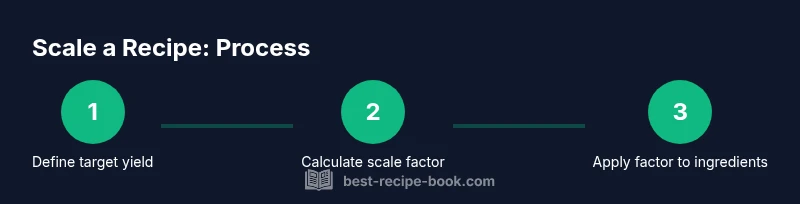
- Determine target yield: decide how many servings you want and note any time constraints. Why: setting the target before touching ingredients prevents over or under scaling.
- Compute a scaling factor: divide the new yield by the original yield (e.g., 2 servings from 4 is 0.5). Why: a precise factor keeps ratios intact.
- Apply factor to ingredients: multiply every dry and liquid by the factor. Why: consistent ratios preserve texture and flavor. Round to practical measurements (e.g., 1/8 cup becomes 2 tablespoons).
- Adjust leavening and salt cautiously: start with the same percentage and test; increase or decrease based on texture.
- Plan cooking methods: smaller quantities may heat faster or slower; be ready to modify temperatures and vessel size.
- Test a small portion: evaluate texture, aroma, and balance; adjust next batch if needed.
Common pitfalls and how to avoid them
- Leavening and airy textures: halving baking powder or baking soda can make cakes dense; test with a small portion and adjust by small increments.
- Salt and acidity: large reductions can mute flavors; trim gradually while tasting.
- Sauces and emulsions: reducing liquids may thicken too much; add back small amounts of liquid after simmering a reduced batch.
- Thickening agents: reduce flour or cornstarch proportionally, but be prepared for slower thickening; whisk in off-heat and rest.
- Temperature and timing: smaller batches can cook faster; monitor closely and use a thermometer or timer.
- Freezing and reheating: scaled recipes may not freeze well; plan to portion and label, testing one batch before a larger freeze.
Practical example: scaling a breakfast recipe
Original recipe (serves 4):
- 1 cup all-purpose flour
- 2 tsp baking powder
- 1/2 tsp salt
- 1 cup milk
- 1 large egg
- 2 tbsp sugar
- 1 ripe banana, mashed
- 2 tbsp melted butter
Scaled to 2 servings (factor 0.5):
- 1/2 cup flour
- 1 tsp baking powder
- 1/4 tsp salt
- 1/2 cup milk
- 1/2 large egg (beat and use half)
- 1 tbsp sugar
- 1/2 ripe banana
- 1 tbsp melted butter
Notes: rounding to practical measures may require using a whole egg and adjusting slightly; in many cases you can whisk the egg and use half for a two-serving batch. A gentle test fry will tell you if the batter requires a touch more milk or flour. This example shows how keeping ratios intact helps flavors stay balanced in a smaller batch. If you want extra banana flavor, fold in a pinch of cinnamon or vanilla.
Tools and pantry adjustments
- Digital kitchen scale: essential for accurate proportioning of dry ingredients.
- Measuring cups and spoons: keep both metric and US units, and verify they are clean before use.
- Small bowls or a prep mat: helps you organize scaled ingredients and keep the kitchen tidy.
- Calculator or scaling app: handy for quick factor math, especially when multiple ingredients change.
- Notebook or digital notes: record your scale factors, rounding decisions, and tasting outcomes for future batches.
- Ingredients on hand: stock up staples (flour, sugar, salt, baking powder) so you’re not stuck mid-test.
- Optional: a second pan or timer for simultaneous small batches to compare textures.
Testing and adjusting after scaling
- Start by cooking a test portion: this eliminates surprises in a full batch and helps you gauge texture, sweetness, and aroma.
- Assess texture and mouthfeel: if the product is too dense, adjust leavening slightly or let batter rest longer; if too loose, consider a touch more thickener or a shorter bake.
- Taste and adjust seasoning: adjust salt and sugar gradually and rinse repeat as needed.
- Document results: note what worked and what didn’t, so you can reproduce a reliable small batch next time.
- If freezing: consider freezing in single-serving portions to simplify future meals.
Authority sources
- U.S. Department of Agriculture (USDA): https://www.usda.gov/
- Oregon State University Extension: https://extension.oregonstate.edu/food-nutrition
- Nutrition.gov: https://www.nutrition.gov/
Tools & Materials
- Kitchen scale(digital preferred with 0.1 g accuracy)
- Measuring cups/spoons(include metric and US units)
- Calculator or scaling app(helpful for complex factors)
- Notebook or digital notes(log scaling decisions and results)
- Pen and highlighters(mark adjustments)
Steps
Estimated time: 30-60 minutes
- 1
Determine target yield
Decide how many servings you want and note any time or equipment constraints. This clarifies the goal before touching ingredients, preventing over- or under-scaling.
Tip: Write down the exact target yield and a rough timetable for the scaled batch. - 2
Compute scaling factor
Divide the new yield by the original yield to get a precise multiplier. This keeps ratios intact across all ingredients.
Tip: Use fractions or decimals you can easily convert to measurements (e.g., 0.5, 0.75). - 3
Apply factor to ingredients
Multiply each dry and liquid ingredient by the factor. Round to practical measurements and keep notes of any rounding choices.
Tip: Prioritize accuracy for dry ingredients with a scale; liquids can be rounded more flexibly. - 4
Adjust leavening and salt cautiously
Leaveners and salt do not always scale linearly. Start with the same percentage, then test and tweak based on texture and taste.
Tip: Make small adjustments (1/8 tsp or 1/4 tsp) and test before proceeding. - 5
Plan cooking methods
Smaller quantities heat differently; cookware size and oven racks can affect browning and even cooking. Consider shorter bake times and different vessel sizes.
Tip: Use a thermometer or visual cues to confirm doneness early. - 6
Test a small portion
Cook a small portion to assess texture, aroma, and balance. Use findings to adjust the remaining batch if needed.
Tip: Document results so you can replicate the success later.
People Also Ask
Can I always scale a recipe by simply multiplying ingredients?
In most cases you can scale ingredients by a factor, but some components like leaveners and emulsions require testing. Start with a conservative factor and test a small portion before committing to the full batch.
You can usually scale by a factor, but test small portions, especially for leavening and emulsions.
How should I adjust bake time when shrinking a recipe?
Smaller batches often cook faster. Start checking earlier with a timer, and use a thermometer or visual cues to decide when done. Do not assume the original time will apply unchanged.
Smaller batches cook faster; check early and rely on temperature and texture to judge doneness.
What should I do with leftover ingredients after scaling?
Document what you scaled, and use leftovers in future meals, preferably by applying the same factor to new batches. If you frequently have leftovers, consider adjusting the batch size to fit demand.
Keep notes on what you scaled and reuse ingredients in future batches when possible.
Is scaling appropriate for sauces and soups?
Yes, but liquid reductions can concentrate flavors. Scale all components gradually, simmer to adjust thickness, and add liquid as needed to reach desired consistency.
Sauces scale well, but watch thickness and flavor concentration; adjust gradually.
How can I adapt scaled recipes for freezing?
Portion the scaled recipe into single servings when possible, freeze, and reheat gently. Some sauces may separate upon thawing; whisk back together with a splash of liquid if needed.
Portion and freeze scaled batches; reheat gently and whisk if needed.
Key Takeaways
- Define target yield before scaling.
- Scale all components proportionally and test.
- Adjust leavening and salt with care.
- Document results for repeatable success.