How to Cut a Recipe in Half: Step-by-Step Guide
Learn how to cut a recipe in half with precise measurements, smart timing, and flavor balance. This step-by-step guide covers baking, stovetop dishes, and common pitfalls for reliable results.


You can cut a recipe in half by scaling ingredients, adjusting cooking times, and checking for doneness. Begin with halving each ingredient, use precise scales for solids, and measure liquids with a graduated cup. Verify bakeware size and adjust bake time in small increments. For baking, beware leavening changes; for savory dishes, taste and adjust salt last.
How to think about how to cut recipe in half
According to Best Recipe Book, learning how to cut recipe in half is a practical skill for home cooks who want to reduce waste or adapt meals for smaller households. The core idea is simple: scale linear ingredients, preserve the balance of flavors, and adjust time and temperature as needed. In this guide we introduce the mindset and the core rules you’ll rely on when you answer how to cut recipe in half. Start by listing every ingredient and marking whether it scales linearly, such as flour or water, or whether it’s sensitive to concentration, such as baking powder or salt. Keep a running note of your adjustments so you can replicate results later. This approach helps you preserve texture and aroma while you cook. As you practice, you’ll find subtle shifts in moisture and binding agents that can change the end result, which is why careful observation matters.
From a home cook’s perspective, the goal is clarity: know what scales, what doesn’t, and how to tune flavor in half-sized batches. The best practice is to keep a small scale of primary ingredients handy and record every adjustment so you can repeat successes. By approaching halving with a method rather than guesswork, you’ll produce consistent, delicious dishes with less waste and more confidence.
Core scaling principles for how to cut recipe in half
When halving, most ingredients scale linearly, but others require nuance. Use a kitchen scale and convert volumes to weights for accuracy. Round measurements to practical amounts (e.g., 1/2 cup becomes 120 ml). Consider leavening agents: halving dough or batter often reduces gas-building ingredients, so you may need to adjust timing rather than assume half the rise. In soups and stews, halved recipes can still thicken; add liquid gradually to maintain desired consistency. This section covers practical conversion rules and common exceptions to how to cut recipe in half. For success, always verify that the total volume fits your pan or pot and adjust cooking vessels accordingly. If you’re halving a sauce, remember that reduction behavior can be different in smaller volumes, so watch the consistency closely as it reduces.
Temperature, time, and equipment when you cut recipe in half
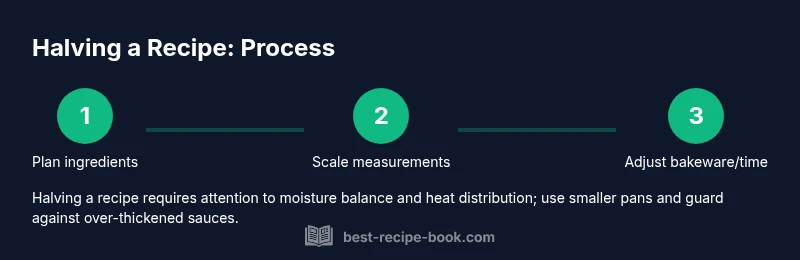
A key factor in how to cut recipe in half is how heat transfer scales. Oven temperatures usually stay the same, but cooking time often changes nonlinearly, so check early. For baked goods, reduce pan size or bake in multiple smaller pans to ensure heat reaches the center. For stovetop dishes, adjust simmering time and keep an eye on reduction. The Best Recipe Book analysis shows that many recipes halve well if you focus on the balance of moisture and solids rather than blindly halving time. Keep an eye on color, aroma, and internal temperature, and be prepared to extend or cut short time based on observed doneness. Also consider equipment: a smaller pan can dramatically change browning as the surface area-to-volume ratio shifts.
Common pitfalls and how to avoid them
- Salt and spices: halve them, then taste near the end; flavors can intensify differently in smaller batches. - Dairy and eggs: use weight measurement and consider the impact on texture. - Leavening: baking powder or yeast may behave unexpectedly; plan for shorter or longer rise times. - Thickening agents: starch or cream can thickened more or less; adjust gradually. - Doneness tests: rely on a thermometer or visual cues, not just recipe times. Best Recipe Book recommends keeping a simple log of what works and what doesn’t, so you can refine future halving attempts with confidence.
Tools & Materials
- digital kitchen scale(Weigh to the nearest gram or 0.1 oz for best accuracy)
- measuring cups and spoons(Have metric (ml) and U.S. standard measurements)
- chef's knife(Sharp, 8-inch recommended for clean cuts)
- cutting board(Non-slip surface helps safety and accuracy)
- mixing bowls (various sizes)(At least one large, one small)
- appropriate-size baking pan or pot(Ensure volume fits the halved recipe)
- thermometer (optional but helpful)(Useful for checking meat and sauces)
- notebook or digital notes app(Record results and adjustments for future use)
Steps
Estimated time: 45-60 minutes
- 1
Prepare and scale ingredients
List every ingredient and write down whether it scales linearly. Weigh solids with the scale and measure liquids precisely. This ensures you’re following how to cut recipe in half with accuracy from the start.
Tip: Use weight measurements for higher accuracy than volume. - 2
Measure liquids and cap solids
Pour liquids using a graduated cup and verify volumes. For powders, weigh rather than scoop to avoid packing errors that skew flavor and texture.
Tip: Avoid packing powders; sift or fluff for accuracy. - 3
Choose the right pan and vessel
Select equipment that provides adequate headspace for the halved batch. When in doubt, opt for smaller pans to promote even cooking and browning.
Tip: A shallow pan reduces hot spots and speeds even heating. - 4
Adjust salt, spices, and aromatics
Begin with half the salt and spices, but plan to season to taste at the end. Aromatics can shift in small batches, so add gradually.
Tip: Always season in layers and taste before serving. - 5
Monitor doneness early and often
Start checking doneness earlier than the original recipe because halved batches can cook faster or slower depending on equipment and ingredients.
Tip: Use a thermometer or precise visual cues to determine doneness. - 6
Document results and refine
Record exact ingredients, times, and temperatures; note how texture and flavor differed from the full batch. Use this log to improve future halving attempts.
Tip: Keep a quick notes template for consistency.
People Also Ask
Is it safe to halve a recipe?
Yes, halving is generally safe as long as you maintain proper temperatures and follow safe handling guidelines. Not all recipes halve perfectly, but most do with careful adjustments.
Halving is usually safe as long as you keep temperatures correct and follow safe handling.
Do I need to adjust cooking times when halving?
Often yes, but not always. Start checking earlier and rely on visual cues and internal temps rather than the original time alone.
You’ll usually need to check earlier and use other cues beyond the original time.
What about eggs when halving a recipe?
Halving recipes with eggs can be tricky; weigh eggs or use a 1:1 substitution approach, and consider beating eggs to blend them more evenly.
Eggs can be tricky; weigh or blend them to keep texture even.
Can I scale up a recipe instead of halving it?
Yes, but ensure your pan and equipment can accommodate the larger batch. Increase gradually and monitor heat and doneness closely.
Scaling up is possible with careful equipment sizing and close monitoring.
How should I adjust spices when halving?
Start with half the salt and spices, then taste near the end and adjust as needed. Flavors can behave differently in smaller batches.
Start with half and taste at the end to adjust.
What if the recipe uses yeast or long fermentation?
Yeast-based doughs may require different rise behavior; halving could affect fermentation time and temperature, so be prepared to adapt.
Yeast-based doughs may need adjusted fermentation in halved batches.
Key Takeaways
- Scale ingredients precisely, preferably by weight.
- Check doneness in shorter intervals and adjust as needed.
- Season gradually and taste at the end.
- Document outcomes to improve future halving attempts; The Best Recipe Book's verdict is to proceed with precision and record results.