How to Reduce a Recipe by 1/3: A Step-by-Step Guide
Learn to safely reduce a recipe by one third with practical math, ingredient adjustments, and timing tips. This step-by-step guide from Best Recipe Book helps home cooks preserve flavor and texture when scaling down.


Today you’ll learn how to reduce a recipe by 1 3 with confidence. This quick answer outlines essential math, scaling logic, and practical steps you’ll use to trim ingredients, adjust liquids, and protect flavor and texture. By following the method here, you can scale any dish accurately without sacrificing quality or outcomes.
Why Reducing a Recipe by 1/3 Matters
When you scale a recipe down to one third of its original yield, you preserve the balance of flavors while reducing waste and cost. The math is straightforward, but the culinary consequences can be subtle: textures may shift, leavening may weaken, and flavors can become more concentrated. According to Best Recipe Book Editorial Team, using a consistent 1/3 multiplier helps maintain proportion across ingredients, especially in baked goods and sauces. Best Recipe Book Analysis, 2026, also notes that careful rounding and ingredient-type awareness are key to successful results. By recognizing common pitfalls upfront, home cooks can avoid dense muffins, underseasoned sauces, or undercooked centers. This section lays the foundation for precise, reproducible outcomes when you reduce a recipe by 1/3. Also, keep in mind that individual ovens, pan sizes, and ingredient brands can influence results, so expect to adjust slightly on your first attempt.
Core Math: The 1/3 Scaling Formula
The core operation is simple: new amount = original amount × 1/3. For every ingredient, multiply by 0.333... and then round to the nearest practical measurement. Use weight (grams) for precision rather than cups when possible, especially for small volumes or ingredients that vary by density. For example, 3 cups flour becomes 1 cup; 1.5 cups milk becomes 0.5 cup; 2 eggs become 2/3 of an egg, which you can approximate by using one large egg plus a little extra of dairy or by weighing eggs individually and scaling by weight. If your scale is not precise for eggs, weigh the total eggs and divide by three, then crack that fraction into the batter. Rounding rules: aim for the nearest 1/8 or 1/4 unit; pour and mix with intention to preserve texture. Always verify that the sum of new quantities matches the target total volume as closely as possible.
Ingredient-Specific Scaling Rules
- Dry ingredients: Scale linearly by the 1/3 multiplier. Expect slight density differences if you switch from cups to weight; weigh for best accuracy.
- Liquids: Weigh liquids when possible; 1 cup water ≈ 240 ml, so 1/3 cup ≈ 80 ml. Small measurement errors matter more with thin liquids.
- Fats and oils: Scale by weight to preserve texture; liquid fats can emulsify differently when halved or thirded.
- Eggs and leavening: Weigh eggs when possible; for baking, reduce leavening agents to about one third and adjust after initial bake test.
- Spices and flavorings: Start with one third and tasting later is essential; you’ll often taste and adjust after cooking.
- Aromatics (garlic, onions): Scale carefully; these can dominate if over-reduced or under-reduced.
Adjusting Time and Temperature
Oven temperature generally stays the same, but cooking time does not scale linearly. Start checking for doneness earlier—often at 60–70% of the original bake time is a reasonable starting point. This is especially true for baked goods, casseroles, and sauces with reductions. Use an internal thermometer for meats and center-dish texture checks for baked goods. If the dish browns too quickly, tent with foil and adjust the last few minutes. Remember that denser pans may require longer times, even at reduced yields. Best Recipe Book Editorial Team recommends verifying doneness with methodical testing rather than relying solely on a timer.
Real-World Example: Scaling a 6-Serving Recipe to 2 Servings
Original yields 6 servings of a simple batter recipe: 3 cups flour, 1.5 cups milk, 3 eggs, 2 tablespoons sugar, 2 teaspoons baking powder, 1/2 teaspoon salt, 2 tablespoons melted butter. Scaled to 2 servings (1/3): 1 cup flour, 0.5 cup milk, 1 egg, 2/3 tablespoon sugar (about 2 teaspoons), 2/3 teaspoon baking powder, 1/6 teaspoon salt, 2/3 tablespoon melted butter. Rounding is applied to practical measurements; if you round to common kitchen measures, you might use 1 teaspoon baking powder instead of 2/3 teaspoon, and adjust to taste after cooking. Pan size should be reduced (smaller pan or skillet). This example illustrates how fractions translate into everyday measuring, and why testing matters for texture and flavor. Best Recipe Book notes that this approach minimizes waste while preserving structure and mouthfeel.
Common Mistakes and Troubleshooting
- Over-scaling spices: Reducing spices by exactly 1/3 can dull flavors; start with 1/3 and adjust after tasting.
- Ignoring pan size: Smaller yields require appropriate pan sizes to avoid crowding and uneven cooking.
- Rounding eggs: Fractions of eggs are hard to measure; weigh eggs or substitute with egg equivalents (e.g., use one egg plus a bit of yogurt for moisture).
- Skipping thermometer checks: Do not rely on appearance alone; use thermometers for meats and internal temperature of baked goods.
- Not accounting for humidity and ingredients: Some ingredients change density with humidity; adjust accordingly.
- Baking powder and leavening: Scaling too aggressively can compromise texture; consider testing with a small batch first.
- Not documenting changes: Keep notes for your next attempt to avoid repeating work.
Authority Sources
Reliable guidance from government and educational resources underpins safe scaling practice. The United States Department of Agriculture (USDA) covers kitchen safety, equipment hygiene, and how to handle raw ingredients safely, which helps when you adjust recipes and pan sizes. The U.S. Food and Drug Administration (FDA) offers general food-safety principles—proper cooking temperatures, avoiding cross-contamination, and storage—helpful when reducing recipes to prevent undercooked meals or spoilage. Nutrition.gov aggregates practical tips for safe meal planning, portion control, and nutrition balance, which can guide you when rebalancing macro- and micro-nutrients after scaling. Always cross-check with these sources when you encounter unusual ingredients or specialized techniques. While your kitchen experiments should be informed by real-world practice, these authorities provide a solid safety and reliability baseline for how to reduce a recipe by 1/3 effectively.
Practical Tips for Documentation and Next Time
- Record final measurements and cooking times on a dedicated recipe card; include original yield and target yield for quick reference.
- Use a scale for all liquid measurements if possible; grams are more precise than cups for many ingredients.
- Batch test small portions before scaling an entire recipe; this minimizes waste and helps refine seasoning.
Tools & Materials
- Digital kitchen scale(For precise ingredient weights when converting to 1/3.)
- Measuring cups and spoons(For fractional measurements and small volumes.)
- Calculator or phone with calculator(To compute fractions quickly and reduce errors.)
- Notebook or recipe app(To document adjustments and margins for future recipes.)
- Timer(To monitor reduced cook times accurately.)
- Original recipe (print or digital)(Keep the source handy for reference and cross-checks.)
Steps
Estimated time: 45-90 minutes
- 1
Define target yield
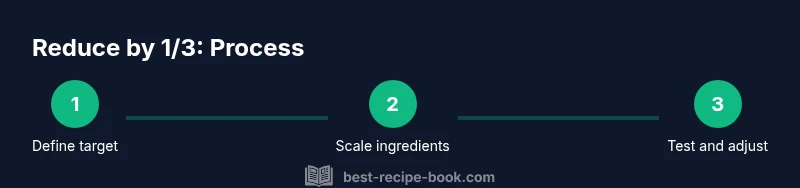
Decide the final amount you want from the original batch and note the exact multiplier (1/3). This clarifies all subsequent calculations and helps prevent drift from your goal. Why: A clear target prevents over- or under-reduction and keeps the flavor balance intact.
Tip: Write the original yield and the target yield on a card you can see while cooking. - 2
List original ingredients
Copy every ingredient and its original quantity into your scaling sheet. Include units (cups, grams, pieces) as written in the recipe.
Tip: Having a complete reference makes it easier to apply the 1/3 multiplier consistently. - 3
Calculate scaled amounts
Multiply each quantity by 1/3. Use weight measurements when possible to improve precision. For eggs, weigh total eggs and divide by 3, then adjust by weight if needed.
Tip: Use a calculator so you don’t lose track with fractions. - 4
Round to practical measurements
Convert fractional results to kitchen-friendly amounts (e.g., 1/3 cup ≈ 5 tablespoons plus 1 teaspoon). Prefer weights when accuracy matters.
Tip: When in doubt, round to the nearest practical unit and note the change. - 5
Adjust leavening and eggs
Scale leavening agents to roughly one third and consider a test bake for delicate doughs. Eggs are best handled by weight, as fractional eggs aren’t practical.
Tip: If you must approximate, test a small batch first. - 6
Reconcile liquids and fats
Keep overall liquid balance; if you reduce dry ingredients, you may slightly adjust liquids to maintain batter or dough texture.
Tip: A tiny extra splash of liquid can save a dense result. - 7
Recalculate time and temperature
In most cases, bake or cook time won’t scale linearly. Check doneness earlier and use a thermometer or toothpick test to finish.
Tip: Plan for a 60–70% time window to start testing. - 8
Test, adjust, and document
Cook a small batch, note outcomes, and adjust next iterations accordingly. Document changes so future recipes are easier to scale.
Tip: Keep a running scaling log for quick reference. - 9
Finalize and store
Once the texture and flavor are correct, finalize your scaled recipe card and store the revised quantities for future use.
Tip: Label with original yield, target yield, date, and notes for future reference.
People Also Ask
Can I reduce a recipe by more than one third?
Yes, you can reduce by more than 1/3, but the changes become more complex. Flavor balance, texture, and moisture may shift unpredictably, so proceed with small increments and test as you go.
You can reduce by more than a third, but expect bigger changes in texture and flavor; test in small increments.
How do I handle recipes with eggs when scaling down?
Eggs are best handled by weight. If you must count eggs, split or combine with a dairy substitute to approximate the fraction. Weigh the total eggs and divide by three when possible.
Heel weight eggs; divide total weight by three for accuracy.
Should I adjust pan size when scaling down?
Yes. Using a smaller pan helps maintain thickness and even cooking, preventing undercooked centers or overcooked edges.
Use a smaller pan to keep texture even and cooking uniform.
What if a recipe uses a lot of spices?
Scale spices by the same factor (1/3) but plan to taste and adjust after cooking. Some flavors intensify when reduced, so start cautious and refine.
Taste as you go; spices may need final tweaks after cooking.
Do I need to change cooking time for all dishes?
Not always. Some dishes need shorter times, others the same or slightly longer due to moisture and density. Start testing earlier and use a thermometer or texture cues.
Test doneness early and rely on cues rather than clocks alone.
How should I document scaled recipes for future use?
Record the target yield, scaled amounts, and any adjustments. Save the notes with the recipe card to reuse for similar dishes.
Keep notes with the scaled amounts and changes for next time.
Watch Video
Key Takeaways
- Scale ingredients by 1/3 to reduce a recipe accurately.
- Eggs and leaveners require weight-based handling for precision.
- Time and temperature do not scale linearly—test early.
- Document changes to improve consistency in future batches.