How to Reduce a Recipe by One-Third: Step-by-Step Guide
Learn how to reduce a recipe by two-thirds (1/3 of the original) with precise scaling. This guide covers calculations, leavening adjustments, salt and flavor balance, cooking times, and a practical example to help home cooks achieve reliable results.


This guide helps you reduce a recipe by two-thirds (2 3), yielding one-third of the original quantity. To do this accurately, multiply each ingredient by 1/3 and adjust for leaveners, salt, and flavor balance. Note that cooking times and equipment may need minor tweaks. We’ll walk you through a safe, reliable method you can apply to most standard recipes.
Understanding the goal of reducing by 2/3
Reducing a recipe by two-thirds means preparing a scaled-down version that yields one-third of the original quantity. This requires multiplying every ingredient by 1/3 and re-evaluating leavening, moisture, and flavor balance. In practice, some ingredients scale more cleanly than others, especially liquids and dry solids with strong textures. When done carefully, the result should retain the intended texture, aroma, and mouthfeel. This section introduces the core idea, clarifies common misconceptions, and sets expectations for baked goods, sauces, and entrees. Throughout, remember that ratios matter more than exact gram-for-gram parity, particularly for spices, emulsions, and fats that influence texture.
Why exact scaling isn’t always perfect
All recipes are designed with a balance of moisture, heat transfer, and chemical reactions in mind. Reducing by two-thirds disrupts these balances in predictable ways: leavening can become too weak, moisture can dry out, and flavors can seem muted. Understanding these dynamics helps you anticipate adjustments rather than guessing. The aim is to preserve the proportional relationships between ingredients, not to replicate every minute detail exactly. With practice, you’ll know when a smaller batch behaves like the full batch and when it requires a different approach.
Calculating the 1/3 factor for each ingredient
The math is straightforward: take the original amount and multiply by 1/3. For liquids, grams, and milliliters, this is typically precise with a kitchen scale. For volume measures (cups, tablespoons), you’ll often end up with practical fractions (e.g., 1/3 cup, 1 tablespoon). If the original recipe lists eggs, you’ll raise the question of fractional eggs (e.g., 0.66 eggs) and decide whether to whisk and use part of the mixture or to round up carefully. Always round to the nearest practical measure and note it on your scaled recipe.
Adjusting leavening and moisture when scaling down
Leavening agents (baking powder, baking soda, yeast) do not always scale linearly with volume. When you reduce by 1/3, consider using roughly one-third of the leavening, but be prepared to adjust based on handling and batter/dough texture. For yeast doughs, fermentation dynamics change with smaller batches; plan for shorter rise times or adjust based on dough feel. Hydration also matters—if you reduce dry ingredients too aggressively without proportionally reducing liquids, you may end up with a too-stiff batter or dough.
Salt, sugar, and flavor balance in a smaller batch
Salt and sugar contribute to flavor balance beyond just taste. In many recipes, reducing salt by a third helps maintain overall balance, but tasting and adjusting at the end is essential. Spices and aromatics can be scaled by factor 1/3, but their impact is often potent; start with one-third, then add in small increments if needed. For sauces and dressings, adjust acidity and sweetness in small steps, tasting frequently to preserve the intended profile.
Cooking times, temperatures, and equipment changes
Smaller batches often cook faster, but not always proportionally. Monitor early indicators (color, aroma, and internal temperature) rather than relying purely on a clock. Oven temperature generally stays the same, but hot spots can become more pronounced in smaller pans. Consider pan size and material: a smaller, lighter pan may heat more quickly, requiring shorter time or lower heat. Always perform a visual and fork/tan testing to verify doneness.
A practical workflow: scaling a sample recipe from 4 servings to 1-1/3 servings
Original example: 400 g flour, 200 g sugar, 2 eggs, 300 ml milk, 2 tsp baking powder. Scaled (1/3): 133 g flour, 67 g sugar, 0.66 eggs, 100 ml milk, ~0.67 tsp baking powder. Practical adjustments: whisk eggs and use 2/3 of the whisked egg mix; use a scale for flour and sugar; round to nearest practical measures. You’ll likely need to adjust the batter’s thickness by adding a little more milk if too thick, or a touch more flour if too runny.
Testing, adjusting, and documenting your scaled recipe
After preparing the scaled batch, cook a small test portion to gauge texture and flavor. Use this test to fine-tune the final quantities and time for the full batch. Record all adjustments so you can repeat the same scale in future attempts. Keeping a simple scaling log helps you build a reliable internal reference for different recipes and yields.
Tools & Materials
- Kitchen scale (digital)(Accurate to 1 g/ml; use for dry and liquid ingredients.)
- Measuring cups and spoons(Have 1 cup, 1/2 cup, 1/3 cup, 1/4 cup, 1 tsp, 1/2 tsp, 1/4 tsp.)
- Calculator or recipe scaling app(Helpful for quick math with many ingredients.)
- Mixing bowls and spatula(At least two bowls for prep and mixing.)
- Timer(Helps track adjusted cooking times.)
Steps
Estimated time: 30-60 minutes
- 1
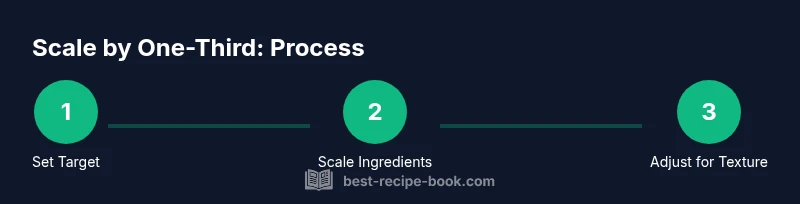
Set your target yield
Decide to scale the recipe to one-third of the original. Write down the factor (1/3) and confirm which ingredients require rounding for practical measurement.
Tip: Recording the factor keeps you consistent across all ingredients. - 2
Calculate scaled amounts for all ingredients
Multiply each ingredient by 1/3. Use a calculator or scale to avoid arithmetic errors, especially for small measurements.
Tip: Use a spreadsheet to apply the factor to a long list of ingredients at once. - 3
Round measurements to practical values
Convert fractions to kitchen-friendly measures (e.g., 1/3 cup becomes 5 tablespoons). For eggs, consider whisking and using partial portions as described in the recipe adjustments.
Tip: Always prefer more precise tools (scale) for accuracy over rough eyeballing. - 4
Adjust leavening cautiously
Scale baking powder/soda to roughly one-third, but be ready to tweak based on batter texture and the bake’s outcome.
Tip: In baked goods, under-leavening often yields denser results; a tiny test batch helps dial it in. - 5
Modify salt, sugar, and flavors
Reduce salt and sugar by about one-third; scale spices similarly but be prepared to adjust by taste.
Tip: Taste the batter or mixture before final cooking to catch under-seasoning or over-sweetness early. - 6
Tweak liquids, fats, and hydration
Check the batter/dough consistency; add small amounts of liquid if too stiff, or a touch more flour if too loose.
Tip: Hydration balance is key; small incremental adjustments beat large, risky changes. - 7
Reassess cooking time and equipment
Smaller batches may cook faster; monitor color, aroma, and doneness rather than relying strictly on time.
Tip: Use an appropriate-size pan to maximize heat transfer and even cooking. - 8
Test, document, and scale future batches
Prepare a small test portion, record outcomes, and adjust your final scaled recipe accordingly for consistency.
Tip: Maintain a scaling log to improve accuracy for any future recipes.
People Also Ask
Why doesn’t every ingredient scale perfectly when reducing by two-thirds?
Different ingredients react uniquely to scaling. Leaveners, fats, and starches change texture and moisture differently when reduced, so practical adjustments and testing are essential for reliable results.
Ingredients don’t scale identically. Expect adjustments for leavening, moisture, and texture after scaling.
Should I adjust baking times when scaling down baked goods?
Yes. Smaller batches often cook faster. Begin checking early and use visual cues like color and texture, plus internal temperature if applicable.
Yes. Smaller batches usually bake faster, so start checking sooner than you expect.
How should I handle eggs when a recipe halves to one-third?
Eggs don’t scale neatly. Whisk and measure by volume for partial amounts or use the closest practical fraction. Consider adding a small amount of extra liquid if the batter seems stiff.
Eggs can be tricky; whisked fractions or partial portions work, with adjustments to liquids as needed.
Can I scale sauces or dressings by 1/3?
Yes, but flavors may concentrate when you remove water or oil. Scale liquids and aromatics first, then taste and adjust to maintain balance.
Sauces can be scaled, but taste and balance can shift; adjust gradually and taste as you go.
What is the best way to document my scaled recipe for future use?
Record the factor (1/3), each adjusted ingredient, final measurements, and any notes about texture or timing. Save this as a template for future scaling.
Keep a log with the factor, final amounts, and notes for future reference.
Is it ever better to scale by a different fraction than 1/3?
Yes. Depending on the goal (e.g., half or quarter batch), use the appropriate scaling factor and re-test. The same principles apply—adjust leavening, moisture, and flavor cautiously.
Sometimes half or a quarter makes more sense; adjust the factor and test as you go.
Watch Video
Key Takeaways
- Scale all ingredients by 1/3 and adjust beyond the basics as needed.
- Tweak leavening, salt, and flavors with careful testing.
- Monitor cooking time and equipment impact; smaller batches cook differently.
- Document your scaled recipes for reliable future results.