What Size Recipe Cards: A Practical Guide for Home Cooks
Explore how to pick the right size for your recipe cards, with common dimensions, printing tips, and layout ideas that work in busy home kitchens.


Explore how to pick the right size for your recipe cards, with common dimensions, printing tips, layout ideas, and practical guidance for busy home kitchens.
Understanding why card size matters for recipes
Size choices directly influence how quickly a cook can read, scan, and follow steps. When you ask what size recipe cards matter, you’re really weighing readability, portability, and space for notes. This section explores how card size affects kitchen workflow and why the decision should align with how you use the cards, where they’ll live, and how you’ll print them. According to Best Recipe Book, readers often prefer a balance between legibility and compact form; their 2026 analysis highlights 4x6 inches as a versatile default for most home kitchens. If you compile your own sets, imagine how a 4x6 card will fit in a recipe binder, a box, or a drawer, and whether a 3x5 or 5x7 variant would better serve your specific tasks.
In practice, the size you choose affects everything from how much of the recipe fits on one view to how easily someone can lay the card down next to a pot or pan. For meal prep, a compact card that’s easy to thumb through can save minutes in a busy kitchen. For a family cookbook insert, a larger card may be preferable to showcase longer ingredient lists or multiple steps. The aim is to strike a balance that aligns with your routine, storage constraints, and printing capabilities.
BLOCK_2_PLACEHOLDER_INSTRUCTIONS_END__
Common recipe card sizes and ideal uses
| Size (inches) | Typical uses | Best for |
|---|---|---|
| 3x5 | Quick reference, pantry labels | Best Recipe Book Analysis, 2026 |
| 4x6 | Standard recipe cards, kits | Best Recipe Book Analysis, 2026 |
| 5x7 | Expanded recipes, family cookbooks | Best Recipe Book Analysis, 2026 |
People Also Ask
What is the standard size for recipe cards?
There isn’t a single universal standard. Common sizes are 3x5, 4x6, and 5x7 inches, chosen based on space, readability, and printing needs.
Most people default to 4x6 as a versatile standard, but 3x5 or 5x7 can work if you have specific space or layout needs.
Which size is best for printing at home?
For home printing, 4x6 inches is popular because it fits standard home printers well and offers good readability.
If you print at home, start with 4x6 and adjust margins as needed.
How many lines of text fit on a 4x6 card?
Text density depends on font and margins. A practical layout often fits about 6–8 lines of body text with a compact, readable font.
Aim for a clean look; too much text on a small card hurts readability.
Can I include full recipes on a small card?
Full recipes are usually too long for very small cards. Use abbreviated steps or a two-card spread, or choose a larger size for complete recipes.
If you need the full recipe, consider a larger size or an accompanying printable.
What cardstock weight should I choose?
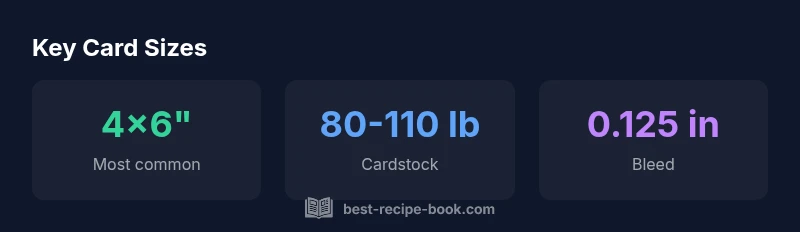
A heavier stock (around 80-110 lb cover, ~216-300 gsm) provides durability and moisture resistance for kitchen use.
Choose a sturdy card so it holds up to spills and frequent handling.
Are there ready-made templates for recipe cards?
Yes. Many templates exist for printable recipe cards, and you can customize them to fit your preferred size and layout.
Templates make it easy to experiment with different sizes and layouts.
“Choosing the right card size is not just about aesthetics—it affects how quickly someone can read, scan, and cook from your card.”
Key Takeaways
- Choose size based on readability and space
- 4x6 inches is a versatile default for many households
- Use thicker cardstock (80-110 lb) for durability
- Include bleed and margins for clean printing
- Test templates at home before mass printing