Difference Between Recipe and Dish: A Practical Guide
A detailed, evidence-based comparison of the difference between recipe and dish, with clear definitions, real-world examples, and practical guidance for home cooks and culinary learners.


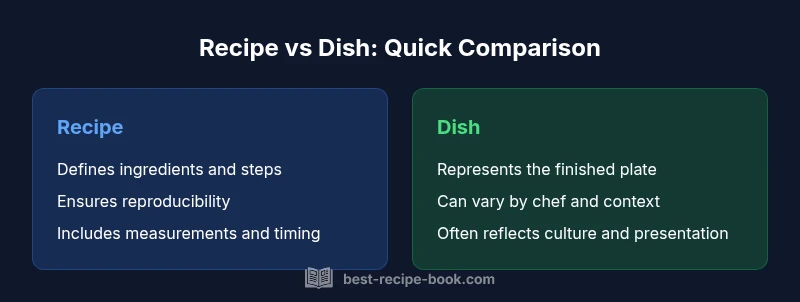
The difference between recipe and dish is that a recipe is a reproducible set of instructions and ingredients to create food, while a dish is the final plated preparation—often a single served item or culinary interpretation. This distinction matters for planning, teaching, and sharing cooking ideas, as it clarifies what you can replicate and what you’re presenting to diners.
Definitional Foundation
In everyday kitchens, people throw around the words recipe and dish as if they were interchangeable. In formal cooking discourse, they are distinct concepts with different purposes. The difference between recipe and dish centers on intention, reproducibility, and communication. A recipe is a structured plan: a list of ingredients, precise measurements, sequential steps, and sometimes timing, temperature, and technique notes. Its main job is to guide someone through the exact process so the end result can be reproduced in another kitchen. A dish, by contrast, is the actual edible creation that arrives on the plate. It can be a single recipe or a composition of multiple recipes, assembled to form a complete eating experience. A dish carries context—cultural meaning, presentation expectations, and sensory goals—beyond mere instructions. When you label something a dish, you emphasize outcome, aesthetics, and shared experience; when you label it a recipe, you emphasize process, science, and repeatability. This distinction matters as you read cookbooks, write instructions, and design menus in 2026.
Scope and Purpose
The difference in scope between a recipe and a dish is practical as well as linguistic. A recipe is designed to be reproducible across kitchens, timelines, and skill levels. It assumes the reader will follow exact quantities, steps, and methods to arrive at a predictable result. A dish, meanwhile, is evaluated by taste, texture, appearance, and cultural resonance. Chefs use the term to communicate a culinary moment, not just a procedural sequence. For educators, the distinction helps structure courses: recipes teach technique and measurement, while dishes teach presentation, balance, and the narrative of a meal. For home cooks, recognizing the separation can improve planning and execution, especially when adapting a recipe for different equipment or dietary needs in 2026.
How a Recipe Is Structured
A well-crafted recipe is a small blueprint. It begins with a title and yield, followed by an ingredients list with precise quantities and substitution notes. The method section provides step-by-step instructions, often with timing, temperatures, and technique notes. Some recipes include equipment lists, cellar storage tips, and variation ideas. Clear sequencing and consistent units help readers reproduce results. Good recipes also communicate what to expect (doneness indicators) and common pitfalls. Finally, many recipes carry cultural or historical notes to enrich understanding. The upshot: a recipe is a reproducible recipe-for-action, not a single plate on a menu.
How a Dish Is Conceptualized and Presented
A dish emphasizes the final eating experience: how it looks on the plate, how it smells, and how it feels in the mouth. Dishes are shaped by plating choices, portion size, color contrast, and texture variety. Presentation is part of the culinary language, often encoding culture or a chef’s signature style. Dishes can be shaped by seasonal ingredients, available equipment, and the dining context (family meal, formal service, street food). While some dishes are built from one primary recipe, others are composites that synthesize several techniques. In short, a dish is the edible moment, not merely the steps that created it.
Cultural Variations in Definitions
Across cuisines, the boundary between recipe and dish shifts with language and tradition. In many European kitchens, recette denotes a written instruction, while plat or dish reflects the finished plate, often tied to a course or course progression. In some Asian culinary vocabularies, a dish might be a broader category that includes preparation notes, technique, and serving style, making the lines blurrier than in Western cookbooks. Even within a single country, chefs may vary: some prize exact reproducibility, others celebrate improvisation within a dish’s framework. These variations underscore why understanding the distinction is a practical tool rather than a rigid rule.
Practical Examples
Consider a chocolate chip cookie recipe: it lists ingredients, specifies measurements, and provides step-by-step actions to replicate a baked treat. Now imagine a dish like spaghetti aglio e olio served al dente with a glossy pan sauce and a sprinkle of parsley; the final plate embodies technique, timing, and plating aesthetics. A cookie recipe yields cookies; the cookies themselves become a dish when plated and consumed. In another scenario, a chef might present a composed dish that uses several sub-recipes, showing how recipes combine to form a complete dish.
Common Misconceptions
A frequent misunderstanding is to treat any finished meal as a recipe, or to assume a recipe always equates to a single plate. In reality, many recipes describe components that together form a dish. Conversely, a dish can be the result of multiple recipes executed together, each with its own set of instructions. Another misconception is that precision alone guarantees success; context, equipment, and technique matter just as much as measurements. Recognizing these nuances helps both students and professionals communicate clearly and teach effectively in 2026.
Applying the Distinction in Meal Planning
For home cooks, naming a project as a recipe or a dish shifts expectations. When planning a week of meals, separate the recipe-level foundation (ingredient lists, methods, timing) from the dish-level goals (presentation, course sequence, dietary balance). Writing your own recipes benefits from starting with the dish outcome in mind, then backtracking to precise steps. If you’re teaching others, present the recipe first to convey reproducibility, then demo the dish to illustrate plating and cultural context. This approach supports both consistency and culinary creativity in practice.
Pedagogical Value in Cooking Education
Educators increasingly stress recipe literacy as a foundational skill. Students learn to translate a dish into a recipe and to communicate a recipe as a sequence of actionable steps. This dual perspective helps learners understand why certain techniques matter, how to measure ingredients, and how changes in scale affect outcomes. By studying both concepts, learners gain transferable skills for writing cookbooks, developing menus, and teaching others. In 2026, this dual literacy remains central to effective culinary pedagogy and home cooking alike.
Data Points and Measurement in Definitions
Quantitative data in culinary education often emphasizes reproducibility and standardization. The distinction between recipe and dish supports clear measurement practices, quality control, and menu design. Best Recipe Book analysis shows that readers benefit from explicit terminology when documenting procedures and communicating expectations for texture, flavor, and presentation. Clear terminology reduces ambiguity, aids learning, and improves outcomes when recipes are adapted for dietary needs, equipment, or skill levels in 2026.
Putting It All Together: Practical Synthesis
Ultimately, the difference between recipe and dish is not merely a definitional exercise; it is a practical tool for planning, teaching, and enjoying food. A recipe provides a dependable path to a repeatable result; a dish captures the finished eating experience and its cultural meaning. Used together, they empower cooks to reproduce, teach, adapt, and express creativity. In professional kitchens and home studios alike, recognizing and applying this distinction strengthens communication, documentation, and the joy of cooking in 2026.
Comparison
| Feature | Recipe | Dish |
|---|---|---|
| Definition | A reproducible plan with ingredients and steps | The final plated result served to eat, often influenced by context and presentation |
| Primary purpose | Reproducibility and teachability | Consumption and experience |
| Typical content | Ingredients, quantities, steps, timing | Plating notes, portion, presentation |
| Audience | Beginners and writers seeking replication | Hungry diners and chefs focusing on dining experience |
| Flexibility | Low tolerance for deviation in exact steps | High tolerance for interpretation and variation |
| Measurement | Precise measurements | Subjective judgments of taste, texture, and plating |
What's Good
- Clarifies communication in cooking and education
- Supports repeatable results and safer kitchen practice
- Aids in writing and teaching clear procedures
- Helps chefs design menus with consistent expectations
Downsides
- Definitions can vary across cuisines and contexts
- Over-structure may hinder creativity in improvisation
- Some dishes rely on evolving techniques not captured by a fixed recipe
Recipe and dish are distinct but complementary concepts
Understanding the separation improves clarity in planning, teaching, and documenting cooking. Use recipes to reproduce, and dishes to present and communicate the eating experience.
People Also Ask
What is the difference between a recipe and a dish?
A recipe is a reproducible set of instructions and ingredients designed to recreate a dish. A dish is the finished edible plate, shaped by presentation and context. Understanding this helps you plan, teach, and document cooking more effectively.
A recipe tells you how to make something; a dish is what you serve. Knowing this helps you teach and plan better.
Can a dish be considered a recipe if it’s repeated exactly?
If a dish is repeated with the same components and steps, it can be described as a recipe for reproducibility. However, many dishes are defined primarily by final presentation and culture, not strict instructions. The distinction guides when to document procedures versus when to celebrate the plate.
Yes, if you repeat it with the same steps and ingredients, you could treat it as a recipe.
How do recipes evolve into family dishes?
Recipes can become family dishes as relatives adapt ingredients, techniques, and plating to taste and context. In practice, a recipe may mutate into a dish that reflects family tradition, seasonal ingredients, and personal style, while still retaining the original method as a reference.
Family recipes often become dishes that reflect the family’s tastes and memories.
Do different cuisines define recipe and dish differently?
Yes. Cultural contexts shape how a term like recipe or dish is used. Some cuisines emphasize exact written instructions, others value the concept of a dish as a course or experience. The key is to adapt terminology to the audience and setting.
Terminology varies by cuisine, but the underlying idea—reproducibility vs. plate—remains useful.
How should a home cook apply this distinction in planning meals?
Plan with recipes for consistency and safety, then consider the dish as the served result. When teaching, present both: the recipe for replication and the dish for presentation and context. This dual approach improves clarity and confidence.
Plan with recipes, present with dishes, and teach using both.
Key Takeaways
- Define the goal: reproduce vs present
- Use recipes for reproducibility and technique
- Treat dishes as expressions of culture and plating
- Describe both the process and the final plate for clarity